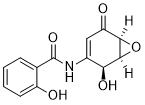
Physicochemical Properties
| Molecular Formula | C13H11NO5 |
| Molecular Weight | 261.2301 |
| Exact Mass | 261.064 |
| CAS # | 287194-40-5 |
| PubChem CID | 9881652 |
| Appearance | Off-white to gray solid powder |
| LogP | 0.291 |
| Hydrogen Bond Donor Count | 3 |
| Hydrogen Bond Acceptor Count | 5 |
| Rotatable Bond Count | 2 |
| Heavy Atom Count | 19 |
| Complexity | 446 |
| Defined Atom Stereocenter Count | 3 |
| SMILES | C1=CC=C(C(=C1)C(=O)NC2=CC(=O)[C@@H]3[C@H]([C@H]2O)O3)O |
| InChi Key | IUOMATKBBPCLFR-TUAOUCFPSA-N |
| InChi Code | InChI=1S/C13H11NO5/c15-8-4-2-1-3-6(8)13(18)14-7-5-9(16)11-12(19-11)10(7)17/h1-5,10-12,15,17H,(H,14,18)/t10-,11+,12-/m0/s1 |
| Chemical Name | 2-Hydroxy-N-[(1S,2S,6S)-2-hydroxy-5-oxo-7-oxabicyclo[4.1.0]hept-3-en-3-yl]benzamide |
| Synonyms | DHMEQ Dehydroxymethylepoxyquinomicin |
| HS Tariff Code | 2934.99.9001 |
| Storage |
Powder-20°C 3 years 4°C 2 years In solvent -80°C 6 months -20°C 1 month Note: Please store this product in a sealed and protected environment (e.g. under nitrogen), avoid exposure to moisture. |
| Shipping Condition | Room temperature (This product is stable at ambient temperature for a few days during ordinary shipping and time spent in Customs) |
Biological Activity
| ln Vitro | Treatment with (-)-DHMEQ (Dehydroxymethylepoxyquinomicin; 2–10 μg/mL; 12-48 hours) dramatically lowers all cell lines' survival in a time- and dose-dependent manner; however, the impact is not statistically significant in the control cell line K562, which lacks constitutive NF-κB activity[2]. In MT-1 and TL-Om1 cell lines, (-)-DHMEQ (10 μg/mL; 0-48 hours; TL-Om1, MT-1, and K562 cells) treatment dramatically increases the Annexin V-positive cells[2]. Under (-)-DHMEQ (10 μg/mL; 4–16 hours; MT-1 cells) treatment, proapoptotic genes such caspase-3, -8, and-9 are up-regulated and Bcl-xL, Bcl-2, c-myc, cyclin D1, Rb, and p53 are down-regulated.Reference [2]. Treatment with (-)-DHMEQ results in a time-dependent increase in cells in the G0 /G1 phase, indicating (-)-DHMEQ's antiproliferative properties[2]. At particular cysteine residues, (-)-DHMEQ binds to p65, cRel, RelB, and p50 but not p52. RelB's DNA binding and interaction with importin are both inhibited by (-)-DHMEQ. RelB becomes unstable as well due to (-)-DHMEQ[1]. |
| ln Vivo | The intraperitoneal injection of (-)-DHMEQ (4 mg/kg or 12 mg/kg) given to SCID mice on day 0 and three times a week for a month significantly increases the mice's survival rate[2]. |
| Cell Assay |
Cell Proliferation Assay[2] Cell Types: TL-Om1, MT-1, KK-1, ST-1 and K562 cells Tested Concentrations: 2 μg/mL, 5 μg/mL, 10 μg/mL Incubation Duration: 12 hrs (hours), 24 hrs (hours), 48 hrs (hours) Experimental Results: Dramatically decreased the viability of all cell lines in a dose- and time- dependent manner. Apoptosis Analysis[2] Cell Types: TL-Om1, MT-1 and K562 cells Tested Concentrations: 10 μg/mL Incubation Duration: 0 hrs (hours), 24 hrs (hours), 48 hrs (hours) Experimental Results: Annexin V-positive cells were Dramatically increased after 24 to 48 hrs (hours). Western Blot Analysis[2] Cell Types: MT-1 cells Tested Concentrations: 10 μg/mL Incubation Duration: 4 hrs (hours), 8 hrs (hours), 16 hrs (hours) Experimental Results: Annexin V-positive cells were Dramatically increased after 24 to 48 hrs (hours). |
| Animal Protocol |
Animal/Disease Models: Male C.B17-scid/scid (5 weeks old) mice injected with MT-2 cells[2] Doses: 4 mg/kg or 12 mg/kg Route of Administration: intraperitoneal (ip)injection; on day 0 and 3 times a week ; for one month Experimental Results: demonstrated a significant increase in the survival rate in mice. |
| References |
[1]. Inhibition of Late and Early Phases of Cancer Metastasis by the NF-κB Inhibitor DHMEQ Derived from Microbial Bioactive Metabolite Epoxyquinomicin: A Review. [2]. Dual targeting of transformed and untransformed HTLV-1-infected T cells by DHMEQ, a potent and selective inhibitor of NF-kappaB, as a strategy for chemoprevention and therapy of adult T-cell leukemia. Blood. 2005 Oct 1;106(7):2462-71. [3]. Eudesmane-Type Sesquiterpene Lactones Inhibit Nuclear Translocation of the Nuclear Factor κB Subunit RelB in Response to a Lymphotoxin β Stimulation. Biol Pharm Bull. 2017;40(10):1669-1677. |
Solubility Data
| Solubility (In Vitro) | DMSO : ~95 mg/mL (~363.66 mM) |
| Solubility (In Vivo) |
Solubility in Formulation 1: 5 mg/mL (19.14 mM) in 10% DMSO + 40% PEG300 +5% Tween-80 + 45% Saline (add these co-solvents sequentially from left to right, and one by one), suspension solution; with sonication. For example, if 1 mL of working solution is to be prepared, you can add 100 μL of 50.0 mg/mL clear DMSO stock solution to 400 μL PEG300 and mix evenly; then add 50 μL Tween-80 + to the above solution and mix evenly; then add 450 μL normal saline to adjust the volume to 1 mL. Preparation of saline: Dissolve 0.9 g of sodium chloride in 100 mL ddH₂ O to obtain a clear solution. (Please use freshly prepared in vivo formulations for optimal results.) |
| Preparing Stock Solutions | 1 mg | 5 mg | 10 mg | |
| 1 mM | 3.8280 mL | 19.1402 mL | 38.2804 mL | |
| 5 mM | 0.7656 mL | 3.8280 mL | 7.6561 mL | |
| 10 mM | 0.3828 mL | 1.9140 mL | 3.8280 mL |