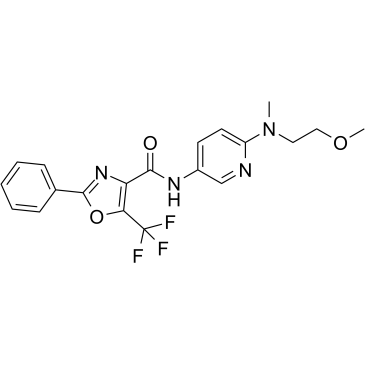
DGAT1-IN-3, also known as RO-5006036, is a novel,potent, selective and orally bioavailable inhibitor of DGAT-1, with IC50s of 38 nM for human DGAT-1 and 120 nM for rat DGAT-1. DGAT1-IN-3 could be used to research of obesity, dyslipidemia, and metabolic syndrome.orally bioavailable DGAT-1 inhibitor with IC50 values of 120 nM for rat DGAT-1 and 38 nM for human DGAT-1. Research on obesity, dyslipidemia, and the metabolic syndrome may benefit from the use of DGAT1-IN-3.
Physicochemical Properties
| Molecular Formula | C20H19F3N4O3 |
| Molecular Weight | 420.385074853897 |
| Exact Mass | 420.14 |
| Elemental Analysis | C, 57.14; H, 4.56; F, 13.56; N, 13.33; O, 11.42 |
| CAS # | 939375-07-2 |
| Related CAS # | 939375-07-2 |
| PubChem CID | 16757107 |
| Appearance | Light yellow to yellow solid powder |
| LogP | 3.3 |
| Hydrogen Bond Donor Count | 1 |
| Hydrogen Bond Acceptor Count | 9 |
| Rotatable Bond Count | 7 |
| Heavy Atom Count | 30 |
| Complexity | 560 |
| Defined Atom Stereocenter Count | 0 |
| InChi Key | QEZWDFXCTTZZRI-UHFFFAOYSA-N |
| InChi Code | InChI=1S/C20H19F3N4O3/c1-27(10-11-29-2)15-9-8-14(12-24-15)25-18(28)16-17(20(21,22)23)30-19(26-16)13-6-4-3-5-7-13/h3-9,12H,10-11H2,1-2H3,(H,25,28) |
| Chemical Name | N-[6-[2-methoxyethyl(methyl)amino]pyridin-3-yl]-2-phenyl-5-(trifluoromethyl)-1,3-oxazole-4-carboxamide |
| Synonyms | DGAT1-IN-3; RO-5006036; RO5006036; RO 5006036 |
| HS Tariff Code | 2934.99.9001 |
| Storage |
Powder-20°C 3 years 4°C 2 years In solvent -80°C 6 months -20°C 1 month Note: This product requires protection from light (avoid light exposure) during transportation and storage. |
| Shipping Condition | Room temperature (This product is stable at ambient temperature for a few days during ordinary shipping and time spent in Customs) |
Biological Activity
| Targets | Glutaminase C (IC50 = 38 nM); rat DGAT-1 (IC50 = 120 nM) |
| ln Vitro |
DGAT1-IN-3 uses an IC20 of 0.2 μM to block the potassium channel encoded by the human ether-a-go-go-related gene (hERG)[1]. DGAT1-IN-3 inhibits inhibits human DGAT-1 with an EC50 of 0.66 μM in CHOK1 cells[1]. |
| ln Vivo |
DGAT1-IN-3 (5-50 mg/kg; p.o once daily for three weeks) enhances lipid profile and lowers weight gain and plasma triglycerides[2]. DGAT1-IN-3 (50 mg/kg; p.o) has a maximum exposure level in plasma (Cmax) of 24 μM and a good oral bioavailability of 77%[2]. DGAT1-IN-3 (5 mg/kg; i.v) has low clearance (13.5 mL/min/kg) and terminal elimination half-lives (1.95 h)[2]. |
| Animal Protocol |
Three-month-old male Sprague Dawley DIO rats (fed with a high-fat diet)[2] 0, 5, 25, 50 mg/kg; once daily for three weeks P.o. administration |
| References |
[1]. New parenteral anticoagulants in development. Ther Adv Cardiovasc Dis. 2011 Feb;5(1):33-59. [2]. Discovery of orally active carboxylic acid derivatives of 2-phenyl-5-trifluoromethyloxazole-4-carboxamide as potent diacylglycerol acyltransferase-1 inhibitors for the potential treatment of obesity and diabetes. J Med Chem. 2011 Apr 14; 54(7): 2433-46. [3]. Discovery and optimization of 2-phenyloxazole derivatives as diacylglycerol acyltransferase-1 inhibitors. Bioorg Med Chem Lett. 2011 Dec 1; 21(23): 7205-9. |
Solubility Data
| Solubility (In Vitro) | DMSO: ~100 mg/mL (~237.9 mM) |
| Solubility (In Vivo) |
Solubility in Formulation 1: ≥ 2.5 mg/mL (5.95 mM) (saturation unknown) in 10% DMSO + 40% PEG300 +5% Tween-80 + 45% Saline (add these co-solvents sequentially from left to right, and one by one), clear solution. For example, if 1 mL of working solution is to be prepared, you can add 100 μL of 25.0 mg/mL clear DMSO stock solution to 400 μL PEG300 and mix evenly; then add 50 μL Tween-80 + to the above solution and mix evenly; then add 450 μL normal saline to adjust the volume to 1 mL. Preparation of saline: Dissolve 0.9 g of sodium chloride in 100 mL ddH₂ O to obtain a clear solution. (Please use freshly prepared in vivo formulations for optimal results.) |
| Preparing Stock Solutions | 1 mg | 5 mg | 10 mg | |
| 1 mM | 2.3787 mL | 11.8937 mL | 23.7874 mL | |
| 5 mM | 0.4757 mL | 2.3787 mL | 4.7575 mL | |
| 10 mM | 0.2379 mL | 1.1894 mL | 2.3787 mL |