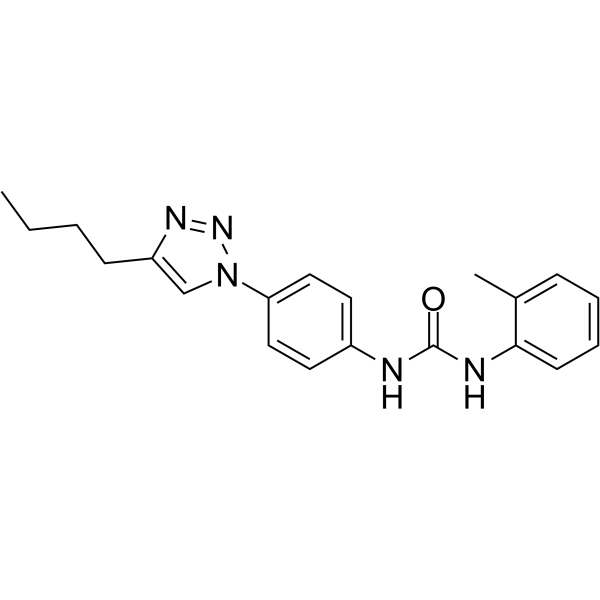
Physicochemical Properties
| Molecular Formula | C20H23N5O |
| Molecular Weight | 349.429523706436 |
| Exact Mass | 349.19 |
| CAS # | 1919828-81-1 |
| PubChem CID | 122455309 |
| Appearance | Off-white to gray solid powder |
| LogP | 4 |
| Hydrogen Bond Donor Count | 2 |
| Hydrogen Bond Acceptor Count | 3 |
| Rotatable Bond Count | 6 |
| Heavy Atom Count | 26 |
| Complexity | 438 |
| Defined Atom Stereocenter Count | 0 |
| SMILES | N(C1=CC=C(N2C=C(CCCC)N=N2)C=C1)C(NC1=CC=CC=C1C)=O |
| InChi Key | LZPQWTRWEKFHPZ-UHFFFAOYSA-N |
| InChi Code | InChI=1S/C20H23N5O/c1-3-4-8-17-14-25(24-23-17)18-12-10-16(11-13-18)21-20(26)22-19-9-6-5-7-15(19)2/h5-7,9-14H,3-4,8H2,1-2H3,(H2,21,22,26) |
| Chemical Name | 1-[4-(4-butyltriazol-1-yl)phenyl]-3-(2-methylphenyl)urea |
| HS Tariff Code | 2934.99.9001 |
| Storage |
Powder-20°C 3 years 4°C 2 years In solvent -80°C 6 months -20°C 1 month |
| Shipping Condition | Room temperature (This product is stable at ambient temperature for a few days during ordinary shipping and time spent in Customs) |
Biological Activity
| Targets | HIV |
| ln Vitro | The fact that DDX3-IN-2's inhibitory potency decreases as RNA substrate concentrations rise indicates that it functions as a competitive inhibitor toward the substrate. When faced with the ATPase of DDX3, DDX1 helicase, and DENV NS3 helicase, DDX3-IN-2 is discovered to be entirely inactive[1]. |
| ln Vivo | Excellent biocompatibility is exhibited by DDX3-IN-2 (20 mg/kg; tail vein injection), and Wistar rats exhibit good tolerance to the 20 mg/kg dose[1]. Half-life elimination and plasmatic clearance values are rapidly eliminated by DDX3-IN-2 (10 mg/kg; IV bolus injection; 0~25 hours)[1]. |
| Animal Protocol |
Animal/Disease Models: Wistar rats[1] Doses: Tail vein injection Route of Administration: 20 mg/kg Experimental Results: Possessed excellent biocompatibility, and Wistar rats demonstrated a good tolerance to the dose of 20 mg/kg. Animal/Disease Models: Rats[1] Doses: Iv bolus injection (pharmacokinetic/PK Analysis) Route of Administration: 10 mg/kg; 0~25 hrs (hours) Experimental Results: Rapidly eliminated the half-life elimination and the plasmatic clearance values. |
| References |
[1]. Human DDX3 protein is a valuable target to develop broad spectrum antiviral agents. Proc Natl Acad Sci U S A. 2016;113(19):5388-5393. |
Solubility Data
| Solubility (In Vitro) | DMSO : 100 mg/mL (286.18 mM) |
| Solubility (In Vivo) |
Solubility in Formulation 1: ≥ 2.5 mg/mL (7.15 mM) (saturation unknown) in 10% DMSO + 90% Corn Oil (add these co-solvents sequentially from left to right, and one by one), clear solution. For example, if 1 mL of working solution is to be prepared, you can add 100 μL of 25.0 mg/mL clear DMSO stock solution to 900 μL of corn oil and mix evenly. (Please use freshly prepared in vivo formulations for optimal results.) |
| Preparing Stock Solutions | 1 mg | 5 mg | 10 mg | |
| 1 mM | 2.8618 mL | 14.3090 mL | 28.6180 mL | |
| 5 mM | 0.5724 mL | 2.8618 mL | 5.7236 mL | |
| 10 mM | 0.2862 mL | 1.4309 mL | 2.8618 mL |