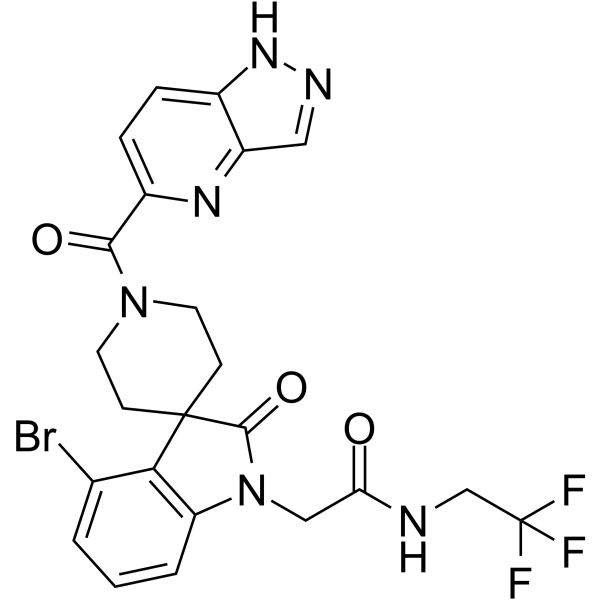
Physicochemical Properties
| Molecular Formula | C23H20BRF3N6O3 |
| Molecular Weight | 565.342514038086 |
| Exact Mass | 564.073 |
| CAS # | 2125676-13-1 |
| PubChem CID | 130301864 |
| Appearance | Off-white to light yellow solid powder |
| LogP | 2.6 |
| Hydrogen Bond Donor Count | 2 |
| Hydrogen Bond Acceptor Count | 8 |
| Rotatable Bond Count | 4 |
| Heavy Atom Count | 36 |
| Complexity | 884 |
| Defined Atom Stereocenter Count | 0 |
| SMILES | BrC1=CC=CC2=C1C1(C(N2CC(NCC(F)(F)F)=O)=O)CCN(C(C2C=CC3=C(C=NN3)N=2)=O)CC1 |
| InChi Key | UXEXYURPAPXPSR-UHFFFAOYSA-N |
| InChi Code | InChI=1S/C23H20BrF3N6O3/c24-13-2-1-3-17-19(13)22(21(36)33(17)11-18(34)28-12-23(25,26)27)6-8-32(9-7-22)20(35)15-5-4-14-16(30-15)10-29-31-14/h1-5,10H,6-9,11-12H2,(H,28,34)(H,29,31) |
| Chemical Name | 2-[4-bromo-2-oxo-1'-(1H-pyrazolo[4,3-b]pyridine-5-carbonyl)spiro[indole-3,4'-piperidine]-1-yl]-N-(2,2,2-trifluoroethyl)acetamide |
| HS Tariff Code | 2934.99.9001 |
| Storage |
Powder-20°C 3 years 4°C 2 years In solvent -80°C 6 months -20°C 1 month |
| Shipping Condition | Room temperature (This product is stable at ambient temperature for a few days during ordinary shipping and time spent in Customs) |
Biological Activity
| Targets | DDR1 29 nM (IC50) DDR2 1900 nM (IC50) |
| ln Vitro | In HT1080 cells overexpressing DDR1, DDR1-IN-4 (Compound 2.45) exhibits a definite dose-dependent inhibition of DDR1 phosphorylation, with more than 70% of phosphorylation inhibition at a concentration of 1 μM and selectivity over inhibition of DDR2[1]. |
| ln Vivo | Using DDR1-IN-4 (Compound 2.45, ip, 90 mg/kg) at a therapeutic dose preserves renal function and minimizes tissue damage in Col4a3–/– mice (the preclinical animal model of Alport syndrome), demonstrating the true therapeutic benefit of specifically suppressing DDR1 phosphorylation in vivo[1]. |
| Animal Protocol |
Animal/Disease Models: Col4a3–/– mice, a mouse model phenocopying Alport syndrome[1]. Doses: 90 mg/kg. Route of Administration: Injected intraperitoneally (ip) daily. Experimental Results: Resulted in a significant reduction of fibrosis evaluated by Picro Sirius Red, smooth muscle actin staining, and collagen I accumulation. Dramatically reduces the levels of pDDR1 in Col4a3 knockout mice compared to controls. |
| References |
[1]. DNA-Encoded Library-Derived DDR1 Inhibitor Prevents Fibrosis and Renal Function Loss in a Genetic Mouse Model of Alport Syndrome. ACS Chem Biol. 2019 Jan 18;14(1):37-49. |
Solubility Data
| Solubility (In Vitro) | DMSO: 250 mg/mL (442.21 mM) |
| Solubility (In Vivo) |
Solubility in Formulation 1: ≥ 2.08 mg/mL (3.68 mM) (saturation unknown) in 10% DMSO + 90% (20% SBE-β-CD in Saline) (add these co-solvents sequentially from left to right, and one by one), clear solution. For example, if 1 mL of working solution is to be prepared, you can add 100 μL of 20.8 mg/mL clear DMSO stock solution to 900 μL of 20% SBE-β-CD physiological saline solution and mix evenly. Preparation of 20% SBE-β-CD in Saline (4°C,1 week): Dissolve 2 g SBE-β-CD in 10 mL saline to obtain a clear solution. Solubility in Formulation 2: ≥ 2.08 mg/mL (3.68 mM) (saturation unknown) in 10% DMSO + 90% Corn Oil (add these co-solvents sequentially from left to right, and one by one), clear solution. For example, if 1 mL of working solution is to be prepared, you can add 100 μL of 20.8 mg/mL clear DMSO stock solution to 900 μL of corn oil and mix evenly. (Please use freshly prepared in vivo formulations for optimal results.) |
| Preparing Stock Solutions | 1 mg | 5 mg | 10 mg | |
| 1 mM | 1.7688 mL | 8.8442 mL | 17.6885 mL | |
| 5 mM | 0.3538 mL | 1.7688 mL | 3.5377 mL | |
| 10 mM | 0.1769 mL | 0.8844 mL | 1.7688 mL |