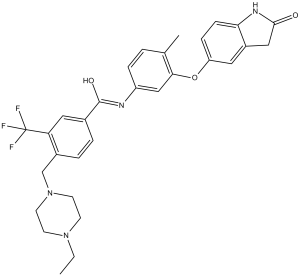
DDR1-IN-1 is a potent and selective discoidin domain receptor 1 (DDR1) receptor tyrosine kinase inhibitor with IC50 of 105 nM, and is about 3-fold selectivity over DDR2. As measured against a panel of 451 kinases, DDR1-IN-1 binds to DDR1 in the conformation known as "DFG-out" and, at submicromolar concentrations, inhibits DDR1 autophosphorylation in cells with good selectivity. A helpful pharmacological probe for DDR1-dependent signal transduction is provided by DDR1-IN-1. Matrix collagens trigger the activation of the DDR1 receptor tyrosine kinase, which is involved in many cellular processes including adhesion, invasion, migration, and proliferation.
Physicochemical Properties
| Molecular Formula | C30H31F3N4O3 | |
| Molecular Weight | 552.59 | |
| Exact Mass | 552.234 | |
| Elemental Analysis | C, 65.21; H, 5.65; F, 10.31; N, 10.14; O, 8.69 | |
| CAS # | 1449685-96-4 | |
| Related CAS # | DDR1-IN-1 dihydrochloride;1780303-76-5 | |
| PubChem CID | 72836888 | |
| Appearance | Light yellow to yellow solid powder | |
| Density | 1.3±0.1 g/cm3 | |
| Boiling Point | 609.0±55.0 °C at 760 mmHg | |
| Flash Point | 322.1±31.5 °C | |
| Vapour Pressure | 0.0±1.7 mmHg at 25°C | |
| Index of Refraction | 1.602 | |
| LogP | 4.7 | |
| Hydrogen Bond Donor Count | 2 | |
| Hydrogen Bond Acceptor Count | 8 | |
| Rotatable Bond Count | 7 | |
| Heavy Atom Count | 40 | |
| Complexity | 881 | |
| Defined Atom Stereocenter Count | 0 | |
| SMILES | FC(C1C([H])=C(C(N([H])C2C([H])=C([H])C(C([H])([H])[H])=C(C=2[H])OC2C([H])=C([H])C3=C(C=2[H])C([H])([H])C(N3[H])=O)=O)C([H])=C([H])C=1C([H])([H])N1C([H])([H])C([H])([H])N(C([H])([H])C([H])([H])[H])C([H])([H])C1([H])[H])(F)F |
|
| InChi Key | AOZPVMOOEJAZGK-UHFFFAOYSA-N | |
| InChi Code | InChI=1S/C30H31F3N4O3/c1-3-36-10-12-37(13-11-36)18-21-6-5-20(15-25(21)30(31,32)33)29(39)34-23-7-4-19(2)27(17-23)40-24-8-9-26-22(14-24)16-28(38)35-26/h4-9,14-15,17H,3,10-13,16,18H2,1-2H3,(H,34,39)(H,35,38) | |
| Chemical Name | 4-[(4-ethylpiperazin-1-yl)methyl]-N-[4-methyl-3-[(2-oxo-1,3-dihydroindol-5-yl)oxy]phenyl]-3-(trifluoromethyl)benzamide | |
| Synonyms |
|
|
| HS Tariff Code | 2934.99.03.00 | |
| Storage |
Powder-20°C 3 years 4°C 2 years In solvent -80°C 6 months -20°C 1 month |
|
| Shipping Condition | Room temperature (This product is stable at ambient temperature for a few days during ordinary shipping and time spent in Customs) |
Biological Activity
| Targets |
DDR1 (IC50 = 105 nM); DDR2 (IC50 = 413 nM) DDR1-IN-1 targets discoidin domain receptor 1 (DDR1) with a Ki value of 1.9 nM and an IC50 of 3.3 nM (human recombinant DDR1 kinase) [1] DDR1-IN-1 shows high selectivity for DDR1 over DDR2 (selectivity ratio = 100-fold, DDR2 IC50 = 330 nM) and other kinases (inhibition <20% at 1 μM for 45 tested kinases) [1] |
| ln Vitro |
DDR1-IN-1 inhibits DDR1 autophosphorylation in U2OS cells at a concentration of 86 nM, which is the basal level. The inhibition of DDR1 autophosphorylation is stronger when collagen stimulation is not present. DDR1-IN-1 does not inhibit proliferation below a concentration of 10 μM in a panel of various cancer cell lines with DDR1 gain-of-function mutations and/or overexpression, whereas GSK2126458 enhances the antiproliferative activity of DDR1-IN-1.[1] In kinase inhibition assays, DDR1-IN-1 (0.1–100 nM) dose-dependently inhibited human recombinant DDR1 kinase activity, with Ki=1.9 nM and IC50=3.3 nM. It exhibited minimal inhibition of DDR2 (IC50=330 nM) and no significant inhibition of other kinases (e.g., EGFR, VEGFR2, c-Met) at concentrations up to 1 μM [1] In HT-29 human colorectal cancer cells (DDR1-positive), DDR1-IN-1 (0.1–10 μM) inhibited collagen-induced DDR1 phosphorylation (IC50=5.1 nM) and downstream ERK1/2 phosphorylation (reduced by 70% at 1 μM). It dose-dependently suppressed cell proliferation with an IC50 of 6.2 μM [1] DDR1-IN-1 (1–10 μM) inhibited HT-29 cell migration (reduced by 55% at 10 μM) and collagen-induced cell adhesion (reduced by 60% at 10 μM) via blocking DDR1-mediated signaling [1] Western blot analysis showed DDR1-IN-1 (1 μM) downregulated DDR1-dependent expression of matrix metalloproteinase 9 (MMP-9) and fibronectin in HT-29 cells [1] |
| Enzyme Assay |
DDR1 is brought on 48 hours before DDR1 activation by rat tail collagen I by 2 Gg/ml doxycycline. The EC50 test media containing 10 Gg/ml collagen and each concentration of the compound is used to treat the DDR1 over-expressed U2OS after the media has been pre-treated for one hour with each concentration of the compound. The lysis buffer (50 mM Tris, pH 7.5, 1% Triton X-100, 0.1% SDS, 150 mM NaCl, 5 mM EDTA, 100 mM NaF, 2 mM Na3VO4, 1 mM PMSF, 10 Gg/ml aprotinin, and 10 Gg/ml leupeptin) is used to lyse each cell after it has been rinsed three times with cold PBS. In order to calculate the EC50 after Western blotting with anti-activated human DDR1b (Y513), the activation of DDR1 is measured by density using the ImageJ program. DDR1 kinase activity assay: Purify human recombinant DDR1 kinase domain and suspend in assay buffer (pH 7.5) containing MgCl₂, ATP, and DTT. Incubate the enzyme (0.5 μg/mL) with serial dilutions of DDR1-IN-1 (0.01–100 nM) at 37°C for 20 minutes. Add a fluorescently labeled peptide substrate (derived from DDR1 phosphorylation site) to initiate the reaction. Incubate for another 60 minutes at 37°C, then terminate the reaction with stop buffer. Measure fluorescence polarization to quantify phosphorylated substrate and calculate Ki and IC50 values [1] Kinase selectivity assay: Repeat the kinase activity assay using 45 different recombinant human kinases (including DDR2, EGFR, VEGFR2, c-Met) at a fixed concentration of DDR1-IN-1 (1 μM). Calculate inhibition rate for each kinase to assess selectivity [1] |
| Cell Assay |
In 96-well plates, cells are plated in triplicate at a density of 3000 cells per well; in 384-well plates, the same density is applied. For 48 hours, different concentrations of compounds are added to plates. CellTiter-Glo and CCK-8 are used to measure cell viability. Both assays are carried out in compliance with the manufacturer's guidelines. Luminescence for the CellTiter-Glo assay is measured using a multi-label reader. Absorbance for the CCK-8 assay is measured at 450 nm in a microplate reader. The data are presented as the mean of at least two independent measurements with a standard error of less than 20%, normalized to the control group (DMSO). Prism 5.0 was used to calculate GI50. DDR1 phosphorylation assay: Culture HT-29 cells in RPMI 1640 medium with 10% FBS, seed into 6-well plates (2×10⁵ cells/well) and incubate overnight. Serum-starve for 24 hours, pretreat with serial dilutions of DDR1-IN-1 (0.1–10 μM) for 1 hour, then stimulate with collagen I (10 μg/mL) for 30 minutes. Lyse cells, extract total proteins, and perform Western blot to detect phosphorylated DDR1 (p-DDR1) and total DDR1. Quantify p-DDR1/total DDR1 ratio to determine IC50 for phosphorylation inhibition [1] Cell proliferation assay: Seed HT-29 cells into 96-well plates (5×10³ cells/well) and incubate overnight. Treat with serial dilutions of DDR1-IN-1 (0.1–20 μM) for 72 hours. Add MTT reagent (0.5 mg/mL) and incubate for 4 hours. Dissolve formazan crystals with DMSO and measure absorbance at 570 nm to calculate cell viability and IC50 [1] Cell migration and adhesion assay: For migration, seed HT-29 cells into the upper chamber of Transwell inserts (8 μm pore size) and treat with DDR1-IN-1 (1–10 μM). For adhesion, coat 96-well plates with collagen I (10 μg/mL), seed HT-29 cells (1×10⁴ cells/well) and treat with DDR1-IN-1 (1–10 μM). Incubate both assays for 24 hours, then count migrated/adhered cells under a microscope [1] Western blot for downstream targets: Treat HT-29 cells with DDR1-IN-1 (0.1–10 μM) for 24 hours, extract total proteins, and detect MMP-9, fibronectin, and phosphorylated ERK1/2 (p-ERK1/2) by Western blot [1] |
| References |
[1]. Discovery of a potent and selective DDR1 receptor tyrosine kinase inhibitor. ACS Chem Biol. 2013 Oct 18;8(10):2145-50. |
| Additional Infomation |
DDR1-IN-1 is a secondary carboxamide resulting from the formal condensation of the carboxy group of 4-[(4-ethylpiperazin-1-yl)methyl]-3-(trifluoromethyl)benzoic acid with the amino group of 5-(5-amino-2-methylphenoxy)-1,3-dihydro-2H-indol-2-one. It is a potent inhibitor of discoidin domain receptor tyrosine kinase 1 and 2 (DDR1/2) with IC50 = 105 nM and 413 nM, respectively. It has a role as an EC 2.7.10.1 (receptor protein-tyrosine kinase) inhibitor. It is a N-alkylpiperazine, a member of benzamides, a member of (trifluoromethyl)benzenes, a secondary carboxamide, an aromatic ether and a member of oxindoles. DDR1-IN-1 is a potent, selective small-molecule inhibitor of DDR1, a receptor tyrosine kinase activated by collagen [1] Its mechanism of action involves binding to the ATP-binding pocket of DDR1 kinase domain, blocking ATP binding and subsequent receptor phosphorylation and downstream signaling (ERK1/2 pathway) [1] DDR1 is overexpressed in various cancers (colorectal, breast, lung) and fibrotic diseases, making DDR1-IN-1 a potential tool compound for studying DDR1 function and a lead compound for therapeutic development [1] It exhibits high selectivity for DDR1 over other kinases, minimizing off-target effects and facilitating specific DDR1 signaling inhibition [1] |
Solubility Data
| Solubility (In Vitro) |
|
|||
| Solubility (In Vivo) |
Solubility in Formulation 1: ≥ 2.5 mg/mL (4.52 mM) (saturation unknown) in 10% DMSO + 40% PEG300 + 5% Tween80 + 45% Saline (add these co-solvents sequentially from left to right, and one by one), clear solution. For example, if 1 mL of working solution is to be prepared, you can add 100 μL of 25.0 mg/mL clear DMSO stock solution to 400 μL PEG300 and mix evenly; then add 50 μL Tween-80 to the above solution and mix evenly; then add 450 μL normal saline to adjust the volume to 1 mL. Preparation of saline: Dissolve 0.9 g of sodium chloride in 100 mL ddH₂ O to obtain a clear solution. Solubility in Formulation 2: 2.5 mg/mL (4.52 mM) in 10% DMSO + 90% (20% SBE-β-CD in Saline) (add these co-solvents sequentially from left to right, and one by one), suspension solution; with ultrasonication. For example, if 1 mL of working solution is to be prepared, you can add 100 μL of 25.0 mg/mL clear DMSO stock solution to 900 μL of 20% SBE-β-CD physiological saline solution and mix evenly. Preparation of 20% SBE-β-CD in Saline (4°C,1 week): Dissolve 2 g SBE-β-CD in 10 mL saline to obtain a clear solution. Solubility in Formulation 3: ≥ 2.5 mg/mL (4.52 mM) (saturation unknown) in 10% DMSO + 90% Corn Oil (add these co-solvents sequentially from left to right, and one by one), clear solution. For example, if 1 mL of working solution is to be prepared, you can add 100 μL of 25.0 mg/mL clear DMSO stock solution to 900 μL of corn oil and mix evenly. (Please use freshly prepared in vivo formulations for optimal results.) |
| Preparing Stock Solutions | 1 mg | 5 mg | 10 mg | |
| 1 mM | 1.8097 mL | 9.0483 mL | 18.0966 mL | |
| 5 mM | 0.3619 mL | 1.8097 mL | 3.6193 mL | |
| 10 mM | 0.1810 mL | 0.9048 mL | 1.8097 mL |