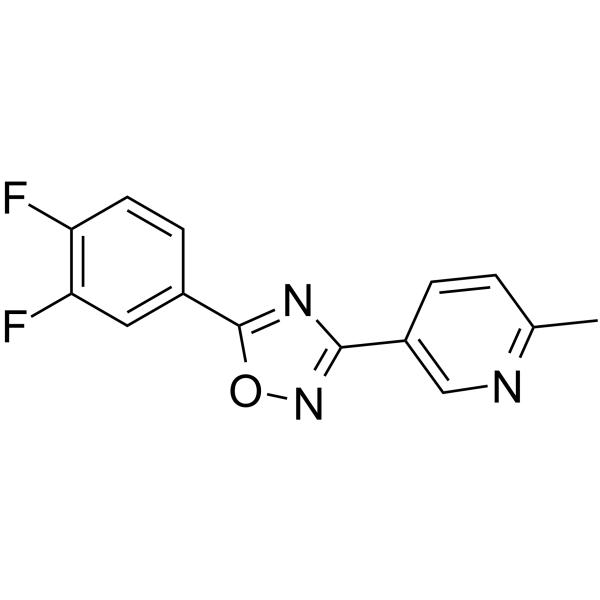
Physicochemical Properties
| Molecular Formula | C14H9F2N3O |
| Molecular Weight | 273.24 |
| Exact Mass | 273.07 |
| Elemental Analysis | C, 61.54; H, 3.32; F, 13.91; N, 15.38; O, 5.86 |
| CAS # | 2254004-96-9 |
| PubChem CID | 145989809 |
| Appearance | White to off-white solid powder |
| LogP | 3 |
| Hydrogen Bond Donor Count | 0 |
| Hydrogen Bond Acceptor Count | 6 |
| Rotatable Bond Count | 2 |
| Heavy Atom Count | 20 |
| Complexity | 334 |
| Defined Atom Stereocenter Count | 0 |
| InChi Key | HITVBBDLWZDVIV-UHFFFAOYSA-N |
| InChi Code | InChI=1S/C14H9F2N3O/c1-8-2-3-10(7-17-8)13-18-14(20-19-13)9-4-5-11(15)12(16)6-9/h2-7H,1H3 |
| Chemical Name | 5-(3,4-difluorophenyl)-3-(6-methylpyridin-3-yl)-1,2,4-oxadiazole |
| Synonyms | DDO-7263; DDO7263; DDO 7263; |
| HS Tariff Code | 2934.99.9001 |
| Storage |
Powder-20°C 3 years 4°C 2 years In solvent -80°C 6 months -20°C 1 month |
| Shipping Condition | Room temperature (This product is stable at ambient temperature for a few days during ordinary shipping and time spent in Customs) |
Biological Activity
| ln Vitro | In a concentration-dependent manner, DDO-7263 (20 μM; 2-24 h) can increase the levels of HO-1 and NQO1 proteins [1]. At 400 μM H2O2, PC12 and THP-Ms cells can be upregulated by DDO-7263 (2.5, 5, 10, 20, 40, 80 μM; 24 h) in a concentration-dependent way. Cell viability is not substantially decreased by DDO-7263 alone [1]. |
| ln Vivo | DDO-7263 (10-100 mg/kg/day; i.p.; for 10 days) dramatically reduces chemically induced dopaminergic neuron tyrosine hydroxylase in the substantia nigra (SN) (TH) loss and mouse brain striatum, as well as inhibits the secretion of inflammatory factors. It also improves MPTP-induced behavioral abnormalities in mice [1]. In rats, DDO-7263 (7, 35, 70 mg/kg; IP) had a Cmax of 1.38 mg/mL and a T1/2 of 3.32 hours [1]. |
| Cell Assay |
Western Blot Analysis[1] Cell Types: PC12 cells Tested Concentrations: 20 μM Incubation Duration: 2, 4, 8, 12, 24 hrs (hours) Experimental Results: Upregulated the protein levels of HO-1 and NQO1 in concentration-dependent manners. |
| Animal Protocol |
Animal/Disease Models: Male C57BL/6 mice at 10 weeks of age and body weights of 22-26 g[1] Doses: 10, 50, 100 mg/kg Route of Administration: IP; daily for 10 days Experimental Results: Improved the reduction of vertical spontaneous activity and mitigated the loss of balance coordination caused by MPTP (20 mg/kg/day; 7 days). Protected dopaminergic neurons from MPTP. Dramatically downregulated the levels of pro-inflammatory factors, including IL-1β and TNF-α, in mouse plasma. Animal/Disease Models: SD rats[1] Doses: 7, 35, 70 mg/kg (pharmacokinetic/PK Analysis) Route of Administration: IP Experimental Results: Had a T1/2 of 3.32 hrs (hours) and a Cmax of 1.38 mg/mL. |
| References |
[1]. 5-(3,4-Difluorophenyl)-3-(6-methylpyridin-3-yl)-1,2,4-oxadiazole (DDO-7263), a novel Nrf2 activator targeting brain tissue, protects against MPTP-induced subacute Parkinson's disease in mice by inhibiting the NLRP3 inflammasome and protects PC12 cells against oxidative stress. Free Radic Biol Med. 2019 Apr;134:288-303. [2]. Target Fishing Reveals a Novel Mechanism of 1,2,4-Oxadiazole Derivatives Targeting Rpn6, a Subunit of 26S Proteasome. J Med Chem. 2022 Mar 24;65(6):5029-5043. |
Solubility Data
| Solubility (In Vitro) | DMSO : ~17.86 mg/mL (~65.36 mM) |
| Solubility (In Vivo) |
Solubility in Formulation 1: 1.79 mg/mL (6.55 mM) in 10% DMSO + 90% Corn Oil (add these co-solvents sequentially from left to right, and one by one), clear solution; with sonication. For example, if 1 mL of working solution is to be prepared, you can add 100 μL of 17.9 mg/mL clear DMSO stock solution to 900 μL of corn oil and mix evenly. (Please use freshly prepared in vivo formulations for optimal results.) |
| Preparing Stock Solutions | 1 mg | 5 mg | 10 mg | |
| 1 mM | 3.6598 mL | 18.2989 mL | 36.5979 mL | |
| 5 mM | 0.7320 mL | 3.6598 mL | 7.3196 mL | |
| 10 mM | 0.3660 mL | 1.8299 mL | 3.6598 mL |