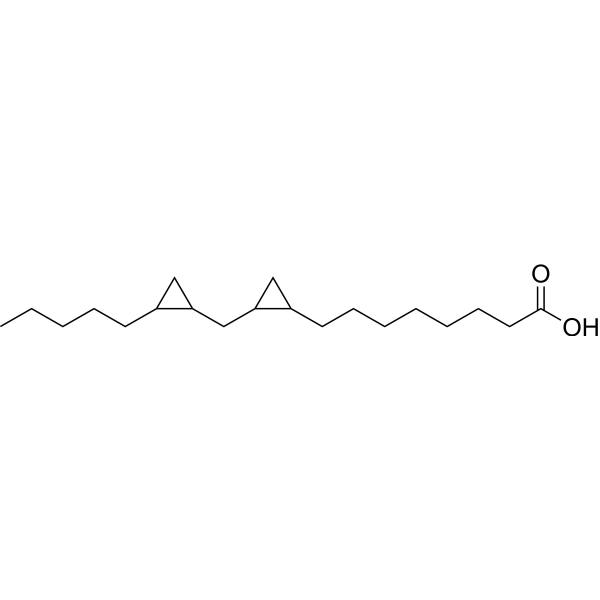
Physicochemical Properties
| Molecular Formula | C20H36O2 |
| Molecular Weight | 308.49864 |
| Exact Mass | 308.272 |
| CAS # | 28399-31-7 |
| Related CAS # | DCPLA-ME;56687-67-3 |
| PubChem CID | 9904718 |
| Appearance | Colorless to light yellow liquid |
| Density | 0.969g/cm3 |
| Boiling Point | 417.047ºC at 760 mmHg |
| Flash Point | 184.49ºC |
| Vapour Pressure | 0mmHg at 25°C |
| Index of Refraction | 1.491 |
| LogP | 6.044 |
| Hydrogen Bond Donor Count | 1 |
| Hydrogen Bond Acceptor Count | 2 |
| Rotatable Bond Count | 14 |
| Heavy Atom Count | 22 |
| Complexity | 326 |
| Defined Atom Stereocenter Count | 0 |
| SMILES | C(C1CC1CC1CC1CCCCCCCC(O)=O)CCCC |
| InChi Key | CONYTTFKIUJZOF-UHFFFAOYSA-N |
| InChi Code | InChI=1S/C20H36O2/c1-2-3-7-10-16-13-18(16)15-19-14-17(19)11-8-5-4-6-9-12-20(21)22/h16-19H,2-15H2,1H3,(H,21,22) |
| Chemical Name | 8-[2-[(2-pentylcyclopropyl)methyl]cyclopropyl]octanoic acid |
| HS Tariff Code | 2934.99.9001 |
| Storage |
Powder-20°C 3 years 4°C 2 years In solvent -80°C 6 months -20°C 1 month |
| Shipping Condition | Room temperature (This product is stable at ambient temperature for a few days during ordinary shipping and time spent in Customs) |
Biological Activity
| Targets |
- Protein kinase C ε (PKCε) (C2-like domain, binding sites: Arg50, Ile89) [1] - Protein phosphatase 1 (PP-1) [2] - Calcium/calmodulin-dependent protein kinase II (CaMKII) [2] - α-Amino-3-hydroxy-5-methyl-4-isoxazolepropionic acid (AMPA) receptor [2] - Caspase-3, caspase-9 [3] |
| ln Vitro |
DCP-LA (100 nM; DCP-LA (10, 100, 100 nM; 15 min)) activates cytosolic PKCε in PL-12 cells by binding to the phosphatidylserine binding/ligation sites Arg50 and Ile89, which depletes cells Surface translocation [1]. 10 min; DCP-LA (100 nM; 35 °C) activates CaMKII and inhibits PP-1 in hippocampus neurons [2]. DCP-LA (100 nM; 20 min) raises the levels responsible for potentiation The expression of receptors on the plasma membrane of the hippocampus system [2]. DCP-LA (100 nM; 10 min) increases hippocampus synaptic transmission [2]. DCP-LA (100 nM; 24 h) prevents nitrosoprin Effect of sodium (SNP) and restored neurons triggered by SNP degradation [3]. - DCP-LA (8-[2-(2-pentylcyclopropylmethyl)cyclopropyl]octanoic acid) specifically activates cytosolic PKCε by binding to its C2-like domain (Arg50 and Ile89 sites). At 1 μM, it increased PKCε activity by 2.3±0.2-fold compared to the control [1] - It stimulated AMPA receptor exocytosis in cultured cortical neurons: 1 μM DCP-LA increased the surface expression of AMPA receptors by 65±5% via PP-1 inhibition and subsequent CaMKII activation [2] - The compound protected rat cortical neurons from H₂O₂-induced oxidative stress apoptosis. At concentrations of 0.1, 1, and 10 μM, it reduced apoptotic rates by 32±4%, 58±5%, and 73±6%, respectively [3] - It inhibited H₂O₂-induced activation of caspase-3 and caspase-9: 10 μM DCP-LA reduced caspase-3 activity by 68±5% and caspase-9 activity by 62±4% [3] - No significant cytotoxicity was observed in cortical neurons at concentrations up to 20 μM [3] |
| ln Vivo | In a mouse model, DCP-LA (1 mg/kg; once daily in mice; 7 d) decreased cerebral cortical deficiencies brought on by middle cerebral artery (MCA) occlusion and showed protection against ischemic brain injury [3]. |
| Enzyme Assay |
- PKCε activation assay: Recombinant PKCε (wild-type or mutant with Arg50/Ile89 substitutions) was incubated with DCP-LA (0.01–10 μM) and a peptide substrate. The phosphorylation of the substrate was measured by a kinase assay kit to evaluate PKCε activation [1] - PP-1 activity assay: Purified PP-1 was mixed with DCP-LA (0.1–10 μM) and a phosphorylated substrate. The dephosphorylation level was detected by absorbance at 620 nm to calculate PP-1 inhibition efficiency [2] - Caspase activity assay: H₂O₂-treated cortical neuron lysates were incubated with DCP-LA (0.1–10 μM) and caspase-3/-9 specific fluorogenic substrates. Fluorescence intensity was measured at excitation/emission wavelengths of 400/505 nm to quantify caspase activity [3] |
| Cell Assay |
Cell viability assay [3] Cell Types: rat cerebral cortex neurons Tested Concentrations: 100 nM Incubation Duration: 24 hrs (hours); 12 h) eliminated (SNP) (1 mM)-induced caspase-3/9 activation [3]. Concomitant with 1 mM Sodium Nitroprusside (SNP) Experimental Results: Prevents SNP-induced neuronal cell death. - PKCε binding and activation assay: HEK293T cells transfected with PKCε expression plasmids (wild-type or mutants) were treated with DCP-LA (1 μM) for 30 minutes. Co-immunoprecipitation and Western blot were used to detect PKCε activation (phosphorylation) [1] - AMPA receptor exocytosis assay: Cultured cortical neurons were treated with DCP-LA (1 μM) for 1 hour. Surface biotinylation and Western blot were performed to quantify surface AMPA receptor levels; CaMKII phosphorylation was detected by Western blot [2] - Neuronal apoptosis and protection assay: Rat cortical neurons were pretreated with DCP-LA (0.1, 1, 10 μM) for 1 hour, then exposed to H₂O₂ for 24 hours. Apoptotic cells were identified by Hoechst 33342 staining; cell viability was measured by MTT assay; caspase-3/-9 activation was detected by Western blot [3] |
| Animal Protocol |
Animal/Disease Models: Mouse middle cerebral artery (MCA) occlusion model (male CB-17 mice, 5-8 weeks old) [3] Doses: 1 mg/kg Route of Administration: po (oral gavage); one time/day for 7 days ; The results of killing the mice on the 28th day: the degeneration area of cerebral infarction was Dramatically diminished, and the rescue area reached 82%. |
| References |
[1]. DCP-LA Activates Cytosolic PKCε by Interacting with the Phosphatidylserine Binding/Associating Sites Arg50 and Ile89 in the C2-Like Domain. Cell Physiol Biochem. 2015;37(1):193-200. [2]. DCP-LA stimulates AMPA receptor exocytosis through CaMKII activation due to PP-1 inhibition. J Cell Physiol. 2009 Oct;221(1):183-8. [3]. Linoleic acid derivative DCP-LA protects neurons from oxidative stress-induced apoptosis by inhibiting caspase-3/-9 activation. Neurochem Res. 2010 May;35(5):712-7. |
| Additional Infomation |
- DCP-LA is a linoleic acid derivative with a unique cyclopropyl structure [1][2][3] - Its mechanism of PKCε activation involves direct binding to the C2-like domain (Arg50 and Ile89 residues), distinguishing it from phosphatidylserine-dependent PKC activators [1] - The stimulation of AMPA receptor exocytosis suggests potential applications in enhancing synaptic plasticity and treating neurocognitive disorders [2] - Its neuroprotective effect against oxidative stress is mediated by inhibiting caspase-3/-9 activation, making it a candidate for neurodegenerative disease therapy [3] |
Solubility Data
| Solubility (In Vitro) | DMSO : ~5 mg/mL (~16.21 mM) |
| Solubility (In Vivo) |
Solubility in Formulation 1: ≥ 0.5 mg/mL (1.62 mM) (saturation unknown) in 10% DMSO + 40% PEG300 + 5% Tween80 + 45% Saline (add these co-solvents sequentially from left to right, and one by one), clear solution. For example, if 1 mL of working solution is to be prepared, you can add 100 μL of 5.0 mg/mL clear DMSO stock solution to 400 μL PEG300 and mix evenly; then add 50 μL Tween-80 to the above solution and mix evenly; then add 450 μL normal saline to adjust the volume to 1 mL. Preparation of saline: Dissolve 0.9 g of sodium chloride in 100 mL ddH₂ O to obtain a clear solution. Solubility in Formulation 2: 0.5 mg/mL (1.62 mM) in 10% DMSO + 90% (20% SBE-β-CD in Saline) (add these co-solvents sequentially from left to right, and one by one), suspension solution; with ultrasonication. For example, if 1 mL of working solution is to be prepared, you can add 100 μL of 5.0 mg/mL clear DMSO stock solution to 900 μL of 20% SBE-β-CD physiological saline solution and mix evenly. Preparation of 20% SBE-β-CD in Saline (4°C,1 week): Dissolve 2 g SBE-β-CD in 10 mL saline to obtain a clear solution. Solubility in Formulation 3: ≥ 0.5 mg/mL (1.62 mM) (saturation unknown) in 10% DMSO + 90% Corn Oil (add these co-solvents sequentially from left to right, and one by one), clear solution. For example, if 1 mL of working solution is to be prepared, you can add 100 μL of 5.0 mg/mL clear DMSO stock solution to 900 μL of corn oil and mix evenly. (Please use freshly prepared in vivo formulations for optimal results.) |
| Preparing Stock Solutions | 1 mg | 5 mg | 10 mg | |
| 1 mM | 3.2415 mL | 16.2075 mL | 32.4149 mL | |
| 5 mM | 0.6483 mL | 3.2415 mL | 6.4830 mL | |
| 10 mM | 0.3241 mL | 1.6207 mL | 3.2415 mL |