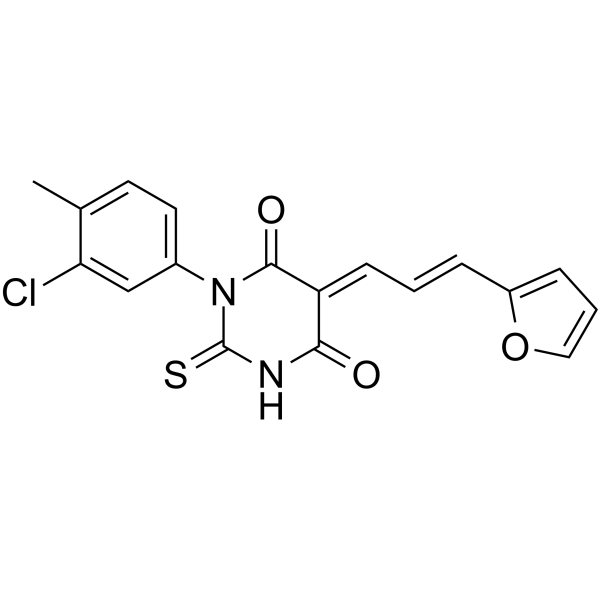
Physicochemical Properties
| Molecular Formula | C18H13CLN2O3S |
| Molecular Weight | 372.825422048569 |
| Exact Mass | 372.033 |
| CAS # | 593273-05-3 |
| PubChem CID | 1797299 |
| Appearance | Orange to red solid powder |
| LogP | 4 |
| Hydrogen Bond Donor Count | 1 |
| Hydrogen Bond Acceptor Count | 4 |
| Rotatable Bond Count | 3 |
| Heavy Atom Count | 25 |
| Complexity | 634 |
| Defined Atom Stereocenter Count | 0 |
| SMILES | ClC1=C(C)C=CC(=C1)N1C(NC(/C(=C\C=C\C2=CC=CO2)/C1=O)=O)=S |
| InChi Key | AYNCXNUUERDREH-FMDPHQNASA-N |
| InChi Code | InChI=1S/C18H13ClN2O3S/c1-11-7-8-12(10-15(11)19)21-17(23)14(16(22)20-18(21)25)6-2-4-13-5-3-9-24-13/h2-10H,1H3,(H,20,22,25)/b4-2+,14-6+ |
| Chemical Name | (5E)-1-(3-chloro-4-methylphenyl)-5-[(E)-3-(furan-2-yl)prop-2-enylidene]-2-sulfanylidene-1,3-diazinane-4,6-dione |
| Synonyms | DCH36-06; DCH36 06; DCH36_06 |
| HS Tariff Code | 2934.99.9001 |
| Storage |
Powder-20°C 3 years 4°C 2 years In solvent -80°C 6 months -20°C 1 month Note: This product requires protection from light (avoid light exposure) during transportation and storage. |
| Shipping Condition | Room temperature (This product is stable at ambient temperature for a few days during ordinary shipping and time spent in Customs) |
Biological Activity
| ln Vitro | Leukemic cells undergo dose-dependent apoptosis and cell cycle arrest in the G1 phase upon treatment with DCH36_06 (6.7–20 μM; 24-48 hours) [1]. The cleavage of pro-caspase 3, pro-caspase 9, and PARP1 is dramatically activated in a dose-dependent manner upon treatment with DCH36_06 (5-10 μM; 24 hours) [1]. When tested against the leukemia cell lines CEM, MOLT3, MOLT4, Jurkat, MV4-11, THP-1, RS4;11, KOPN8, Kasumi-1, and K562 cells, DCH36_06 shown strong antiproliferative activity in a dose-dependent manner; its IC50 values are in the single-digit micromolar range [1]. |
| ln Vivo | DCH36_06 inhibits the growth of mouse leukemia xenografts when administered intraperitoneally (i.p.) at 25–50 mg/kg for 20 days [1]. |
| Cell Assay |
Cell cycle analysis[1] Cell Types: MV4-11 Cell Tested Concentrations: 6.7 μM, 20 μM Incubation Duration: 24 hrs (hours), 48 hrs (hours) Experimental Results: Dose-dependent cell cycle arrest in G1 phase. Apoptosis analysis [1] Cell Types: MV4-11 Cell Tested Concentrations: 6.7 μM, 20 μM Incubation Duration: 24 hrs (hours), 48 hrs (hours) Experimental Results: Significant induction of apoptosis. Western Blot Analysis [1] Cell Types: MV4-11 cells Tested Concentrations: 5 μM, 10 μM Incubation Duration: 24 hrs (hours) Experimental Results: Significant activation of pro-caspase 3, pro-caspase 9 and cleavage of PARP1 in a dose-dependent manner. |
| Animal Protocol |
Animal/Disease Models: MV4-11 xenograft nude mice [1] Doses: 25 mg/kg, 50 mg/kg Route of Administration: intraperitoneal (ip) injection; every two days; 20 days Experimental Results: Tumor growth rate was Dramatically diminished in a dose-dependent manner . |
| References |
[1]. Discovery and biological evaluation of thiobarbituric derivatives as potent p300/CBP inhibitors. Bioorg Med Chem. 2018 Nov 1;26(20):5397-5407. |
Solubility Data
| Solubility (In Vitro) | DMSO : ~125 mg/mL (~335.27 mM) |
| Solubility (In Vivo) |
Solubility in Formulation 1: ≥ 2.08 mg/mL (5.58 mM) (saturation unknown) in 10% DMSO + 40% PEG300 + 5% Tween80 + 45% Saline (add these co-solvents sequentially from left to right, and one by one), clear solution. For example, if 1 mL of working solution is to be prepared, you can add 100 μL of 20.8 mg/mL clear DMSO stock solution to 400 μL PEG300 and mix evenly; then add 50 μL Tween-80 to the above solution and mix evenly; then add 450 μL normal saline to adjust the volume to 1 mL. Preparation of saline: Dissolve 0.9 g of sodium chloride in 100 mL ddH₂ O to obtain a clear solution. Solubility in Formulation 2: 2.08 mg/mL (5.58 mM) in 10% DMSO + 90% (20% SBE-β-CD in Saline) (add these co-solvents sequentially from left to right, and one by one), suspension solution; with ultrasonication. For example, if 1 mL of working solution is to be prepared, you can add 100 μL of 20.8 mg/mL clear DMSO stock solution to 900 μL of 20% SBE-β-CD physiological saline solution and mix evenly. Preparation of 20% SBE-β-CD in Saline (4°C,1 week): Dissolve 2 g SBE-β-CD in 10 mL saline to obtain a clear solution. (Please use freshly prepared in vivo formulations for optimal results.) |
| Preparing Stock Solutions | 1 mg | 5 mg | 10 mg | |
| 1 mM | 2.6822 mL | 13.4109 mL | 26.8219 mL | |
| 5 mM | 0.5364 mL | 2.6822 mL | 5.3644 mL | |
| 10 mM | 0.2682 mL | 1.3411 mL | 2.6822 mL |