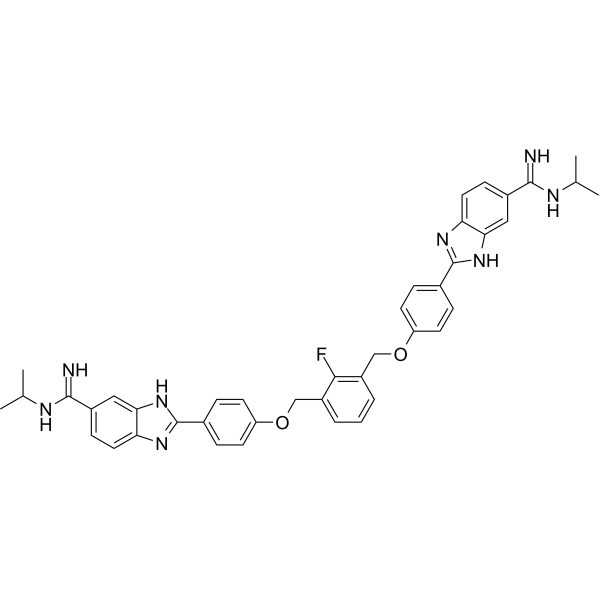
Physicochemical Properties
| Molecular Formula | C42H41FN8O2 |
| Molecular Weight | 708.825752019882 |
| Exact Mass | 708.333 |
| CAS # | 2170606-74-1 |
| PubChem CID | 138556040 |
| Appearance | Typically exists as solid at room temperature |
| LogP | 6.9 |
| Hydrogen Bond Donor Count | 4 |
| Hydrogen Bond Acceptor Count | 7 |
| Rotatable Bond Count | 12 |
| Heavy Atom Count | 53 |
| Complexity | 1130 |
| Defined Atom Stereocenter Count | 0 |
| InChi Key | NUVPJXUYFGWDGB-UHFFFAOYSA-N |
| InChi Code | InChI=1S/C42H41FN8O2/c1-24(2)46-39(44)28-12-18-34-36(20-28)50-41(48-34)26-8-14-32(15-9-26)52-22-30-6-5-7-31(38(30)43)23-53-33-16-10-27(11-17-33)42-49-35-19-13-29(21-37(35)51-42)40(45)47-25(3)4/h5-21,24-25H,22-23H2,1-4H3,(H2,44,46)(H2,45,47)(H,48,50)(H,49,51) |
| Chemical Name | 2-[4-[[2-fluoro-3-[[4-[6-(N'-propan-2-ylcarbamimidoyl)-1H-benzimidazol-2-yl]phenoxy]methyl]phenyl]methoxy]phenyl]-N'-propan-2-yl-3H-benzimidazole-5-carboximidamide |
| Synonyms | DB-2313; DB 2313; DB2313 |
| HS Tariff Code | 2934.99.9001 |
| Storage |
Powder-20°C 3 years 4°C 2 years In solvent -80°C 6 months -20°C 1 month |
| Shipping Condition | Room temperature (This product is stable at ambient temperature for a few days during ordinary shipping and time spent in Customs) |
Biological Activity
| ln Vitro | Treatment with DB2313 significantly inhibited the proliferation of PU.1 URE–/– acute myeloid leukemia (AML) cells (IC50 of 7.1 μM), but at identical concentrations, had no effect on normal hematopoietic cells. In mouse PU.1 URE–/– AML cells, DB2313 therapy led to a 3.5-fold increase in apoptotic cells. Additionally, in the second and third rounds of plating, DB2313 significantly reduces clonogenicity; in the fourth and succeeding rounds, clonogenicity is completely disrupted [1]. PU.1 occupancy on the E2f1, Junb, and Csf1r promoters is decreased in AML cells by DB2313 [1]. |
| ln Vivo | Mice treated with DB2313 (17 mg/kg; intraperitoneal injection; three times per week; for three weeks) had enhanced survival and delayed the course of leukemia [1]. |
| Animal Protocol |
Animal/Disease Models: NSG mice receiving sublethal radiation (2.0 Gy) and injected with PU.1 URE–/– AML cells [1] Doses: 17 mg/kg Route of Administration: intraperitoneal (ip) injection; three times per week; for 3 weeks Experimental Results: Tumor burden diminished and resulted in increased survival. |
| References |
[1]. Iléana Antony-Debré, et al. Pharmacological inhibition of the transcription factor PU.1 in leukemia. J Clin Invest. 2017 Dec 1;127(12):4297-4313. [2]. Zhang S, Zhao S, Qi Y, et al. SPI1-induced downregulation of FTO promotes GBM progression by regulating pri-miR-10a processing in an m6A-dependent manner. Mol Ther Nucleic Acids. 2022;27:699-717. |
Solubility Data
| Solubility (In Vitro) | DMSO : ~3.7 mg/mL (~5.22 mM () |
| Solubility (In Vivo) |
Solubility in Formulation 1: 5 mg/mL (7.05 mM) in 50% PEG300 +50% Saline (add these co-solvents sequentially from left to right, and one by one), suspension solution; with sonication. Preparation of saline: Dissolve 0.9 g of sodium chloride in 100 mL ddH₂ O to obtain a clear solution. (Please use freshly prepared in vivo formulations for optimal results.) |
| Preparing Stock Solutions | 1 mg | 5 mg | 10 mg | |
| 1 mM | 1.4108 mL | 7.0539 mL | 14.1078 mL | |
| 5 mM | 0.2822 mL | 1.4108 mL | 2.8216 mL | |
| 10 mM | 0.1411 mL | 0.7054 mL | 1.4108 mL |