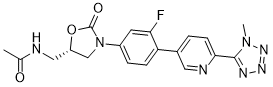
DA-7867 is a novel and potent oxazolidinone
Physicochemical Properties
| Molecular Formula | C19H18FN7O3 |
| Molecular Weight | 411.4 |
| Exact Mass | 411.146 |
| Elemental Analysis | C, 55.47; H, 4.41; F, 4.62; N, 23.83; O, 11.67 |
| CAS # | 380382-38-7 |
| PubChem CID | 10409343 |
| Appearance | Typically exists as solid at room temperature |
| LogP | 2.444 |
| Hydrogen Bond Donor Count | 1 |
| Hydrogen Bond Acceptor Count | 8 |
| Rotatable Bond Count | 5 |
| Heavy Atom Count | 30 |
| Complexity | 641 |
| Defined Atom Stereocenter Count | 1 |
| SMILES | CC(=O)NCC1CN(C(=O)O1)C2=CC(=C(C=C2)C3=CN=C(C=C3)C4=NN=NN4C)F |
| InChi Key | XLLXHGCGAQJLLK-AWEZNQCLSA-N |
| InChi Code | InChI=1S/C19H18FN7O3/c1-11(28)21-9-14-10-27(19(29)30-14)13-4-5-15(16(20)7-13)12-3-6-17(22-8-12)18-23-24-25-26(18)2/h3-8,14H,9-10H2,1-2H3,(H,21,28)/t14-/m0/s1 |
| Chemical Name | N-[[(5S)-3-[3-fluoro-4-[6-(1-methyltetrazol-5-yl)pyridin-3-yl]phenyl]-2-oxo-1,3-oxazolidin-5-yl]methyl]acetamide |
| Synonyms | DA7867; DA-7867; DA-7867; UNII-491MT9GU8K; 380382-38-7; 491MT9GU8K; Acetamide, N-(((5S)-3-(3-fluoro-4-(6-(1-methyl-1H-tetrazol-5-yl)-3-pyridinyl)phenyl)-2-oxo-5-oxazolidinyl)methyl)-; (S)-(N-3-(4-(2-m(1-methyl-5-tetrazolyl)-pyridine-5-yl)-3-fluorophenyl)-2-oxo-5-oxazolidinyl)methyl; N-[[(5S)-3-[3-fluoro-4-[6-(1-methyltetrazol-5-yl)pyridin-3-yl]phenyl]-2-oxo-1,3-oxazolidin-5-yl]methyl]acetamide; SCHEMBL6793230; DA 7867; UNII-491MT9GU8K |
| HS Tariff Code | 2934.99.9001 |
| Storage |
Powder-20°C 3 years 4°C 2 years In solvent -80°C 6 months -20°C 1 month |
| Shipping Condition | Room temperature (This product is stable at ambient temperature for a few days during ordinary shipping and time spent in Customs) |
Biological Activity
| Targets | Antibacterial |
| ln Vitro | The incidence of invasive bacterial infections has increased remarkably over the past two decades, which was mainly attributed to the increasing emergence of drug-resistant bacteria especially multidrug-resistant strains, intractable pathogens and newly arising pathogenic organisms. Tetrazoles, the bioisoster of carboxylic acid, possess considerable antibacterial property. Hybridization of tetrazole with other antibacterial pharmacophores has the potential to enhance the efficacy against both drug-sensitive and drug-resistant pathogens. Some tetrazole hybrids such as tetrazole-oxazolidinone hybrid Tedizolid 25 and Tedizolid phosphate 26 have already been marketed for the treatment of acute bacterial skin and skin structure infections caused by various bacteria. DA-7867(27), the amide analog of Tedizolid, also exhibited promising activities against a panel of clinically important pathogens including drug-resistant organisms, demonstrating the possible utility of the tetrazole scaffolds in the development of new antibacterial agents. Thus, hybridization of tetrazole with other antibacterial pharmacophores represents a promising strategy to develop novel antibacterial candidates. This work is attempted to systematically review the research of tetrazole hybrids in the design and development of antibacterial agents during the past two decades. The structure-activity relationship (SAR) is also discussed to provide an insight for rational design of more effective tetrazole antibacterial candidates [1]. |
| ln Vivo |
Background Mycetoma is a chronic infectious disease of tropical and subtropical countries. It is produced by true fungi and actinobacteria. In México, Nocardia brasiliensis is the main causative agent of mycetoma, producing about 86% of the cases; the gold standard for the therapy of mycetoma by N. brasiliensis is the use of sulfonamides which give a 70% cure rate. The addition of amikacin to this regime increases to 95% the cure rate; however, the patients have to be monitored for creatinine clearance and audiometry studies because of the potential development of side effects. Because of that it is important to search for new active compounds. In the present work, we evaluated the in vivo effect of DA-7867, an experimental oxazolidinone, on the development of experimental mycetomas by N. brasiliensis in BALB/c mice. Methodology/Principal Findings In order to determine the optimal dose utilized to apply to the animals, we first determined by HPLC the plasma levels using several concentrations of the compounds. Based on these results, we used 10 and 25 mg/kg subcutaneously every 24 hr; DA-7867 was also supplied in the drinking water at a calculated dose of 25 mg/kg. As a control we utilized linezolid at 25 mg/kg, a compound active in murine and human infections, three times a day. The mice were infected in the right footpad with a young culture of N. brasiliensis HUJEG-1, and one week later we started the application of the antimicrobials for six more weeks. After that we compared the development of lesions in the groups injected with saline solution or with the antimicrobials; the results were analyzed by the variance ANOVA test. DA-7867 was able to reduce the production of lesions at 25 mg/kg, when given either subcutaneously or in the drinking water. Conclusions/Significance The experimental oxazolidinone DA-7867 is active in vivo against N. brasiliensis, which opens the possibility of using this drug once it is accepted for human application. Since oxazolidinones seem to be active against a wide spectrum of actinobacteria, it is possible they could be used in human cases of mycetoma by other actinomycetales, such as Streptomyces somaliensis, highly prevalent in Sudan, or Actinomadura madurae and A. pelletieri, which are commonly observed in Africa and India [2]. |
| Animal Protocol |
Determination of plasma levels of the antimicrobials [2] Several doses of each compound linezolid or DA-7867 were used to determine their plasma concentrations in BALB/c mice. Linezolid was used at 10 mg/kg, 25 mg/kg and 50 mg/kg; DA-7867 at 10 mg/kg and 25 mg/kg. Eight-to-twelve week-old female BALB/c mice were injected subcutaneously with the antimicrobials. For each dose tested, 27 mice were utilized; 24 were injected with the selected dose and 3 mice were not injected to represent time 0. Next, 500 µl blood samples were taken from the infraorbitary sinus of each mouse, which previously had undergone general anesthesia with ethylic ether. The samples were taken from groups of 3 mice each at the following time intervals: 0 min, 20 min, 40 min, 1 hr, 2 h, 4 h, 6 h, 8 h and 10 h. After sample collection, the plastic tubes containing the blood were centrifuged and the plasma separated and frozen at −70°C. Plasma concentrations were determined by using by using a previously validated HPLC (High Performance Liquid Chromatography) method as follows [13]. The serum protein was precipitated by combining 50 µL of sample with 150 µl of acetonitrile. The mixture was vortexed for 10 sec and centrifuged for 5 min at 5304×g, and the supernatant was filtered through 0.45 µm Nylon filters. Filtrates were received into 150 µL inserts for chromatographic analysis. The chromatographic separation of antimicrobials was achieved using a Waters 2690 Alliance liquid chromatograph with diode array detector 996 (DAD) and fluorescence detector 474. An Atlantis dC18 column 150 mm×4.6 mm I.D., with 5 µm particle size was used. Column temperature was maintained at 30°C. Samples were eluted with a mobile phase consisting of 0.1% trichloroacetic acid (solvent A) and acetonitrile (solvent B); a gradient program was utilized for the elution. In the case of DA-7867, in order to reduce the retention time of this analyte, this program was modified with an increase in the initial proportion of acetonitrile. The flow rate of the mobile phase was 1.0 mL/min and the injection volume was 10 µL. The DAD wavelength was set at 254 nm for linezolid; for DA-7867 the fluorescence intensities were measured at an excitation wavelength of 292 nm and an emission wavelength of 408 nm. Therapeutic assays [2] Groups of 15 mice each were used. One group was injected subcutaneously in the back with 0.1 ml pyrogen-free saline solution; the rest were treated with DA-7867 at a dose of 10 mg/kg and 25 mg/kg daily, and linezolid at a dose of 25 mg/kg three times a day. The drugs were administered subcutaneously on the back of each mouse during a four week period. Since it is more comfortable for the patient to take the compounds orally, we studied this possibility by giving DA-7867 in this way. However, since it was a long term experiment (the antimicrobial had to be given five times a week during four weeks ) and to avoid a possible esophageal ripping due to the insertion of the oral cateter, we decided to give it in the drinking water. DA-7867 was suspended in 10% hydroxypropylcellulose and given in the drinking water at a dose of 25 mg/kg. The amount of compound was calculated according to the amount of water drank during the day per each animal. Since the amount of antimicrobial taken by the animals was not completely controlled we determined the levels in the plasma of the animals by the HPLC method described above at 0, 3, 6, 9, and 12 h after they started to drink a new bottle. |
| References |
[1]. Current scenario of tetrazole hybrids for antibacterial activity. Eur J Med Chem. 2019 Dec 15:184:111744. [2]. Therapeutic Effect of a Novel Oxazolidinone, DA-7867, in BALB/c Mice Infected with Nocardia brasiliensis. PLoS Negl Trop Dis. 2008 Sep 10;2(9):e289. |
| Additional Infomation |
Further study indicated that DA-7867 (27), the amide analog of Tedizolid, also displayed promising in vitro activities against a panel of clinically important pathogens including drug-resistant MSSA, MRSA, vancomycin-resistant E. faecium (VRE), and penicillin-resistant S. pneumoniae (PRSP). Both in vitro and in vivo potencies of DA-7867 were higher than those of Linezolid, so it is worthy to be further investigated [1]. Actinomycetoma is an infectious disease of tropical and subtropical regions produced by actinobacteria of the genera Nocardia, Streptomyces, and Actinomadura. Therapeutic alternatives are scarce and include trimethoprim-sulfamethoxazole, diaminodiphenylsulfone, amoxicillin-clavulanate, imipenem, and amikacin. Oxazolidinones are a new class of antimicrobials with a completely different cellular target; the first compound in the market, linezolid, was introduced in the year 2000. It is active against many species of Nocardia and other aerobic actinomycetes; however, the long-term application in human subjects produces side effects including peripheral neuropathy and mielossupression. Therefore, it is important to screen other oxazolidinones with higher activity and less toxicity. In the present work, we tested DA-7867, a new oxazolidinone, in an experimental mouse model. The drug is active in vivo and decreases the production of lesions using only one dose a day in contrast to linezolid, which needs to be injected three times a day. Although it was tested on N. brasiliensis, it can possibly be active (once it is accepted for its use in humans) against Actinomadura spp and Streptomyces spp, which are frequently found in places of Africa and India where actinomycetoma is also an important consult in dermatology.[2] |
Solubility Data
| Solubility (In Vitro) | May dissolve in DMSO (in most cases), if not, try other solvents such as H2O, Ethanol, or DMF with a minute amount of products to avoid loss of samples |
| Solubility (In Vivo) |
Note: Listed below are some common formulations that may be used to formulate products with low water solubility (e.g. < 1 mg/mL), you may test these formulations using a minute amount of products to avoid loss of samples. Injection Formulations (e.g. IP/IV/IM/SC) Injection Formulation 1: DMSO : Tween 80: Saline = 10 : 5 : 85 (i.e. 100 μL DMSO stock solution → 50 μL Tween 80 → 850 μL Saline) *Preparation of saline: Dissolve 0.9 g of sodium chloride in 100 mL ddH ₂ O to obtain a clear solution. Injection Formulation 2: DMSO : PEG300 :Tween 80 : Saline = 10 : 40 : 5 : 45 (i.e. 100 μL DMSO → 400 μLPEG300 → 50 μL Tween 80 → 450 μL Saline) Injection Formulation 3: DMSO : Corn oil = 10 : 90 (i.e. 100 μL DMSO → 900 μL Corn oil) Example: Take the Injection Formulation 3 (DMSO : Corn oil = 10 : 90) as an example, if 1 mL of 2.5 mg/mL working solution is to be prepared, you can take 100 μL 25 mg/mL DMSO stock solution and add to 900 μL corn oil, mix well to obtain a clear or suspension solution (2.5 mg/mL, ready for use in animals). Injection Formulation 4: DMSO : 20% SBE-β-CD in saline = 10 : 90 [i.e. 100 μL DMSO → 900 μL (20% SBE-β-CD in saline)] *Preparation of 20% SBE-β-CD in Saline (4°C,1 week): Dissolve 2 g SBE-β-CD in 10 mL saline to obtain a clear solution. Injection Formulation 5: 2-Hydroxypropyl-β-cyclodextrin : Saline = 50 : 50 (i.e. 500 μL 2-Hydroxypropyl-β-cyclodextrin → 500 μL Saline) Injection Formulation 6: DMSO : PEG300 : castor oil : Saline = 5 : 10 : 20 : 65 (i.e. 50 μL DMSO → 100 μLPEG300 → 200 μL castor oil → 650 μL Saline) Injection Formulation 7: Ethanol : Cremophor : Saline = 10: 10 : 80 (i.e. 100 μL Ethanol → 100 μL Cremophor → 800 μL Saline) Injection Formulation 8: Dissolve in Cremophor/Ethanol (50 : 50), then diluted by Saline Injection Formulation 9: EtOH : Corn oil = 10 : 90 (i.e. 100 μL EtOH → 900 μL Corn oil) Injection Formulation 10: EtOH : PEG300:Tween 80 : Saline = 10 : 40 : 5 : 45 (i.e. 100 μL EtOH → 400 μLPEG300 → 50 μL Tween 80 → 450 μL Saline) Oral Formulations Oral Formulation 1: Suspend in 0.5% CMC Na (carboxymethylcellulose sodium) Oral Formulation 2: Suspend in 0.5% Carboxymethyl cellulose Example: Take the Oral Formulation 1 (Suspend in 0.5% CMC Na) as an example, if 100 mL of 2.5 mg/mL working solution is to be prepared, you can first prepare 0.5% CMC Na solution by measuring 0.5 g CMC Na and dissolve it in 100 mL ddH2O to obtain a clear solution; then add 250 mg of the product to 100 mL 0.5% CMC Na solution, to make the suspension solution (2.5 mg/mL, ready for use in animals). Oral Formulation 3: Dissolved in PEG400 Oral Formulation 4: Suspend in 0.2% Carboxymethyl cellulose Oral Formulation 5: Dissolve in 0.25% Tween 80 and 0.5% Carboxymethyl cellulose Oral Formulation 6: Mixing with food powders Note: Please be aware that the above formulations are for reference only. InvivoChem strongly recommends customers to read literature methods/protocols carefully before determining which formulation you should use for in vivo studies, as different compounds have different solubility properties and have to be formulated differently. (Please use freshly prepared in vivo formulations for optimal results.) |
| Preparing Stock Solutions | 1 mg | 5 mg | 10 mg | |
| 1 mM | 2.4307 mL | 12.1536 mL | 24.3072 mL | |
| 5 mM | 0.4861 mL | 2.4307 mL | 4.8614 mL | |
| 10 mM | 0.2431 mL | 1.2154 mL | 2.4307 mL |