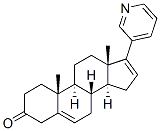
D4-abiraterone is an androgen receptor antagonist with an IC50 of 5.3 nM and an active metabolite of abiraterone Δ4-Abiraterone (D4A), an inhibitor of CYP17A1, an androgen receptor. An authorized anticancer drug, biratterone (previously CB-7598; Zytiga), functions as a selective and irreversible CYP17 inhibitor.
Physicochemical Properties
| Molecular Formula | C24H29NO |
| Molecular Weight | 347.49316 |
| Exact Mass | 347.225 |
| Elemental Analysis | C, 82.95; H, 8.41; N, 4.03; O, 4.60 |
| CAS # | 154229-21-7 |
| Related CAS # | 154229-21-7 |
| PubChem CID | 196941 |
| Appearance | White to off-white solid powder |
| LogP | 5.606 |
| Hydrogen Bond Donor Count | 0 |
| Hydrogen Bond Acceptor Count | 2 |
| Rotatable Bond Count | 1 |
| Heavy Atom Count | 26 |
| Complexity | 676 |
| Defined Atom Stereocenter Count | 5 |
| SMILES | C[C@@]12C(C3=CC=CN=C3)=CC[C@@]1([H])[C@]4([H])CCC5=CC(CC[C@]5(C)[C@@]4([H])CC2)=O |
| InChi Key | GYJZZAJJENTSTP-NHFPKVKZSA-N |
| InChi Code | InChI=1S/C24H29NO/c1-23-11-9-18(26)14-17(23)5-6-19-21-8-7-20(16-4-3-13-25-15-16)24(21,2)12-10-22(19)23/h3-4,7,13-15,19,21-22H,5-6,8-12H2,1-2H3/t19-,21-,22-,23-,24+/m0/s1 |
| Chemical Name | (8R,9S,10R,13S,14S)-10,13-dimethyl-17-pyridin-3-yl-1,2,6,7,8,9,11,12,14,15-decahydrocyclopenta[a]phenanthren-3-one |
| Synonyms | CB 7627; D4A; Δ4-Abiraterone |
| HS Tariff Code | 2934.99.9001 |
| Storage |
Powder-20°C 3 years 4°C 2 years In solvent -80°C 6 months -20°C 1 month Note: Please store this product in a sealed and protected environment (e.g. under nitrogen), avoid exposure to moisture. |
| Shipping Condition | Room temperature (This product is stable at ambient temperature for a few days during ordinary shipping and time spent in Customs) |
Biological Activity
| ln Vitro | D4-abiraterone (D4A ) (10 mM) almost totally prevents the conversion of D4-androstenedione (AD) into 5α-androstanedione and other 5α-reduced androgens. Abiraterone (Abi) (IC50=418 and >500 nM, respectively) has a lower affinity for the mutant and wild type androgen receptors (IC50=5.3 nM and 7.9 nM, respectively) than does D4-abiraterone (expressed in LNCaP and IC50=5.3 nM). When it comes to suppressing PSA, TMPRSS2, and FKBP5 expression in LNCAP, LAPC4, and C4-2 cell lines, D4-abiraterone performs a notably better job than Albi. The expression of AR target genes is also dose-dependently inhibited by D4-abiraterone[1]. |
| ln Vivo | D4-abiraterone (D4A) is ten times more effective than abiraterone (Abi) at preventing the conversion of dehydroepiandrosterone (DHEA) to D4-androstenedione (AD) by 3β-hydroxysteroid dehydrogenase (3βHSD) in LNCaP and VCaP xenografts. For the purpose of preventing AD accumulation at 48 hours in both LNCaP and VCaP xenografts, 0.1 μM D4-abiraterone is equal to 1 μM Abi. When comparing the D4-abiraterone group to the Abi acetate group, there is a significant delay in progression (P=0.011). When compared to Abi acetate, treatment with D4-abiraterone improves progression-free survival[1]. |
| Enzyme Assay | Enzyme assays are used to determine whether D4-abiraterone (D4A) is an inhibitor of 3βHSD. In summary, 0.5 mL of potassium phosphate buffer (pH 7.4), D4-abiraterone (5 to 20 μM), or ethanol vehicle are prepared along with recombinant human 3βHSD1 or 3βHSD2 (in yeast microsomes, 45 or 2.5 μg protein per incubation, respectively). NAD+ (1 mM) is added after a pre-incubation at 37°C for 1 to 3 min, and the incubation is carried out at 37°C for 20 min. The addition of 1 mL of ethyl acetate:isooctane (1:1) stops the reaction, after which the steroids are extracted into the organic phase and dried. In-line scintillation counting is used to quantify the steroids in the dried extracts, and HPLC is used to resolve the steroids[1]. |
| Cell Assay | The indicated concentrations of D4-abiraterone (D4A) are applied to the cells for 30 minutes after they have been cultured for 48 hours in serum-free medium. The cells are lysed using RIPA buffer after being washed twice with 0.9% NaCl solution and four times with 1×PBS. A multilabel counter is used to detect the protein concentration, which is then used to normalize the intracellular radioactivity measured using a liquid scintillation counter|1]. |
| Animal Protocol | In this study, male NSG mice aged 6 to 8 weeks are employed. Mice with castration-resistant prostate cancer (CRPC) are surgically orchiectomized and given a 5 mg sustained-release dehydroepiandrosterone (DHEA) pellet to be administered over a 90-day period, simulating human adrenal physiology. Two days later, matrigel is subcutaneously injected with 107 VCaP or C4-2 cells. Mice are randomly assigned, without following strict randomization, to treatment groups consisting of either vehicle (n = 9 or 10 mice for VCaP and C4-2, respectively) or D4-abiraterone (n = 10 mice for both cell lines) once tumors reach 300mm3. For up to 15 days, 5 mL per kg intraperitoneal injection of D4-abiraterone (0.5 mmol per kg per day in 0.1 mL 5% benzyl alcohol and 95% safflower oil solution) is given daily. Every day, intraperitoneal injections of 0.1 mL of a 5% benzyl alcohol and 95% safflower oil solution are given to the control groups. Every day, the volume of the tumor is measured, and the time it takes for the tumor to grow by 20% is calculated. When the tumor size doubles over the baseline or on day 15 of treatment, mice are killed[1]. |
| References |
[1]. Conversion of abiraterone to D4A drives anti-tumour activity in prostate cancer. Nature. 2015 Jul 16;523(7560):347-51. |
Solubility Data
| Solubility (In Vitro) | DMSO : ~50 mg/mL (~143.89 mM) |
| Solubility (In Vivo) |
Solubility in Formulation 1: ≥ 2.5 mg/mL (7.19 mM) (saturation unknown) in 10% DMSO + 90% (20% SBE-β-CD in Saline) (add these co-solvents sequentially from left to right, and one by one), clear solution. For example, if 1 mL of working solution is to be prepared, you can add 100 μL of 25.0 mg/mL clear DMSO stock solution to 900 μL of 20% SBE-β-CD physiological saline solution and mix evenly. Preparation of 20% SBE-β-CD in Saline (4°C,1 week): Dissolve 2 g SBE-β-CD in 10 mL saline to obtain a clear solution. Solubility in Formulation 2: ≥ 2.5 mg/mL (7.19 mM) (saturation unknown) in 10% DMSO + 90% Corn Oil (add these co-solvents sequentially from left to right, and one by one), clear solution. For example, if 1 mL of working solution is to be prepared, you can add 100 μL of 25.0 mg/mL clear DMSO stock solution to 900 μL of corn oil and mix evenly. (Please use freshly prepared in vivo formulations for optimal results.) |
| Preparing Stock Solutions | 1 mg | 5 mg | 10 mg | |
| 1 mM | 2.8778 mL | 14.3889 mL | 28.7778 mL | |
| 5 mM | 0.5756 mL | 2.8778 mL | 5.7556 mL | |
| 10 mM | 0.2878 mL | 1.4389 mL | 2.8778 mL |