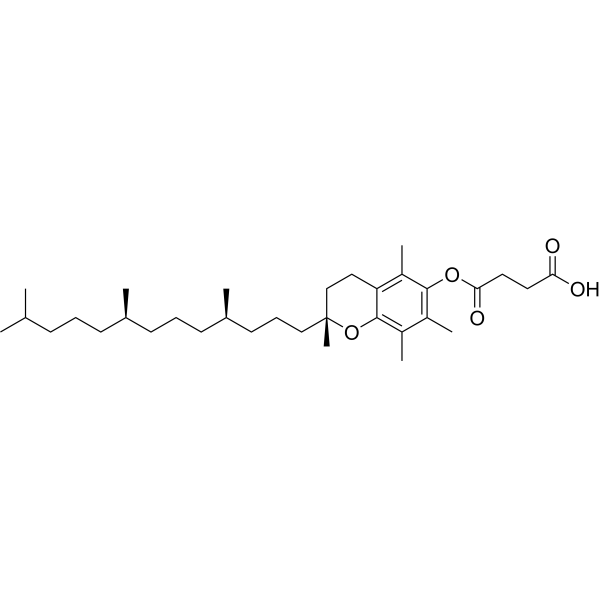
Physicochemical Properties
| Molecular Formula | C33H54O5 |
| Molecular Weight | 530.7789 |
| Exact Mass | 530.397 |
| Elemental Analysis | C, 74.67; H, 10.25; O, 15.07 |
| CAS # | 4345-03-3 |
| Related CAS # | 59-02-9 (vitamin E);58-95-7 (acetate);17407-37-3 (Hemisuccinate);4345-03-3; 9002-96-4 (PEG 1000 succinate); |
| PubChem CID | 20353 |
| Appearance | Solid powder |
| Density | 1.0±0.1 g/cm3 |
| Boiling Point | 625.8±55.0 °C at 760 mmHg |
| Melting Point | ~76 °C(lit.) |
| Flash Point | 187.0±25.0 °C |
| Vapour Pressure | 0.0±1.9 mmHg at 25°C |
| Index of Refraction | 1.498 |
| LogP | 11.88 |
| Hydrogen Bond Donor Count | 1 |
| Hydrogen Bond Acceptor Count | 5 |
| Rotatable Bond Count | 17 |
| Heavy Atom Count | 38 |
| Complexity | 720 |
| Defined Atom Stereocenter Count | 3 |
| SMILES | O1C2C(C([H])([H])[H])=C(C([H])([H])[H])C(=C(C([H])([H])[H])C=2C([H])([H])C([H])([H])[C@@]1(C([H])([H])[H])C([H])([H])C([H])([H])C([H])([H])[C@]([H])(C([H])([H])[H])C([H])([H])C([H])([H])C([H])([H])[C@]([H])(C([H])([H])[H])C([H])([H])C([H])([H])C([H])([H])C([H])(C([H])([H])[H])C([H])([H])[H])OC(C([H])([H])C([H])([H])C(=O)O[H])=O |
| InChi Key | IELOKBJPULMYRW-NJQVLOCASA-N |
| InChi Code | InChI=1S/C33H54O5/c1-22(2)12-9-13-23(3)14-10-15-24(4)16-11-20-33(8)21-19-28-27(7)31(25(5)26(6)32(28)38-33)37-30(36)18-17-29(34)35/h22-24H,9-21H2,1-8H3,(H,34,35)/t23-,24-,33-/m1/s1 |
| Chemical Name | 4-oxo-4-[[(2R)-2,5,7,8-tetramethyl-2-[(4R,8R)-4,8,12-trimethyltridecyl]-3,4-dihydrochromen-6-yl]oxy]butanoic acid |
| Synonyms | D –α-Tocopherol Hemisuccinate; Vitamin E Succinate; Tocopherol succinate; D-α-Tocopherol Succinate |
| HS Tariff Code | 2934.99.9001 |
| Storage |
Powder-20°C 3 years 4°C 2 years In solvent -80°C 6 months -20°C 1 month |
| Shipping Condition | Room temperature (This product is stable at ambient temperature for a few days during ordinary shipping and time spent in Customs) |
Biological Activity
| ln Vitro | D-alpha-tocopheryl succinate (1-20 μM; 24 hours) is lethal to Heterocyclic O Cells [1]. D-alpha-tocopherol succinate (10 μM; 48 hours) reduces caspase-3 activity and shields HEI-OC1 cells from ototoxicity caused by cisplatin [1]. To TC-1 tumor cells, D-alpha-tocopheryl succinate (0-50 μM; 18 hours) is cytotoxic [2]. |
| ln Vivo | Mice with TC-1 tumors were given injections of D-alpha-tocopherol succinate (1-2 mg/kg) three times, two days apart, for a period of 10 to 14 days. This treatment demonstrated antitumor effects [2]. |
| Cell Assay |
Cytotoxicity assay [1] Cell Types: HEI-OC1 cell line Tested Concentrations: 1-20 μM Incubation Duration: 24 hrs (hours) Experimental Results: Cytotoxicity was Dramatically induced at the concentration of 20 μM and demonstrated higher cytotoxicity compared with 10 μM Potency. Cell viability assay[1] Cell Types: HEI-OC1 Cell Line Tested Concentrations: 10 μM Incubation Duration: 48 hrs (hours) Experimental Results: Cisplatin-induced increase in cell population. Inhibits cisplatin-induced necrosis, ROS production, and late-stage apoptosis. Reduces cleaved PARP and inhibits the expression of caspase-3 associated with cisplatin-induced apoptosis. Cytotoxicity assay[2] Cell Types: TC-1 Tumor Cell Tested Concentrations: 0, 25 and 50 μM Incubation Duration: 18 hrs (hours) Experimental Results: Displayed dose-dependent cytotoxicity and induced a higher percentage of necrotic TC-1 cells (while not apoptotic cells). |
| Animal Protocol |
Animal/Disease Models: Six to eightweeks old female C57BL/6 mice bearing TC-1 tumor cells [2] Doses: 1 and 2 mg/kg Route of Administration: intraperitoneal (ip) injection; 1 and 2 mg/kg 3 times, spaced 2 days; 10 days to 14 days of TC-1 tumor cell injection Experimental Results: tumor volume diminished, especially at the dose of 2 mg/kg. |
| ADME/Pharmacokinetics |
Absorption, Distribution and Excretion _In addition to any following information, owing to alpha-Tocopherol succinate's closely related chemical nature with alpha-Tocopherol acetate, please also refer to the drug information page for alpha-Tocopherol acetate for further data._ It is generally believed that alpha-tocopherol succinate is ultimately de-esterified or cleaved to provide alpha-tocopherol once administered to the human body. It is consequently expected that pharmacodynamics and pharmacokinetics similar to that of alpha-tocopherol to be followed. 50 to 80% absorbed from gastrointestinal tract. _In addition to any following information, owing to alpha-Tocopherol succinate's closely related chemical nature with alpha-Tocopherol acetate, please also refer to the drug information page for alpha-Tocopherol acetate for further data._ It is generally believed that alpha-tocopherol succinate is ultimately de-esterified or cleaved to provide alpha-tocopherol once administered to the human body. It is consequently expected that pharmacodynamics and pharmacokinetics similar to that of alpha-tocopherol to be followed. _In addition to any following information, owing to alpha-Tocopherol succinate's closely related chemical nature with alpha-Tocopherol acetate, please also refer to the drug information page for alpha-Tocopherol acetate for further data._ It is generally believed that alpha-tocopherol succinate is ultimately de-esterified or cleaved to provide alpha-tocopherol once administered to the human body. It is consequently expected that pharmacodynamics and pharmacokinetics similar to that of alpha-tocopherol to be followed. _In addition to any following information, owing to alpha-Tocopherol succinate's closely related chemical nature with alpha-Tocopherol acetate, please also refer to the drug information page for alpha-Tocopherol acetate for further data._ It is generally believed that alpha-tocopherol succinate is ultimately de-esterified or cleaved to provide alpha-tocopherol once administered to the human body. It is consequently expected that pharmacodynamics and pharmacokinetics similar to that of alpha-tocopherol to be followed. Metabolism / Metabolites _In addition to any following information, owing to alpha-Tocopherol succinate's closely related chemical nature with alpha-Tocopherol acetate, please also refer to the drug information page for alpha-Tocopherol acetate for further data._ It is generally believed that alpha-tocopherol succinate is ultimately de-esterified or cleaved to provide alpha-tocopherol once administered to the human body. It is consequently expected that pharmacodynamics and pharmacokinetics similar to that of alpha-tocopherol to be followed. Hepatic. Biological Half-Life _In addition to any following information, owing to alpha-Tocopherol succinate's closely related chemical nature with alpha-Tocopherol acetate, please also refer to the drug information page for alpha-Tocopherol acetate for further data._ It is generally believed that alpha-tocopherol succinate is ultimately de-esterified or cleaved to provide alpha-tocopherol once administered to the human body. It is consequently expected that pharmacodynamics and pharmacokinetics similar to that of alpha-tocopherol to be followed. |
| Toxicity/Toxicokinetics |
Protein Binding _In addition to any following information, owing to alpha-Tocopherol succinate's closely related chemical nature with alpha-Tocopherol acetate, please also refer to the drug information page for alpha-Tocopherol acetate for further data._ It is generally believed that alpha-tocopherol succinate is ultimately de-esterified or cleaved to provide alpha-tocopherol once administered to the human body. It is consequently expected that pharmacodynamics and pharmacokinetics similar to that of alpha-tocopherol to be followed. Bound to beta-lipoproteins in blood. |
| References |
[1]. The effects of the antioxidant α-tocopherol succinate on cisplatin-induced ototoxicity in HEI-OC1 auditory cells. Int J Pediatr Otorhinolaryngol. 2016 Jul;86:9-14. [2]. Treatment of tumors with vitamin E suppresses myeloid derived suppressor cells and enhances CD8+ T cell-mediated antitumor effects. PLoS One. 2014 Jul 29;9(7):e103562. |
| Additional Infomation |
Pharmacodynamics Of the eight separate variants of vitamin E, alpha-tocopherol is the predominant form of vitamin E in human and animal tissues, and it has the highest bioavailability. This is because the liver preferentially resecretes only alpha-tocopherol by way of the hepatic alpha-tocopherol transfer protein (alpha-TTP); the liver metabolizes and excretes all the other vitamin E variants, which is why blood and cellular concentrations of other forms of vitamin E other than alpha-tocopherol are ultimately lower. Furthermore, the term alpha-tocopherol generally refers to a group of eight possible stereoisomers which is often called all-rac-tocopherol for being a racemic mixture of all eight stereoisomers. Of the eight stereoisomers, the RRR-alpha-tocopherol - or sometimes referred to as the d-alpha-tocopherol - stereoisomer is the naturally occurring form of alpha-tocopherol that is perhaps best recognized by the alpha-TTP and has been reported to demonstrate approximately twice the systemic availability of all-rac-tocopherol. As a result, often times (but certainly not always) the discussion of vitamin E - at least within the context of using the vitamin for health-related indications - is generally in reference to the use of RRR- or d-alpha-tocopherol. Subsequently, without further evidence to suggest otherwise, alpha-tocpherol succinate is generally believed to undergo a logical de-esterification in the gastrointestinal tract before being subsequently absorbed as free tocopherol. |
Solubility Data
| Solubility (In Vitro) | DMSO : ~250 mg/mL (~471.00 mM) |
| Solubility (In Vivo) |
Note: Listed below are some common formulations that may be used to formulate products with low water solubility (e.g. < 1 mg/mL), you may test these formulations using a minute amount of products to avoid loss of samples. Injection Formulations (e.g. IP/IV/IM/SC) Injection Formulation 1: DMSO : Tween 80: Saline = 10 : 5 : 85 (i.e. 100 μL DMSO stock solution → 50 μL Tween 80 → 850 μL Saline) *Preparation of saline: Dissolve 0.9 g of sodium chloride in 100 mL ddH ₂ O to obtain a clear solution. Injection Formulation 2: DMSO : PEG300 :Tween 80 : Saline = 10 : 40 : 5 : 45 (i.e. 100 μL DMSO → 400 μLPEG300 → 50 μL Tween 80 → 450 μL Saline) Injection Formulation 3: DMSO : Corn oil = 10 : 90 (i.e. 100 μL DMSO → 900 μL Corn oil) Example: Take the Injection Formulation 3 (DMSO : Corn oil = 10 : 90) as an example, if 1 mL of 2.5 mg/mL working solution is to be prepared, you can take 100 μL 25 mg/mL DMSO stock solution and add to 900 μL corn oil, mix well to obtain a clear or suspension solution (2.5 mg/mL, ready for use in animals). Injection Formulation 4: DMSO : 20% SBE-β-CD in saline = 10 : 90 [i.e. 100 μL DMSO → 900 μL (20% SBE-β-CD in saline)] *Preparation of 20% SBE-β-CD in Saline (4°C,1 week): Dissolve 2 g SBE-β-CD in 10 mL saline to obtain a clear solution. Injection Formulation 5: 2-Hydroxypropyl-β-cyclodextrin : Saline = 50 : 50 (i.e. 500 μL 2-Hydroxypropyl-β-cyclodextrin → 500 μL Saline) Injection Formulation 6: DMSO : PEG300 : castor oil : Saline = 5 : 10 : 20 : 65 (i.e. 50 μL DMSO → 100 μLPEG300 → 200 μL castor oil → 650 μL Saline) Injection Formulation 7: Ethanol : Cremophor : Saline = 10: 10 : 80 (i.e. 100 μL Ethanol → 100 μL Cremophor → 800 μL Saline) Injection Formulation 8: Dissolve in Cremophor/Ethanol (50 : 50), then diluted by Saline Injection Formulation 9: EtOH : Corn oil = 10 : 90 (i.e. 100 μL EtOH → 900 μL Corn oil) Injection Formulation 10: EtOH : PEG300:Tween 80 : Saline = 10 : 40 : 5 : 45 (i.e. 100 μL EtOH → 400 μLPEG300 → 50 μL Tween 80 → 450 μL Saline) Oral Formulations Oral Formulation 1: Suspend in 0.5% CMC Na (carboxymethylcellulose sodium) Oral Formulation 2: Suspend in 0.5% Carboxymethyl cellulose Example: Take the Oral Formulation 1 (Suspend in 0.5% CMC Na) as an example, if 100 mL of 2.5 mg/mL working solution is to be prepared, you can first prepare 0.5% CMC Na solution by measuring 0.5 g CMC Na and dissolve it in 100 mL ddH2O to obtain a clear solution; then add 250 mg of the product to 100 mL 0.5% CMC Na solution, to make the suspension solution (2.5 mg/mL, ready for use in animals). Oral Formulation 3: Dissolved in PEG400 Oral Formulation 4: Suspend in 0.2% Carboxymethyl cellulose Oral Formulation 5: Dissolve in 0.25% Tween 80 and 0.5% Carboxymethyl cellulose Oral Formulation 6: Mixing with food powders Note: Please be aware that the above formulations are for reference only. InvivoChem strongly recommends customers to read literature methods/protocols carefully before determining which formulation you should use for in vivo studies, as different compounds have different solubility properties and have to be formulated differently. (Please use freshly prepared in vivo formulations for optimal results.) |
| Preparing Stock Solutions | 1 mg | 5 mg | 10 mg | |
| 1 mM | 1.8840 mL | 9.4201 mL | 18.8402 mL | |
| 5 mM | 0.3768 mL | 1.8840 mL | 3.7680 mL | |
| 10 mM | 0.1884 mL | 0.9420 mL | 1.8840 mL |