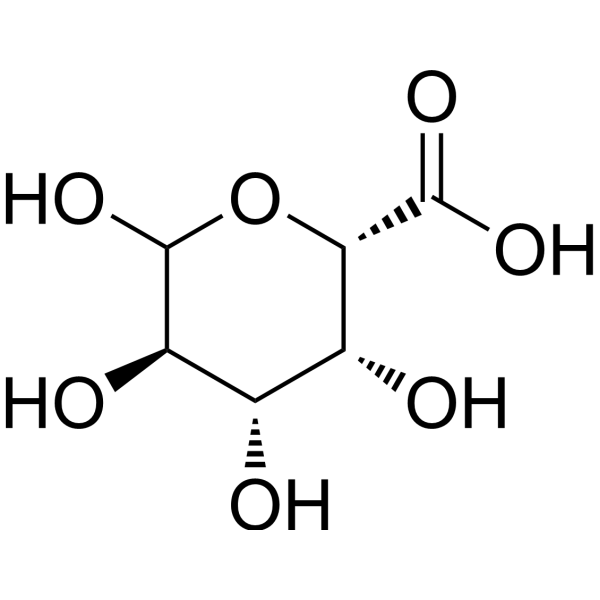
Physicochemical Properties
| Molecular Formula | C6H10O7 |
| Molecular Weight | 194.14 |
| CAS # | 552-12-5 |
| Appearance | Typically exists as solids at room temperature |
| SMILES | [C@@H]1([C@H]([C@@H](C(=O)O)OC([C@@H]1O)O)O)O |
| Synonyms | D-Galactopyranuronic acid; D-GalA; GALA; Galacuronate; Galactopyranuronate; galactopyranuronic acid; D-galacturonate; ...; 552-12-5; |
| HS Tariff Code | 2934.99.9001 |
| Storage |
Powder-20°C 3 years 4°C 2 years In solvent -80°C 6 months -20°C 1 month |
| Shipping Condition | Room temperature (This product is stable at ambient temperature for a few days during ordinary shipping and time spent in Customs) |
Biological Activity
| Targets | Biochemical |
| ln Vitro | A microbial production platform has been developed in Escherichia coli to synthesize D-glyceric acid from D-galacturonate. The expression of uronate dehydrogenase (udh) from Pseudomonas syringae and galactarolactone isomerase (gli) from Agrobacterium fabrum, along with the inactivation of garK, encoding for glycerate kinase, enables D-glyceric acid accumulation by utilizing the endogenous expression of galactarate dehydratase (garD), 5-keto-4-deoxy-D-glucarate aldolase (garL), and 2-hydroxy-3-oxopropionate reductase (garR). Optimization of carbon flux through the elimination of competing metabolic pathways led to the development of a ΔgarKΔhyiΔglxKΔuxaC mutant strain that produced 4.8 g/l of D-glyceric acid from D-galacturonate, with an 83% molar yield. Cultivation in a minimal medium produced similar yields and demonstrated that galactose or glycerol serve as possible carbon co-feeds for industrial production. This novel platform represents an alternative for the production of D-glyceric acid, an industrially relevant chemical, that addresses current challenges in using acetic acid bacteria for its synthesis: increasing yield, enantio-purity and biological stability. [2] |
| References |
[1]. Polygalacturonic acid metabolism in bacteria. II. Formation and metabolism of 3-deoxy-D-glycero-2, 5-hexodiulosonic acid. J Biol Chem. 1963 May;238:1577-83. [2]. Production of D-Glyceric acid from D-Galacturonate in Escherichia coliJ. Journal of Industrial Microbiology & Biotechnology: Official Journal of the Society for Industrial Microbiology and Biotechnology, 2020, 47(12): 1075-1081. |
| Additional Infomation |
D-galactopyranuronic acid is the pyranose form of D-galacturonic acid It is a conjugate acid of a D-galactopyranuronate.
D-Galacturonate is a metabolite found in or produced by Escherichia coli (strain K12, MG1655). D-Galacturonic Acid has been reported in Codonopsis pilosula, Larix decidua, and other organisms with data available. |
Solubility Data
| Solubility (In Vitro) | May dissolve in DMSO (in most cases), if not, try other solvents such as H2O, Ethanol, or DMF with a minute amount of products to avoid loss of samples |
| Solubility (In Vivo) |
Note: Listed below are some common formulations that may be used to formulate products with low water solubility (e.g. < 1 mg/mL), you may test these formulations using a minute amount of products to avoid loss of samples. Injection Formulations (e.g. IP/IV/IM/SC) Injection Formulation 1: DMSO : Tween 80: Saline = 10 : 5 : 85 (i.e. 100 μL DMSO stock solution → 50 μL Tween 80 → 850 μL Saline) *Preparation of saline: Dissolve 0.9 g of sodium chloride in 100 mL ddH ₂ O to obtain a clear solution. Injection Formulation 2: DMSO : PEG300 :Tween 80 : Saline = 10 : 40 : 5 : 45 (i.e. 100 μL DMSO → 400 μLPEG300 → 50 μL Tween 80 → 450 μL Saline) Injection Formulation 3: DMSO : Corn oil = 10 : 90 (i.e. 100 μL DMSO → 900 μL Corn oil) Example: Take the Injection Formulation 3 (DMSO : Corn oil = 10 : 90) as an example, if 1 mL of 2.5 mg/mL working solution is to be prepared, you can take 100 μL 25 mg/mL DMSO stock solution and add to 900 μL corn oil, mix well to obtain a clear or suspension solution (2.5 mg/mL, ready for use in animals). Injection Formulation 4: DMSO : 20% SBE-β-CD in saline = 10 : 90 [i.e. 100 μL DMSO → 900 μL (20% SBE-β-CD in saline)] *Preparation of 20% SBE-β-CD in Saline (4°C,1 week): Dissolve 2 g SBE-β-CD in 10 mL saline to obtain a clear solution. Injection Formulation 5: 2-Hydroxypropyl-β-cyclodextrin : Saline = 50 : 50 (i.e. 500 μL 2-Hydroxypropyl-β-cyclodextrin → 500 μL Saline) Injection Formulation 6: DMSO : PEG300 : castor oil : Saline = 5 : 10 : 20 : 65 (i.e. 50 μL DMSO → 100 μLPEG300 → 200 μL castor oil → 650 μL Saline) Injection Formulation 7: Ethanol : Cremophor : Saline = 10: 10 : 80 (i.e. 100 μL Ethanol → 100 μL Cremophor → 800 μL Saline) Injection Formulation 8: Dissolve in Cremophor/Ethanol (50 : 50), then diluted by Saline Injection Formulation 9: EtOH : Corn oil = 10 : 90 (i.e. 100 μL EtOH → 900 μL Corn oil) Injection Formulation 10: EtOH : PEG300:Tween 80 : Saline = 10 : 40 : 5 : 45 (i.e. 100 μL EtOH → 400 μLPEG300 → 50 μL Tween 80 → 450 μL Saline) Oral Formulations Oral Formulation 1: Suspend in 0.5% CMC Na (carboxymethylcellulose sodium) Oral Formulation 2: Suspend in 0.5% Carboxymethyl cellulose Example: Take the Oral Formulation 1 (Suspend in 0.5% CMC Na) as an example, if 100 mL of 2.5 mg/mL working solution is to be prepared, you can first prepare 0.5% CMC Na solution by measuring 0.5 g CMC Na and dissolve it in 100 mL ddH2O to obtain a clear solution; then add 250 mg of the product to 100 mL 0.5% CMC Na solution, to make the suspension solution (2.5 mg/mL, ready for use in animals). Oral Formulation 3: Dissolved in PEG400 Oral Formulation 4: Suspend in 0.2% Carboxymethyl cellulose Oral Formulation 5: Dissolve in 0.25% Tween 80 and 0.5% Carboxymethyl cellulose Oral Formulation 6: Mixing with food powders Note: Please be aware that the above formulations are for reference only. InvivoChem strongly recommends customers to read literature methods/protocols carefully before determining which formulation you should use for in vivo studies, as different compounds have different solubility properties and have to be formulated differently. (Please use freshly prepared in vivo formulations for optimal results.) |
| Preparing Stock Solutions | 1 mg | 5 mg | 10 mg | |
| 1 mM | 5.1509 mL | 25.7546 mL | 51.5092 mL | |
| 5 mM | 1.0302 mL | 5.1509 mL | 10.3018 mL | |
| 10 mM | 0.5151 mL | 2.5755 mL | 5.1509 mL |