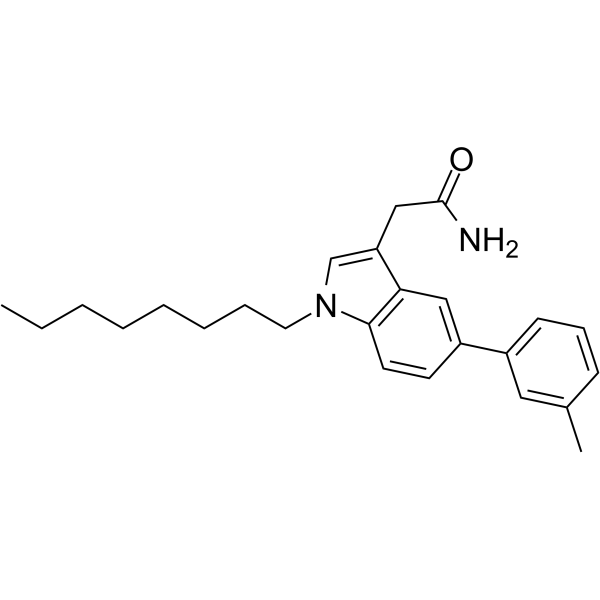
Physicochemical Properties
| Molecular Formula | C25H32N2O |
| Molecular Weight | 376.534386634827 |
| Exact Mass | 376.251 |
| CAS # | 851636-83-4 |
| PubChem CID | 6918831 |
| Appearance | Off-white to light yellow solid powder |
| LogP | 7.154 |
| Hydrogen Bond Donor Count | 1 |
| Hydrogen Bond Acceptor Count | 1 |
| Rotatable Bond Count | 10 |
| Heavy Atom Count | 28 |
| Complexity | 479 |
| Defined Atom Stereocenter Count | 0 |
| InChi Key | QIXBOOVPFRZHQQ-UHFFFAOYSA-N |
| InChi Code | InChI=1S/C25H32N2O/c1-3-4-5-6-7-8-14-27-18-22(17-25(26)28)23-16-21(12-13-24(23)27)20-11-9-10-19(2)15-20/h9-13,15-16,18H,3-8,14,17H2,1-2H3,(H2,26,28) |
| Chemical Name | 2-[5-(3-methylphenyl)-1-octylindol-3-yl]acetamide |
| HS Tariff Code | 2934.99.9001 |
| Storage |
Powder-20°C 3 years 4°C 2 years In solvent -80°C 6 months -20°C 1 month |
| Shipping Condition | Room temperature (This product is stable at ambient temperature for a few days during ordinary shipping and time spent in Customs) |
Biological Activity
| ln Vitro | Icmt+/+ and Icmt-/-/ICMT cells proliferate less when exposed to 15 μM, 20 μM, or 30 μM of cerimethynil for six days, while Icmt-/-cell growth is unaffected [1]. The proliferation of PC3 cells is inhibited by Cysmethynil (20-30 μM; 1-6 days), which also causes a dose- and time-dependent decrease in the quantity of viable PC3 cells[2]. |
| ln Vivo | No detrimental effects on mice body weight have been seen with cyanomethine nitrile (100 mg/kg, 200 mg/kg; intraperitoneal injection; once every 48 hours; 28 days); however, it can dramatically alter tumor growth, resulting in G1 phase cell proliferation and cell death [ 2]. Intraperitoneal injection (three times a week for two weeks, either alone or in conjunction with doxorubicin/paclitaxel) does not cause toxicity to rats and only moderately inhibits tumor development when administered alone or in conjunction with these drugs. greatly increase the therapeutic efficacy and stop the growth of the tumor. In xenograft models, cysmethynil sensitizes the cervix to chemotherapeutic agents [3]. |
| Cell Assay |
Cell Viability Assay Cell Types: PC3 cells [2] Tested Concentrations: 20-30 μM Cysmethynil Incubation Duration: 1-6 days Result 6 days) Inhibits PC3 cell proliferation, resulting in final PC3 numbers Cells diminished in a dose- and time-dependent manner [2]. Experimental Results: Causes a dose- and time-dependent decrease in the number of viable PC3 cells. |
| Animal Protocol |
Animal/Disease Models: 6weeks old SCID (severe combined immunodeficient) mouse, with SiHa cells in the flank of the mice [3] Doses: 20 mg/kg (alone; combined with paclitaxel or doxorubicin) Route of Administration: intraperitoneal (ip) injection; three times a week; 2-week Experimental Results: Tumor size diminished when treated with Cys alone or Cysmethynil+Paclitaxel Cysmethynil+Doxorubicin. Animal/Disease Models: PC3 cell xenograft model SCID (severe combined immunodeficient) mouse [2] Doses: 0.1 mg/g or 0.2 mg/g Cysmethynil Route of Administration: intraperitoneal (ip) injection; once every 48 hrs (hrs (hours)); 28 days Experimental Results: Two doses of cyanomethynil Tumor size diminished during amine treatment. |
| References |
[1]. A small-molecule inhibitor of isoprenylcysteine carboxyl methyltransferase with antitumor activity in cancer cells. Proc Natl Acad Sci U S A. 2005 Mar 22;102(12):4336-41. [2]. A small molecule inhibitor of isoprenylcysteine carboxymethyltransferase induces autophagic cell death in PC3 prostate cancer cells. J Biol Chem. 2008 Jul 4;283(27):18678-84. [3]. Inhibition of isoprenylcysteine carboxylmethyltransferase sensitizes common chemotherapies in cervical cancer via Ras-dependent pathway. Biomed Pharmacother. 2018 Mar;99:169-175. [4]. Targeting KRAS mutant cancers: from druggable therapy to drug resistance. Mol Cancer. 2022 Aug 4;21(1):159. |
Solubility Data
| Solubility (In Vitro) | May dissolve in DMSO (in most cases), if not, try other solvents such as H2O, Ethanol, or DMF with a minute amount of products to avoid loss of samples |
| Solubility (In Vivo) |
Note: Listed below are some common formulations that may be used to formulate products with low water solubility (e.g. < 1 mg/mL), you may test these formulations using a minute amount of products to avoid loss of samples. Injection Formulations (e.g. IP/IV/IM/SC) Injection Formulation 1: DMSO : Tween 80: Saline = 10 : 5 : 85 (i.e. 100 μL DMSO stock solution → 50 μL Tween 80 → 850 μL Saline) *Preparation of saline: Dissolve 0.9 g of sodium chloride in 100 mL ddH ₂ O to obtain a clear solution. Injection Formulation 2: DMSO : PEG300 :Tween 80 : Saline = 10 : 40 : 5 : 45 (i.e. 100 μL DMSO → 400 μLPEG300 → 50 μL Tween 80 → 450 μL Saline) Injection Formulation 3: DMSO : Corn oil = 10 : 90 (i.e. 100 μL DMSO → 900 μL Corn oil) Example: Take the Injection Formulation 3 (DMSO : Corn oil = 10 : 90) as an example, if 1 mL of 2.5 mg/mL working solution is to be prepared, you can take 100 μL 25 mg/mL DMSO stock solution and add to 900 μL corn oil, mix well to obtain a clear or suspension solution (2.5 mg/mL, ready for use in animals). Injection Formulation 4: DMSO : 20% SBE-β-CD in saline = 10 : 90 [i.e. 100 μL DMSO → 900 μL (20% SBE-β-CD in saline)] *Preparation of 20% SBE-β-CD in Saline (4°C,1 week): Dissolve 2 g SBE-β-CD in 10 mL saline to obtain a clear solution. Injection Formulation 5: 2-Hydroxypropyl-β-cyclodextrin : Saline = 50 : 50 (i.e. 500 μL 2-Hydroxypropyl-β-cyclodextrin → 500 μL Saline) Injection Formulation 6: DMSO : PEG300 : castor oil : Saline = 5 : 10 : 20 : 65 (i.e. 50 μL DMSO → 100 μLPEG300 → 200 μL castor oil → 650 μL Saline) Injection Formulation 7: Ethanol : Cremophor : Saline = 10: 10 : 80 (i.e. 100 μL Ethanol → 100 μL Cremophor → 800 μL Saline) Injection Formulation 8: Dissolve in Cremophor/Ethanol (50 : 50), then diluted by Saline Injection Formulation 9: EtOH : Corn oil = 10 : 90 (i.e. 100 μL EtOH → 900 μL Corn oil) Injection Formulation 10: EtOH : PEG300:Tween 80 : Saline = 10 : 40 : 5 : 45 (i.e. 100 μL EtOH → 400 μLPEG300 → 50 μL Tween 80 → 450 μL Saline) Oral Formulations Oral Formulation 1: Suspend in 0.5% CMC Na (carboxymethylcellulose sodium) Oral Formulation 2: Suspend in 0.5% Carboxymethyl cellulose Example: Take the Oral Formulation 1 (Suspend in 0.5% CMC Na) as an example, if 100 mL of 2.5 mg/mL working solution is to be prepared, you can first prepare 0.5% CMC Na solution by measuring 0.5 g CMC Na and dissolve it in 100 mL ddH2O to obtain a clear solution; then add 250 mg of the product to 100 mL 0.5% CMC Na solution, to make the suspension solution (2.5 mg/mL, ready for use in animals). Oral Formulation 3: Dissolved in PEG400 Oral Formulation 4: Suspend in 0.2% Carboxymethyl cellulose Oral Formulation 5: Dissolve in 0.25% Tween 80 and 0.5% Carboxymethyl cellulose Oral Formulation 6: Mixing with food powders Note: Please be aware that the above formulations are for reference only. InvivoChem strongly recommends customers to read literature methods/protocols carefully before determining which formulation you should use for in vivo studies, as different compounds have different solubility properties and have to be formulated differently. (Please use freshly prepared in vivo formulations for optimal results.) |
| Preparing Stock Solutions | 1 mg | 5 mg | 10 mg | |
| 1 mM | 2.6558 mL | 13.2792 mL | 26.5583 mL | |
| 5 mM | 0.5312 mL | 2.6558 mL | 5.3117 mL | |
| 10 mM | 0.2656 mL | 1.3279 mL | 2.6558 mL |