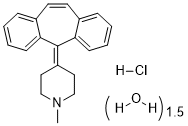
Cyproheptadine HCl hydrate is a hydrochloride salt form of cyproheptadine which is a histamine receptor antagonist. Furthermore, cyproheptadine functions as an antimuscarinic and serotonin reagent. Pituitary-dependent Cushing's syndrome, anorexia, migraine, pruritic dermatoses, and postgastrectomy-dumping syndrome are among the conditions it is used to treat. Cyproheptadine, a 5-HT2A receptor antagonist, has been shown to counteract serotonin-induced platelet aggregation caused by ADP both in vitro and in vivo, indicating that it has antiplatelet and thromboprotective properties.
Physicochemical Properties
| Molecular Formula | C21H21N.HCL.1.5H2O |
| Molecular Weight | 350.0 |
| Exact Mass | 287.17 |
| Elemental Analysis | C, 71.88; H, 7.18; Cl, 10.10; N, 3.99; O, 6.84 |
| CAS # | 41354-29-4 |
| Related CAS # | Cyproheptadine hydrochloride; 969-33-5 |
| PubChem CID | 11954233 |
| Appearance | White to off-white solid powder |
| Boiling Point | 440.1ºC at 760 mmHg |
| Melting Point | 165 °C (dec.)(lit.) |
| Flash Point | 194.5ºC |
| LogP | 5.373 |
| Hydrogen Bond Donor Count | 5 |
| Hydrogen Bond Acceptor Count | 5 |
| Rotatable Bond Count | 0 |
| Heavy Atom Count | 49 |
| Complexity | 423 |
| Defined Atom Stereocenter Count | 0 |
| SMILES | CN1CC/C(CC1)=C2C3=CC=CC=C3C=CC4=CC=CC=C/24.[H]Cl.[1.5H2O] |
| InChi Key | OERTXEVZEWASFH-UHFFFAOYSA-N |
| InChi Code | InChI=1S/C21H21N.ClH.H2O/c1-22-12-10-16(11-13-22)21-15-18-7-3-2-6-17(18)14-19-8-4-5-9-20(19)21;;/h2-9,14-15H,10-13H2,1H3;1H;1H2 |
| Chemical Name | 4-(dibenzo[1,2-a:1',2'-e][7]annulen-11-ylidene)-1-methylpiperidine hydrochloride sesquihydrate |
| Synonyms | Periactin; Eiproheptadine; Cyproheptadine Hydrochloride; Sesquihydrate; Periactinol; Dronactin; Ciproheptadina; Peritol |
| HS Tariff Code | 2934.99.9001 |
| Storage |
Powder-20°C 3 years 4°C 2 years In solvent -80°C 6 months -20°C 1 month Note: Please store this product in a sealed and protected environment, avoid exposure to moisture. |
| Shipping Condition | Room temperature (This product is stable at ambient temperature for a few days during ordinary shipping and time spent in Customs) |
Biological Activity
| Targets | 5-HT2 Receptor |
| References |
[1]. J Anal Toxicol . 1998 Jan-Feb;22(1):72-4. [2]. PLoS One . 2014 Jan 23;9(1):e87026. |
| Additional Infomation |
Cyproheptadine hydrochloride sesquihydrate is the sesquihydrate of cyproheptadine hydrochloride. Note that the drug named cyproheptadine hydrochloride generally refers to cyproheptadine hydrochloride sesquihydrate. A sedating antihistamine with antimuscarinic and calcium-channel blocking actions, it is used for the relief of allergic conditions including rhinitis, conjunctivitis due to inhalant allergens and foods, urticaria and angioedema, and in pruritic skin disorders. Unlike other antihistamines, it is also a seratonin receptor antagonist, making it useful in conditions such as vascular headache and anorexia. It has a role as a serotonergic antagonist, an antipruritic drug, an anti-allergic agent, a gastrointestinal drug and a H1-receptor antagonist. It contains a cyproheptadine hydrochloride (anhydrous). Cyproheptadine Hydrochloride is the hydrochloride salt of a synthetic methyl-piperidine derivative with antihistaminic and anti-serotoninergic properties. Cyproheptadine competes with free histamine (HA) for binding at HA-receptor sites, thereby competitively antagonizing histamine stimulation of HA-receptors in the gastrointestinal tract, large blood vessels, and bronchial smooth muscle. This agent also competes with free serotonin for binding at serotonin receptor sites. Cyproheptadine exhibits anticholinergic and sedative properties and has been shown to stimulate appetite and weight gain. (NCI04) A serotonin antagonist and a histamine H1 blocker used as antipruritic, appetite stimulant, antiallergic, and for the post-gastrectomy dumping syndrome, etc. See also: Cyproheptadine Hydrochloride (annotation moved to). |
Solubility Data
| Solubility (In Vitro) |
DMSO: ~33.3 mg/mL (~95 mM) H2O: ~0.67 mg/mL (~1.9 mM) |
| Solubility (In Vivo) |
Solubility in Formulation 1: ≥ 3 mg/mL (8.55 mM) (saturation unknown) in 10% DMSO + 40% PEG300 + 5% Tween80 + 45% Saline (add these co-solvents sequentially from left to right, and one by one), clear solution. For example, if 1 mL of working solution is to be prepared, you can add 100 μL of 30.0 mg/mL clear DMSO stock solution to 400 μL PEG300 and mix evenly; then add 50 μL Tween-80 to the above solution and mix evenly; then add 450 μL normal saline to adjust the volume to 1 mL. Preparation of saline: Dissolve 0.9 g of sodium chloride in 100 mL ddH₂ O to obtain a clear solution. Solubility in Formulation 2: ≥ 3 mg/mL (8.55 mM) (saturation unknown) in 10% DMSO + 90% (20% SBE-β-CD in Saline) (add these co-solvents sequentially from left to right, and one by one), clear solution. For example, if 1 mL of working solution is to be prepared, you can add 100 μL of 30.0 mg/mL clear DMSO stock solution to 900 μL of 20% SBE-β-CD physiological saline solution and mix evenly. Preparation of 20% SBE-β-CD in Saline (4°C,1 week): Dissolve 2 g SBE-β-CD in 10 mL saline to obtain a clear solution. Solubility in Formulation 3: ≥ 3 mg/mL (8.55 mM) (saturation unknown) in 10% DMSO + 90% Corn Oil (add these co-solvents sequentially from left to right, and one by one), clear solution. For example, if 1 mL of working solution is to be prepared, you can add 100 μL of 30.0 mg/mL clear DMSO stock solution to 900 μL of corn oil and mix evenly. (Please use freshly prepared in vivo formulations for optimal results.) |
| Preparing Stock Solutions | 1 mg | 5 mg | 10 mg | |
| 1 mM | 2.8571 mL | 14.2857 mL | 28.5714 mL | |
| 5 mM | 0.5714 mL | 2.8571 mL | 5.7143 mL | |
| 10 mM | 0.2857 mL | 1.4286 mL | 2.8571 mL |