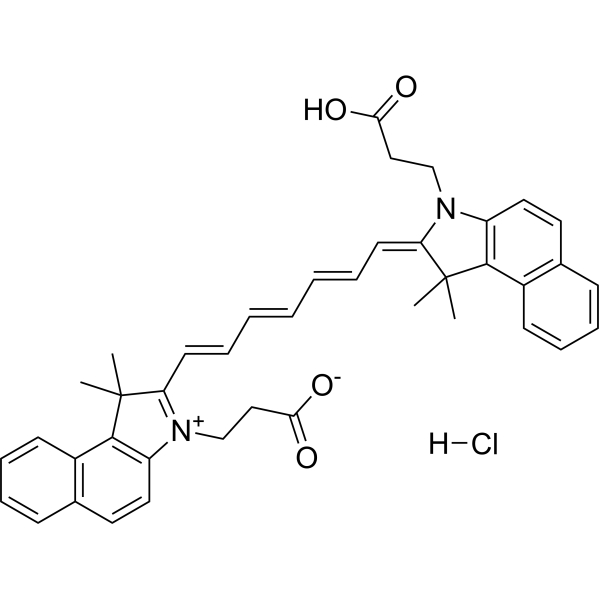
Physicochemical Properties
| Molecular Formula | C41H41CLN2O4 |
| Molecular Weight | 661.23 |
| Related CAS # | Cypate;95837-47-1 |
| Appearance | Green to dark green solid powder |
| HS Tariff Code | 2934.99.9001 |
| Storage |
Powder-20°C 3 years 4°C 2 years In solvent -80°C 6 months -20°C 1 month Note: Please store this product in a sealed and protected environment, avoid exposure to moisture. |
| Shipping Condition | Room temperature (This product is stable at ambient temperature for a few days during ordinary shipping and time spent in Customs) |
Biological Activity
| ln Vitro | According to the study, Cypate coupled upconversion nanoparticles (UCNP-cy) loaded with anti-heat shock protein 70 small interfering RNA genes (UCNP-cy-siRNA) can cause targeted cellular damage and have anti-tumor properties [1]. In order to track, label, and photograph particular biomolecules or cells, Cypate can also be connected to CBT (Cysteine-containing Peptide Backbone Tag). For instance, cathepsin B (CTSB) activity can be specifically seen and tracked in real time in tumors and cells that overexpress CTSB using Cypate-CBT, a near-infrared photoacoustic (PA) probe. Cypate-CBT increases the strength and duration of the PA signal at the tumor site by entering CTSB-overexpressing cells, where it is then subjected to glutathione reduction and CTSB cleavage to produce cypate nanoparticles, or Cypate-CBT-NPs. For the clinical diagnosis of early cancer, cipate-CBT has the potential to be a useful PA imaging agent [2]. |
| References |
[1]. Cypate-conjugated porous upconversion nanocomposites for programmed delivery of heat shock protein 70 small interfering RNA for gene silencing and photothermal ablation. Advanced Functional Materials, 2016, 26(20): 3480-3489. [2]. Cathespin B-Initiated Cypate Nanoparticle Formation for Tumor Photoacoustic Imaging. Angew Chem Int Ed Engl. 2022 Jan 26;61(5):e202114766. |
Solubility Data
| Solubility (In Vitro) |
DMSO :~12.5 mg/mL (~18.90 mM) H2O :< 0.1 mg/mL |
| Solubility (In Vivo) |
Solubility in Formulation 1: ≥ 1.25 mg/mL (1.89 mM) (saturation unknown) in 10% DMSO + 40% PEG300 + 5% Tween80 + 45% Saline (add these co-solvents sequentially from left to right, and one by one), clear solution. For example, if 1 mL of working solution is to be prepared, you can add 100 μL of 12.5 mg/mL clear DMSO stock solution to 400 μL PEG300 and mix evenly; then add 50 μL Tween-80 to the above solution and mix evenly; then add 450 μL normal saline to adjust the volume to 1 mL. Preparation of saline: Dissolve 0.9 g of sodium chloride in 100 mL ddH₂ O to obtain a clear solution. Solubility in Formulation 2: 1.25 mg/mL (1.89 mM) in 10% DMSO + 90% (20% SBE-β-CD in Saline) (add these co-solvents sequentially from left to right, and one by one), suspension solution; with ultrasonication. For example, if 1 mL of working solution is to be prepared, you can add 100 μL of 12.5 mg/mL clear DMSO stock solution to 900 μL of 20% SBE-β-CD physiological saline solution and mix evenly. Preparation of 20% SBE-β-CD in Saline (4°C,1 week): Dissolve 2 g SBE-β-CD in 10 mL saline to obtain a clear solution. (Please use freshly prepared in vivo formulations for optimal results.) |
| Preparing Stock Solutions | 1 mg | 5 mg | 10 mg | |
| 1 mM | 1.5123 mL | 7.5617 mL | 15.1233 mL | |
| 5 mM | 0.3025 mL | 1.5123 mL | 3.0247 mL | |
| 10 mM | 0.1512 mL | 0.7562 mL | 1.5123 mL |