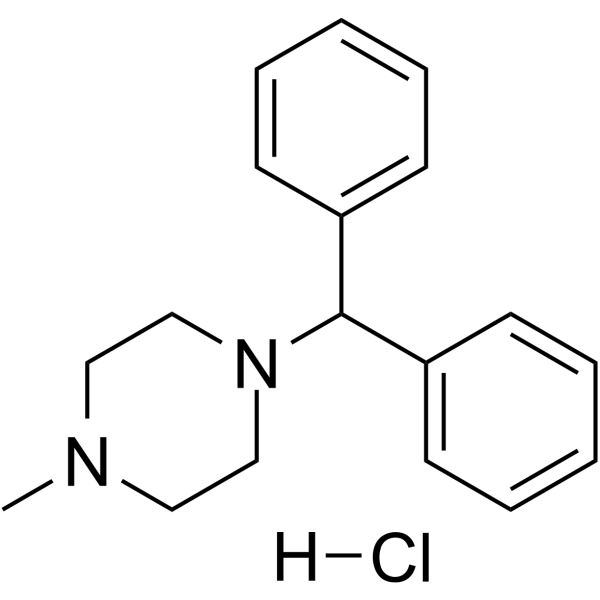
Physicochemical Properties
| Molecular Formula | C18H23CLN2 |
| Molecular Weight | 302.84 |
| Exact Mass | 302.155 |
| CAS # | 303-25-3 |
| Related CAS # | Cyclizine;82-92-8;Cyclizine dihydrochloride;5897-18-7;Cyclizine lactate;5897-19-8 |
| PubChem CID | 6726 |
| Appearance |
CRYSTALS FROM PETROLEUM ETHER WHITE OR CREAMY WHITE CRYSTALLINE POWDER |
| Boiling Point | 363.7ºC at 760mmHg |
| Melting Point | 258-260ºC |
| Flash Point | 159.1ºC |
| LogP | 3.701 |
| Hydrogen Bond Donor Count | 0 |
| Hydrogen Bond Acceptor Count | 2 |
| Rotatable Bond Count | 3 |
| Heavy Atom Count | 20 |
| Complexity | 253 |
| Defined Atom Stereocenter Count | 0 |
| SMILES | Cl.CN1CCN(C(C2C=CC=CC=2)C2C=CC=CC=2)CC1 |
| InChi Key | UVKZSORBKUEBAZ-UHFFFAOYSA-N |
| InChi Code | InChI=1S/C18H22N2/c1-19-12-14-20(15-13-19)18(16-8-4-2-5-9-16)17-10-6-3-7-11-17/h2-11,18H,12-15H2,1H3 |
| Chemical Name | 1-benzhydryl-4-methylpiperazine |
| HS Tariff Code | 2934.99.9001 |
| Storage |
Powder-20°C 3 years 4°C 2 years In solvent -80°C 6 months -20°C 1 month |
| Shipping Condition | Room temperature (This product is stable at ambient temperature for a few days during ordinary shipping and time spent in Customs) |
Biological Activity
| Targets | H1 Receptor |
| ln Vitro | Cyclizine hydrochloride (100 μM) greatly reduces the levels of iNOS protein and nitrite buildup in the supernatants of LPS-stimulated RAW 264.7 cells[1]. With an IC50 of 5.42 µM, cyclidine hydrochloride suppresses the release of histamine from isolated human lung segments produced by anti-IgE [2]. |
| ln Vivo | Mice's locomotor activity is enhanced by cyclizine hydrochloride (1–10 mg/kg) in a dose-dependent manner[3]. |
| ADME/Pharmacokinetics |
Absorption, Distribution and Excretion BENZHYDROLPIPERAZINES & THEIR N-DEALKYLATION PRODUCTS ARE DISTRIBUTED IN ALL TISSUES OF RAT & ARE TRANSFERRED TO FETUS. /BENZYHYDROLPIPERAZINES/ Metabolism / Metabolites Cyclizine is metabolised to its N-demethylated derivative, norcyclizine, which has little antihistaminic (H1) activity compared to Cyclizine. OXIDATIVE N-DEALKYLATION IS MAIN METABOLIC PATHWAY OF BENZHYDROLPIPERAZINES; CYCLIZINE.../IS/ TRANSFORMED INTO NORCYCLIZINE... WITH A PURIFIED MIXED FUNCTION OXIDASE FROM LIVER MICROSOMES IN PRESENCE OF REDUCED PYRIDINE NUCLEOTIDE & O2.../CYCLIZINE IS/ OXIDIZED TO N-OXIDE. Biological Half-Life 20 hours |
| Toxicity/Toxicokinetics |
Effects During Pregnancy and Lactation ◉ Summary of Use during Lactation Occasional doses of cyclizine are probably acceptable during breastfeeding. Large doses or more prolonged use may cause effects in the infant or decrease the milk supply, particularly in combination with a sympathomimetic such as pseudoephedrine or before lactation is well established. ◉ Effects in Breastfed Infants Relevant published information on cyclizine was not found as of the revision date. In one telephone follow-up study, mothers reported irritability and colicky symptoms 10% of infants exposed to various antihistamines and drowsiness was reported in 1.6% of infants. None of the reactions required medical attention and none of the infants were exposed to cyclizine. ◉ Effects on Lactation and Breastmilk Antihistamines in relatively high doses given by injection can decrease basal serum prolactin in nonlactating women and in early postpartum women. However, suckling-induced prolactin secretion is not affected by antihistamine pretreatment of postpartum mothers. Whether lower oral doses of antihistamines have the same effect on serum prolactin or whether the effects on prolactin have any consequences on breastfeeding success have not been studied. The prolactin level in a mother with established lactation may not affect her ability to breastfeed. Interactions COMBINATIONS OF CAFFEINE 100 MG WITH CYCLIZINE-HCL 50 & 100 MG DID NOT PRODUCE ANY SUBJECTIVE CHANGES OR CHANGES IN PERFORMANCE TESTS, DIFFERING FROM CONTROL. |
| References |
[1]. The effects of H1-antihistamines on the nitric oxide production by RAW 264.7 cells with respect to their lipophilicity. Int Immunopharmacol. 2009 Jul;9(7-8):990-5. [2]. Inhibition of histamine release from human lung in vitro by antihistamines and related drugs. Br J Pharmacol. 1980 Aug;69(4):663-7. [3]. Effects of antihistaminics on locomotor activity in mice. Comparison with opiate and amphetamine-induced hyperactivity. Gen Pharmacol. 1991;22(2):293-6. |
| Additional Infomation |
Cyclizine is an N-alkylpiperazine in which one nitrogen of the piperazine ring is substituted by a methyl group, while the other is substituted by a diphenylmethyl group. It has a role as an antiemetic, a cholinergic antagonist, a central nervous system depressant, a local anaesthetic and a H1-receptor antagonist. A histamine H1 antagonist given by mouth or parenterally for the control of postoperative and drug-induced vomiting and in motion sickness. (From Martindale, The Extra Pharmacopoeia, 30th ed, p935) A histamine H1 antagonist given by mouth or parenterally for the control of postoperative and drug-induced vomiting and in motion sickness. (From Martindale, The Extra Pharmacopoeia, 30th ed, p935) Drug Indication For prevention and treatment of nausea, vomiting, and dizziness associated with motion sickness, and vertigo (dizziness caused by other medical problems). Mechanism of Action Vomiting (emesis) is essentially a protective mechanism for removing irritant or otherwise harmful substances from the upper GI tract. Emesis or vomiting is controlled by the vomiting centre in the medulla region of the brain, an important part of which is the chemotrigger zone (CTZ). The vomiting centre possesses neurons which are rich in muscarinic cholinergic and histamine containing synapses. These types of neurons are especially involved in transmission from the vestibular apparatus to the vomiting centre. Motion sickness principally involves overstimulation of these pathways due to various sensory stimuli. Hence the action of cyclizine which acts to block the histamine receptors in the vomiting centre and thus reduce activity along these pathways. Furthermore since cyclizine possesses anti-cholinergic properties as well, the muscarinic receptors are similarly blocked. .../IT SEEMS/ THAT STIMULATION OF VESTIBULAR APPARATUS IS NECESSARY & SUFFICIENT...& THAT VESTIBULAR CEREBELLAR MIDBRAIN "INTEGRATIVE VOMITING CENTER" & MEDULLARY CHEMORECEPTIVE TRIGGER ZONE ARE...INVOLVED /IN MOTION SICKNESS/. IT IS...PROBABLE THAT EFFECTIVE ANTIHISTAMINES EXERT.../ACTION/ IN THESE CENTERS. /ANTIHISTAMINE/ Therapeutic Uses Antiemetics; Histamine H1 Antagonists ANTIHISTAMINE USED AS HYDROCHLORIDE & LACTATE IN PREVENTION & TREATMENT OF MOTION SICKNESS (NAUSEA, VOMITING & VERTIGO). IT IS ALSO PROBABLY EFFECTIVE FOR CONTROL OF POSTOPERATIVE NAUSEA & VOMITING. DURATION OF ACTION IS ABOUT 4 HR. ...LARGE SCALE STUDY, INCL PREGNANT WOMEN RECEIVING CYCLIZINE DURING 1ST TRIMESTER, FAILED TO CONFIRM THAT DRUG HAD ANY TERATOGENIC EFFECT IN MAN WITH DOSES EMPLOYED. For more Therapeutic Uses (Complete) data for CYCLIZINE (7 total), please visit the HSDB record page. Drug Warnings .../DO NOT/ EXCEED 4 TABLETS/DAY. /HYDROCHLORIDE/ .../IT/ SHOULD NOT BE USED IN WOMEN DURING PREGNANCY & THOSE LIKELY TO BECOME PREGNANT UNLESS SPECIFICALLY DIRECTED BY PHYSICIAN. IN 1965 AN AD HOC COMMITTEE OF US FDA CONCLUDED THAT EVIDENCE OF TERATOGENIC EFFECTS IN HUMAN...WAS NOT SIGNIFICANT, BUT IT MADE NO SPECIFIC MENTION OF EYES. ...OFFSPRING OF PROBABLY SEVERAL THOUSAND WOMEN WHO HAD RECEIVED APPROX 150 MG CYCLIZINE/DAY DURING PREGNANCY...HAD A VARIETY OF NONOCULAR ABNORMALITIES, BUT STATISTICAL SIGNIFICANCE IN RELATION TO CYCLIZINE WAS UNCERTAIN. For more Drug Warnings (Complete) data for CYCLIZINE (8 total), please visit the HSDB record page. Pharmacodynamics Cyclizine is a piperazine-derivative antihistamine used as an antivertigo/antiemetic agent. Cyclizine is used in the prevention and treatment of nausea, vomiting, and dizziness associated with motion sickness. Additionally, it has been used in the management of vertigo in diseases affecting the vestibular apparatus. Although the mechanism by which cyclizine exerts its antiemetic and antivertigo effects has not been fully elucidated, its central anticholinergic properties are partially responsible. The drug depresses labyrinth excitability and vestibular stimulation, and it may affect the medullary chemoreceptor trigger zone. It also possesses anticholinergic, antihistaminic, central nervous system depressant, and local anesthetic effects. |
Solubility Data
| Solubility (In Vitro) | May dissolve in DMSO (in most cases), if not, try other solvents such as H2O, Ethanol, or DMF with a minute amount of products to avoid loss of samples |
| Solubility (In Vivo) |
Note: Listed below are some common formulations that may be used to formulate products with low water solubility (e.g. < 1 mg/mL), you may test these formulations using a minute amount of products to avoid loss of samples. Injection Formulations (e.g. IP/IV/IM/SC) Injection Formulation 1: DMSO : Tween 80: Saline = 10 : 5 : 85 (i.e. 100 μL DMSO stock solution → 50 μL Tween 80 → 850 μL Saline) *Preparation of saline: Dissolve 0.9 g of sodium chloride in 100 mL ddH ₂ O to obtain a clear solution. Injection Formulation 2: DMSO : PEG300 :Tween 80 : Saline = 10 : 40 : 5 : 45 (i.e. 100 μL DMSO → 400 μLPEG300 → 50 μL Tween 80 → 450 μL Saline) Injection Formulation 3: DMSO : Corn oil = 10 : 90 (i.e. 100 μL DMSO → 900 μL Corn oil) Example: Take the Injection Formulation 3 (DMSO : Corn oil = 10 : 90) as an example, if 1 mL of 2.5 mg/mL working solution is to be prepared, you can take 100 μL 25 mg/mL DMSO stock solution and add to 900 μL corn oil, mix well to obtain a clear or suspension solution (2.5 mg/mL, ready for use in animals). Injection Formulation 4: DMSO : 20% SBE-β-CD in saline = 10 : 90 [i.e. 100 μL DMSO → 900 μL (20% SBE-β-CD in saline)] *Preparation of 20% SBE-β-CD in Saline (4°C,1 week): Dissolve 2 g SBE-β-CD in 10 mL saline to obtain a clear solution. Injection Formulation 5: 2-Hydroxypropyl-β-cyclodextrin : Saline = 50 : 50 (i.e. 500 μL 2-Hydroxypropyl-β-cyclodextrin → 500 μL Saline) Injection Formulation 6: DMSO : PEG300 : castor oil : Saline = 5 : 10 : 20 : 65 (i.e. 50 μL DMSO → 100 μLPEG300 → 200 μL castor oil → 650 μL Saline) Injection Formulation 7: Ethanol : Cremophor : Saline = 10: 10 : 80 (i.e. 100 μL Ethanol → 100 μL Cremophor → 800 μL Saline) Injection Formulation 8: Dissolve in Cremophor/Ethanol (50 : 50), then diluted by Saline Injection Formulation 9: EtOH : Corn oil = 10 : 90 (i.e. 100 μL EtOH → 900 μL Corn oil) Injection Formulation 10: EtOH : PEG300:Tween 80 : Saline = 10 : 40 : 5 : 45 (i.e. 100 μL EtOH → 400 μLPEG300 → 50 μL Tween 80 → 450 μL Saline) Oral Formulations Oral Formulation 1: Suspend in 0.5% CMC Na (carboxymethylcellulose sodium) Oral Formulation 2: Suspend in 0.5% Carboxymethyl cellulose Example: Take the Oral Formulation 1 (Suspend in 0.5% CMC Na) as an example, if 100 mL of 2.5 mg/mL working solution is to be prepared, you can first prepare 0.5% CMC Na solution by measuring 0.5 g CMC Na and dissolve it in 100 mL ddH2O to obtain a clear solution; then add 250 mg of the product to 100 mL 0.5% CMC Na solution, to make the suspension solution (2.5 mg/mL, ready for use in animals). Oral Formulation 3: Dissolved in PEG400 Oral Formulation 4: Suspend in 0.2% Carboxymethyl cellulose Oral Formulation 5: Dissolve in 0.25% Tween 80 and 0.5% Carboxymethyl cellulose Oral Formulation 6: Mixing with food powders Note: Please be aware that the above formulations are for reference only. InvivoChem strongly recommends customers to read literature methods/protocols carefully before determining which formulation you should use for in vivo studies, as different compounds have different solubility properties and have to be formulated differently. (Please use freshly prepared in vivo formulations for optimal results.) |
| Preparing Stock Solutions | 1 mg | 5 mg | 10 mg | |
| 1 mM | 3.3021 mL | 16.5104 mL | 33.0207 mL | |
| 5 mM | 0.6604 mL | 3.3021 mL | 6.6041 mL | |
| 10 mM | 0.3302 mL | 1.6510 mL | 3.3021 mL |