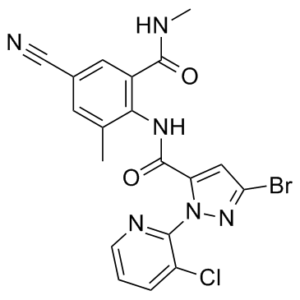
Cyantraniliprole (also known as HGW-86), an anthranilic diamide analog, is a novel and potent second-generation insecticide which is able to deter insect feeding and reduce disease transmission. Cyantraniliprol is a valuable tool for managing Frankliniella occidentalis (Pergande) and also is as effective as abamectin in deterring potato psyllid feeding and could significantly reduce transmission of Lso and the spread of ZC. Cyantraniliprole is approved for use in the United States, Canada, China, and India. Because of its uncommon mechanism of action as a ryanoid, it has activity against pests such as Diaphorina citri that have developed resistance to other classes insecticides. Cyantraniliprole is highly toxic to bees, which resulted in registration of its use as a pesticide being delayed in the USA.
Physicochemical Properties
| Molecular Formula | C19H14BRCLN6O2 | |
| Molecular Weight | 473.71 | |
| Exact Mass | 472.005 | |
| CAS # | 736994-63-1 | |
| Related CAS # | Cyantraniliprole-d3;1392493-34-3 | |
| PubChem CID | 11578610 | |
| Appearance | White to off-white solid powder | |
| Density | 1.612g/cm3 | |
| Boiling Point | 561.256ºC at 760 mmHg | |
| Flash Point | 293.237ºC | |
| Index of Refraction | 1.704 | |
| LogP | 4.433 | |
| Hydrogen Bond Donor Count | 2 | |
| Hydrogen Bond Acceptor Count | 5 | |
| Rotatable Bond Count | 4 | |
| Heavy Atom Count | 29 | |
| Complexity | 672 | |
| Defined Atom Stereocenter Count | 0 | |
| SMILES | O=C(C1=CC(Br)=NN1C2=NC=CC=C2Cl)NC3=C(C(NC)=O)C=C(C#N)C=C3C |
|
| InChi Key | DVBUIBGJRQBEDP-UHFFFAOYSA-N | |
| InChi Code | InChI=1S/C19H14BrClN6O2/c1-10-6-11(9-22)7-12(18(28)23-2)16(10)25-19(29)14-8-15(20)26-27(14)17-13(21)4-3-5-24-17/h3-8H,1-2H3,(H,23,28)(H,25,29) | |
| Chemical Name | 5-bromo-2-(3-chloropyridin-2-yl)-N-[4-cyano-2-methyl-6-(methylcarbamoyl)phenyl]pyrazole-3-carboxamide | |
| Synonyms |
|
|
| HS Tariff Code | 2934.99.9001 | |
| Storage |
Powder-20°C 3 years 4°C 2 years In solvent -80°C 6 months -20°C 1 month |
|
| Shipping Condition | Room temperature (This product is stable at ambient temperature for a few days during ordinary shipping and time spent in Customs) |
Biological Activity
| ln Vitro |
|
||
| ln Vivo |
|
||
| Animal Protocol |
|
||
| References | Pest Manag Sci.2013 Sep;69(9):1066-72. | ||
| Additional Infomation | Cyantraniliprole is a carboxamide that is chlorantraniliprole in which the chlorine atom attached to the phenyl ring has been replaced by a cyano group. A ryanodine receptor agonist, it is used as insecticide for the control of whitefly, thrips, aphids, fruitflies, and fruit worms in crops such as onions, potatoes and tomatoes. It is highly toxic to honeybees. It has a role as a ryanodine receptor agonist. It is a pyrazole insecticide, a nitrile, an organochlorine compound, an organobromine compound, a member of pyridines and a secondary carboxamide. |
Solubility Data
| Solubility (In Vitro) |
|
|||
| Solubility (In Vivo) |
Solubility in Formulation 1: ≥ 2.5 mg/mL (5.28 mM) (saturation unknown) in 10% DMSO + 40% PEG300 + 5% Tween80 + 45% Saline (add these co-solvents sequentially from left to right, and one by one), clear solution. For example, if 1 mL of working solution is to be prepared, you can add 100 μL of 25.0 mg/mL clear DMSO stock solution to 400 μL PEG300 and mix evenly; then add 50 μL Tween-80 to the above solution and mix evenly; then add 450 μL normal saline to adjust the volume to 1 mL. Preparation of saline: Dissolve 0.9 g of sodium chloride in 100 mL ddH₂ O to obtain a clear solution. Solubility in Formulation 2: ≥ 2.5 mg/mL (5.28 mM) (saturation unknown) in 10% DMSO + 90% Corn Oil (add these co-solvents sequentially from left to right, and one by one), clear solution. For example, if 1 mL of working solution is to be prepared, you can add 100 μL of 25.0 mg/mL clear DMSO stock solution to 900 μL of corn oil and mix evenly. (Please use freshly prepared in vivo formulations for optimal results.) |
| Preparing Stock Solutions | 1 mg | 5 mg | 10 mg | |
| 1 mM | 2.1110 mL | 10.5550 mL | 21.1100 mL | |
| 5 mM | 0.4222 mL | 2.1110 mL | 4.2220 mL | |
| 10 mM | 0.2111 mL | 1.0555 mL | 2.1110 mL |