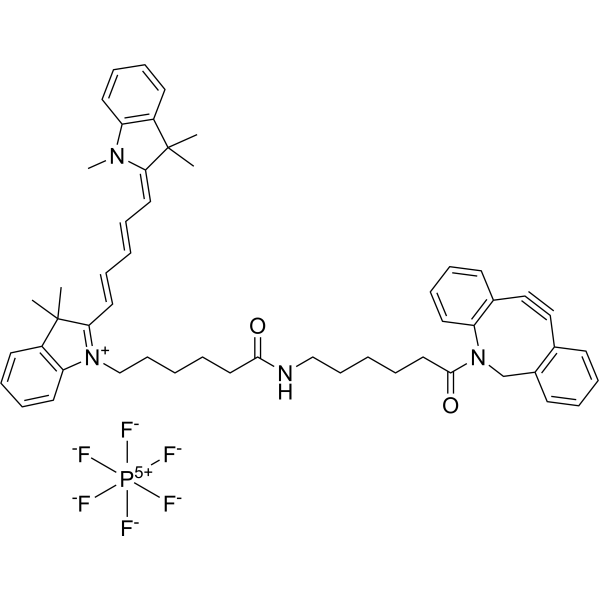
Physicochemical Properties
| Molecular Formula | C53H59F6N4O2P |
| Molecular Weight | 929.05 |
| Exact Mass | 928.427 |
| CAS # | 2360411-64-7 |
| PubChem CID | 164577372 |
| Appearance | Dark purple to black solid powder |
| Hydrogen Bond Donor Count | 1 |
| Hydrogen Bond Acceptor Count | 10 |
| Rotatable Bond Count | 15 |
| Heavy Atom Count | 66 |
| Complexity | 1720 |
| Defined Atom Stereocenter Count | 0 |
| SMILES | [P+5]([F-])([F-])([F-])([F-])([F-])[F-].C([N+]1=C(C(C)(C)C2=CC=CC=C12)C=CC=CC=C1N(C2=CC=CC=C2C1(C)C)C)CCCCC(=O)NCCCCCC(N1CC2=CC=CC=C2C#CC2=CC=CC=C12)=O |
| InChi Key | YPXNDZYXPDFNEL-UHFFFAOYSA-O |
| InChi Code | InChI=1S/C53H58N4O2.F6P/c1-52(2)43-26-16-19-29-46(43)55(5)48(52)31-9-6-10-32-49-53(3,4)44-27-17-20-30-47(44)56(49)38-22-8-11-33-50(58)54-37-21-7-12-34-51(59)57-39-42-25-14-13-23-40(42)35-36-41-24-15-18-28-45(41)57;1-7(2,3,4,5)6/h6,9-10,13-20,23-32H,7-8,11-12,21-22,33-34,37-39H2,1-5H3;/q;-1/p+1 |
| Chemical Name | N-[6-(2-azatricyclo[10.4.0.04,9]hexadeca-1(16),4,6,8,12,14-hexaen-10-yn-2-yl)-6-oxohexyl]-6-[3,3-dimethyl-2-[5-(1,3,3-trimethylindol-1-ium-2-yl)penta-2,4-dienylidene]indol-1-yl]hexanamide;hexafluorophosphate |
| HS Tariff Code | 2934.99.9001 |
| Storage |
Powder-20°C 3 years 4°C 2 years In solvent -80°C 6 months -20°C 1 month Note: (1). This product requires protection from light (avoid light exposure) during transportation and storage.(2). Please store this product in a sealed and protected environment (e.g. under nitrogen), avoid exposure to moisture. |
| Shipping Condition | Room temperature (This product is stable at ambient temperature for a few days during ordinary shipping and time spent in Customs) |
Biological Activity
| ln Vitro | Advice (These are our suggested choices; please note that this is merely a guide and should be adjusted to meet your own requirements). Labeling of cells (such as A549 cells) [5][2]: 1. 2. Transfer 2 milliliters of mature seed cells at a density of 3 x 10⁴ (cell-to-cell) into a 35 mm glass-bottomed dish. For three days in a row, add Ac4ManNAz (final concentration of 50 μM) to create azide groups on the cell surface. 3. 4. Use Cyanine5 DBCO (20 μM, final concentration) and wash the cells with DPBS for one hour at 37°C. 5. After rinsing the cells in DPBS (pH 7.4), fix them at 25°C using a mixed formaldehyde-glutaraldehyde fixative. 6. DPBS Stain cells twice (to a pH of 7.4) and mark nuclei with DAPI. 7. Measure the Cyanine5 DBCO fluorophore (Ex=635 nm, Em=650-700 nm) using confocal laser scanning microscopy. Note: 1) Cyanine5 DBCO can inhibit the artificially introduced azide groups on the cell surface for longer than three days when utilizing Ac4ManNAz After treatment. 2) The amount of Cyanine5 DBCO labeling. |
| ln Vivo | Advice (These are our suggested choices; please note that this is merely a guide and can be altered to meet your individual requirements). Tracking cells in vivo[1][2]: 1. Count seeded cells at a density of 3×10⁴ (varies per cell) in a 35 mm glass-bottomed culture dish with 2 mL of growth medium. 2. For three days, add Ac4ManNAz (final concentration of 50 μM) to create azide groups on the cell surface. 3. Use DPBS 4 to wash. After giving the mice anesthesia, inject the cells into the liver's left lobe following treatment with Ac4ManNAz. 5. Put a 200 μL injection of Cyanine5 DBCO (25 μM) into the tail vein that the imaging system identified. |
| References |
[1]. Cell labeling and tracking method without distorted signals by phagocytosis of macrophages. Theranostics. 2014 Feb 12;4(4):420-31. [2]. Coupling Aptamer-based Protein Tagging with Metabolic Glycan Labeling for In Situ Visualization and Biological Function Study of Exosomal Protein-Specific Glycosylation. Angew Chem Int Ed Engl. 2021 Aug 9;60(33):18111-18115. [3]. In Situ One-Step Fluorescence Labeling Strategy of Exosomes via Bioorthogonal Click Chemistry for Real-Time Exosome Tracking In Vitro and In Vivo. Bioconjug Chem. 2020 May 20;31(5):1562-1574. |
Solubility Data
| Solubility (In Vitro) | DMSO : ~125 mg/mL (~134.55 mM) |
| Solubility (In Vivo) |
Note: Listed below are some common formulations that may be used to formulate products with low water solubility (e.g. < 1 mg/mL), you may test these formulations using a minute amount of products to avoid loss of samples. Injection Formulations (e.g. IP/IV/IM/SC) Injection Formulation 1: DMSO : Tween 80: Saline = 10 : 5 : 85 (i.e. 100 μL DMSO stock solution → 50 μL Tween 80 → 850 μL Saline) *Preparation of saline: Dissolve 0.9 g of sodium chloride in 100 mL ddH ₂ O to obtain a clear solution. Injection Formulation 2: DMSO : PEG300 :Tween 80 : Saline = 10 : 40 : 5 : 45 (i.e. 100 μL DMSO → 400 μLPEG300 → 50 μL Tween 80 → 450 μL Saline) Injection Formulation 3: DMSO : Corn oil = 10 : 90 (i.e. 100 μL DMSO → 900 μL Corn oil) Example: Take the Injection Formulation 3 (DMSO : Corn oil = 10 : 90) as an example, if 1 mL of 2.5 mg/mL working solution is to be prepared, you can take 100 μL 25 mg/mL DMSO stock solution and add to 900 μL corn oil, mix well to obtain a clear or suspension solution (2.5 mg/mL, ready for use in animals). Injection Formulation 4: DMSO : 20% SBE-β-CD in saline = 10 : 90 [i.e. 100 μL DMSO → 900 μL (20% SBE-β-CD in saline)] *Preparation of 20% SBE-β-CD in Saline (4°C,1 week): Dissolve 2 g SBE-β-CD in 10 mL saline to obtain a clear solution. Injection Formulation 5: 2-Hydroxypropyl-β-cyclodextrin : Saline = 50 : 50 (i.e. 500 μL 2-Hydroxypropyl-β-cyclodextrin → 500 μL Saline) Injection Formulation 6: DMSO : PEG300 : castor oil : Saline = 5 : 10 : 20 : 65 (i.e. 50 μL DMSO → 100 μLPEG300 → 200 μL castor oil → 650 μL Saline) Injection Formulation 7: Ethanol : Cremophor : Saline = 10: 10 : 80 (i.e. 100 μL Ethanol → 100 μL Cremophor → 800 μL Saline) Injection Formulation 8: Dissolve in Cremophor/Ethanol (50 : 50), then diluted by Saline Injection Formulation 9: EtOH : Corn oil = 10 : 90 (i.e. 100 μL EtOH → 900 μL Corn oil) Injection Formulation 10: EtOH : PEG300:Tween 80 : Saline = 10 : 40 : 5 : 45 (i.e. 100 μL EtOH → 400 μLPEG300 → 50 μL Tween 80 → 450 μL Saline) Oral Formulations Oral Formulation 1: Suspend in 0.5% CMC Na (carboxymethylcellulose sodium) Oral Formulation 2: Suspend in 0.5% Carboxymethyl cellulose Example: Take the Oral Formulation 1 (Suspend in 0.5% CMC Na) as an example, if 100 mL of 2.5 mg/mL working solution is to be prepared, you can first prepare 0.5% CMC Na solution by measuring 0.5 g CMC Na and dissolve it in 100 mL ddH2O to obtain a clear solution; then add 250 mg of the product to 100 mL 0.5% CMC Na solution, to make the suspension solution (2.5 mg/mL, ready for use in animals). Oral Formulation 3: Dissolved in PEG400 Oral Formulation 4: Suspend in 0.2% Carboxymethyl cellulose Oral Formulation 5: Dissolve in 0.25% Tween 80 and 0.5% Carboxymethyl cellulose Oral Formulation 6: Mixing with food powders Note: Please be aware that the above formulations are for reference only. InvivoChem strongly recommends customers to read literature methods/protocols carefully before determining which formulation you should use for in vivo studies, as different compounds have different solubility properties and have to be formulated differently. (Please use freshly prepared in vivo formulations for optimal results.) |
| Preparing Stock Solutions | 1 mg | 5 mg | 10 mg | |
| 1 mM | 1.0764 mL | 5.3818 mL | 10.7637 mL | |
| 5 mM | 0.2153 mL | 1.0764 mL | 2.1527 mL | |
| 10 mM | 0.1076 mL | 0.5382 mL | 1.0764 mL |