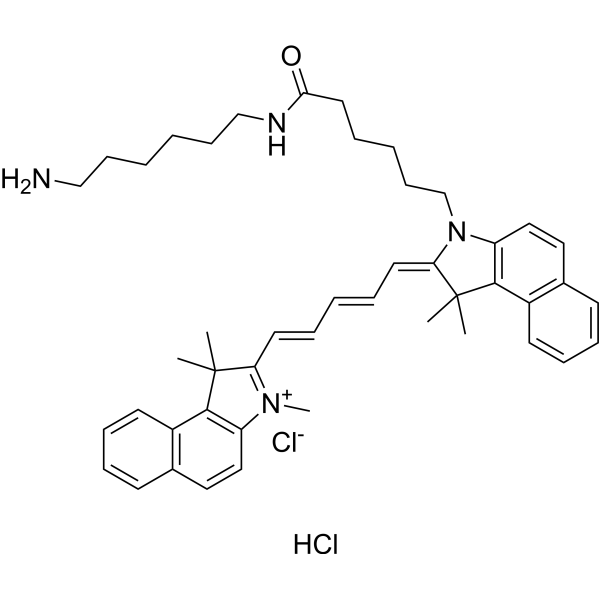
Physicochemical Properties
| Molecular Formula | C46H58CL2N4O |
| Molecular Weight | 753.8849 |
| Exact Mass | 752.398 |
| CAS # | 2097714-45-7 |
| Related CAS # | 2097714-44-6 (without anion);2097714-45-7 (chloride); |
| PubChem CID | 165412490 |
| Appearance | Purple to purplish red solid powder |
| Hydrogen Bond Donor Count | 3 |
| Hydrogen Bond Acceptor Count | 4 |
| Rotatable Bond Count | 15 |
| Heavy Atom Count | 53 |
| Complexity | 1290 |
| Defined Atom Stereocenter Count | 0 |
| SMILES | [Cl-].[Cl-].O=C(CCCCCN1C2C=CC3=CC=CC=C3C=2C(C)(C)/C/1=C\C=C\C=C\C1C(C)(C)C2C3=CC=CC=C3C=CC=2[N+]=1C)NCCCCCC[NH3+] |
| InChi Key | KVJPEAWDFIBHDL-UHFFFAOYSA-N |
| InChi Code | InChI=1S/C46H56N4O.2ClH/c1-45(2)40(49(5)38-29-27-34-20-13-15-22-36(34)43(38)45)24-10-8-11-25-41-46(3,4)44-37-23-16-14-21-35(37)28-30-39(44)50(41)33-19-9-12-26-42(51)48-32-18-7-6-17-31-47;;/h8,10-11,13-16,20-25,27-30H,6-7,9,12,17-19,26,31-33,47H2,1-5H3;2*1H |
| Chemical Name | N-(6-aminohexyl)-6-[(2E)-1,1-dimethyl-2-[(2E,4E)-5-(1,1,3-trimethylbenzo[e]indol-3-ium-2-yl)penta-2,4-dienylidene]benzo[e]indol-3-yl]hexanamide;chloride;hydrochloride |
| HS Tariff Code | 2934.99.9001 |
| Storage |
Powder-20°C 3 years 4°C 2 years In solvent -80°C 6 months -20°C 1 month Note: Please store this product in a sealed and protected environment (e.g. under nitrogen), avoid exposure to moisture and light. |
| Shipping Condition | Room temperature (This product is stable at ambient temperature for a few days during ordinary shipping and time spent in Customs) |
Biological Activity
| ln Vivo | Cy5.5-labeled nanoparticles (Cy5.5-PLGA) in retinal blood vessels: real-time monitoring. Advice (This is our suggested protocol, which should be adjusted to meet your unique requirements as it only offers guidance) [2]. 1. Give freshly made Cy5.5-PLGA suspension intravenously (0.5 mL); resuspend in 0.5 ml of 1% Poloxamer 188; vortex gently and let sit at room temperature for 30 minutes before using. 2. Rats are anesthetized, the iris is relaxed with 5% neosynephrine-POS, and Vidisic eye gel is applied to prevent dry eyes and to act as a soaking medium for contact lenses. 3. With the rat's eyes at working distance below the objective lens, place it under a confocal scanning microscope and place the cannula into the vein in its tail. 4. Take pictures and record retinal fluorescence at various intervals (0, 1, 3, 5, 15, 30, 60, 90 minutes). NOTE: Throughout every step of the in vivo imaging process, the rats stay on the heating plate. 5. The rat should be put to death with an overdose of the aforementioned anesthetic after in vivo real-time imaging. The eyeball should then be removed and placed in a cooled HEPES buffer solution (135 mM NaCl, 5 mM NaOH, 2.5 mM KCl, 7 mM MgCl2, 10 mM HEPES, 10 mM glucose; pH7.4). 6. The entire retina should be carefully separated, the anterior segment and vitreous body removed, and it should be laid flat on a modified culture plate. 7. To stain the nuclei, incubate the entire mount in 0.1 mg/mL Hoechst 33342 in HEPES solution for 20 minutes. 8. After 20 minutes of fixing flat-mounted retinas with 4% paraformaldehyde solution, wash with HEPES solution. 9. As soon as the retinal plain slide is ready, use the microscope to take a picture. |
| References |
[1]. Intracellular Uptake Mechanism of Bioorthogonally Conjugated Nanoparticles on Metabolically Engineered Mesenchymal Stem Cells. Bioconjug Chem. 2021 Jan 20;32(1):199-214. [2]. Release kinetics of fluorescent dyes from PLGA nanoparticles in retinal blood vessels: In vivo monitoring and ex vivo localization. Eur J Pharm Biopharm. 2020 May;150:131-142. |
Solubility Data
| Solubility (In Vitro) | DMSO : ~125 mg/mL (~165.81 mM) |
| Solubility (In Vivo) |
Solubility in Formulation 1: 2.08 mg/mL (2.76 mM) in 10% DMSO + 40% PEG300 + 5% Tween80 + 45% Saline (add these co-solvents sequentially from left to right, and one by one), suspension solution; with sonication. For example, if 1 mL of working solution is to be prepared, you can add 100 μL of 20.8 mg/mL clear DMSO stock solution to 400 μL PEG300 and mix evenly; then add 50 μL Tween-80 to the above solution and mix evenly; then add 450 μL normal saline to adjust the volume to 1 mL. Preparation of saline: Dissolve 0.9 g of sodium chloride in 100 mL ddH₂ O to obtain a clear solution. Solubility in Formulation 2: 2.08 mg/mL (2.76 mM) in 10% DMSO + 90% (20% SBE-β-CD in Saline) (add these co-solvents sequentially from left to right, and one by one), suspension solution; with ultrasonication. For example, if 1 mL of working solution is to be prepared, you can add 100 μL of 20.8 mg/mL clear DMSO stock solution to 900 μL of 20% SBE-β-CD physiological saline solution and mix evenly. Preparation of 20% SBE-β-CD in Saline (4°C,1 week): Dissolve 2 g SBE-β-CD in 10 mL saline to obtain a clear solution. (Please use freshly prepared in vivo formulations for optimal results.) |
| Preparing Stock Solutions | 1 mg | 5 mg | 10 mg | |
| 1 mM | 1.3265 mL | 6.6324 mL | 13.2647 mL | |
| 5 mM | 0.2653 mL | 1.3265 mL | 2.6529 mL | |
| 10 mM | 0.1326 mL | 0.6632 mL | 1.3265 mL |