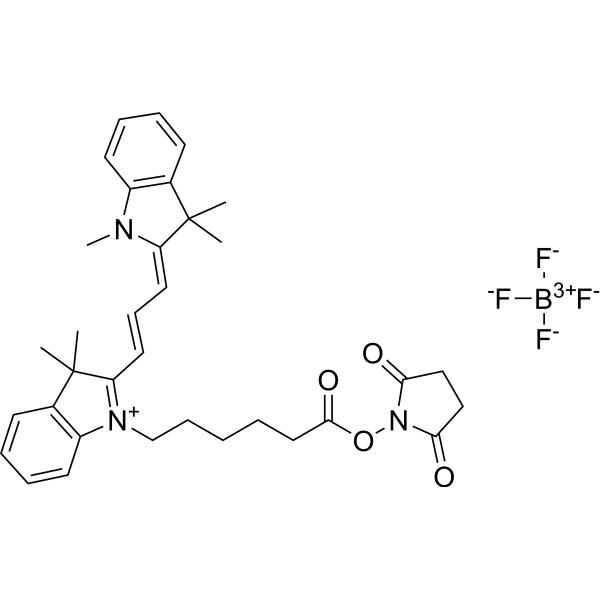
Physicochemical Properties
| Molecular Formula | C34H40BF4N3O4 |
| Molecular Weight | 641.50 |
| Exact Mass | 641.304 |
| CAS # | 2632339-91-2 |
| PubChem CID | 164577367 |
| Appearance | Typically exists as solid at room temperature |
| Hydrogen Bond Donor Count | 0 |
| Hydrogen Bond Acceptor Count | 9 |
| Rotatable Bond Count | 10 |
| Heavy Atom Count | 46 |
| Complexity | 1120 |
| Defined Atom Stereocenter Count | 0 |
| InChi Key | STPLGCDKSHGEBA-UHFFFAOYSA-M |
| InChi Code | InChI=1S/C34H40N3O4.BF3.FH/c1-33(2)24-14-8-10-16-26(24)35(5)28(33)18-13-19-29-34(3,4)25-15-9-11-17-27(25)36(29)23-12-6-7-20-32(40)41-37-30(38)21-22-31(37)39;2-1(3)4;/h8-11,13-19H,6-7,12,20-23H2,1-5H3;;1H/q+1;;/p-1 |
| Chemical Name | (2,5-dioxopyrrolidin-1-yl) 6-[3,3-dimethyl-2-[3-(1,3,3-trimethylindol-1-ium-2-yl)prop-2-enylidene]indol-1-yl]hexanoate;trifluoroborane;fluoride |
| HS Tariff Code | 2934.99.9001 |
| Storage |
Powder-20°C 3 years 4°C 2 years In solvent -80°C 6 months -20°C 1 month |
| Shipping Condition | Room temperature (This product is stable at ambient temperature for a few days during ordinary shipping and time spent in Customs) |
Biological Activity
| ln Vitro | Protocol I. Protein preparation 1) For optimal labeling, prepare the protein (antibody) at a concentration of 2 mg/mL. 2) The pH of the protein solution is 8.5±0.5. If the pH is lower than 8.0, 1M sodium bicarbonate should be used for adjustment. 3) If the protein concentration is lower than 2 mg/mL, the labeling efficiency will be greatly reduced. For optimal labeling efficiency, the recommended final protein concentration range is 2-10 mg/mL. 4) The protein must be in a buffer that does not contain primary amines (such as Tris or glycine) and ammonium ions, otherwise it will affect the labeling efficiency. 2. Dye preparation (taking CY3-NHS ester as an example) Add anhydrous DMSO to the CY3-NHS ester vial to make a 10 mM stock solution. Mix well by pipetting or vortexing. 3. Calculation of the amount of dye The amount of CY3-NHS ester required for the reaction depends on the amount of protein to be labeled and the optimal molar ratio of CY3-NHS ester to protein is about 10. Example: Assuming that the required marker protein is 500 μL 2 mg/mL IgG (MW=150,000), 100 μL DMSO is used to dissolve 1 mg CY3-NHS ester, and the required volume of CY3-NHS ester is 5.05 μL. The detailed calculation process is as follows: 1) mmol (IgG) = mg/mL (IgG) × mL (IgG)/MW (IgG) = 2 mg/mL × 0.5 mL/150,000 mg/mmol= 6.7×10⁻⁶ mmol 2) mmol (CY3-NHS ester) = mmol (IgG) × 10=6.7×10⁻⁶ mmol×10=6.7 × 10⁻⁵ mmol 3) uL (CY3-NHS ester) = mmol (CY3-NHS ester) × MW (CY3-NHS ester)/mg/μL (CY3-NHS ester) = 6.7 × 10⁻⁵ mmol × 753.88 mg/mmol/0.01 mg/μL = 5.05 μL (CY3-NHS ester) 4. Run the coupling reaction 1) Slowly add an appropriate amount of freshly prepared 10 mg/mL CY3-NHS ester to 0.5 mL of protein sample in the solution, gently shake to mix, and then briefly centrifuge to collect the sample at the bottom of the reaction tube. Do not mix to avoid denaturation of the protein sample. 2) Place the reaction tube in a dark place and incubate gently at room temperature for 60 minutes. After 10-15 minutes, gently reverse the reaction 5. Purify the conjugate The following protocol is an example of purification of dye-protein conjugates using SepHadex G-25 columns. br/> 1) Prepare SepHadex G-25 columns according to the manufacturer's instructions. 2) Load the reaction mixture (from "Run conjugation reaction") onto the top of the SepHadex G-25 column. 3) Add PBS (pH 7.2-7.4) as soon as the sample runs below the top resin surface. 4) Add more PBS (pH 7.2-7.4) to the desired sample to complete the column purification. Pool the fractions containing the desired dye-protein conjugate. |
| References |
[1]. Ptaszek M. Rational design of fluorophores for in vivo applications. Prog Mol Biol Transl Sci. 2013;113:59-108. [2]. Shindy, H. A. (2017). Fundamentals in the chemistry of cyanine dyes: A review. Dyes and Pigments, 145, 505–513. |
Solubility Data
| Solubility (In Vitro) | May dissolve in DMSO (in most cases), if not, try other solvents such as H2O, Ethanol, or DMF with a minute amount of products to avoid loss of samples |
| Solubility (In Vivo) |
Note: Listed below are some common formulations that may be used to formulate products with low water solubility (e.g. < 1 mg/mL), you may test these formulations using a minute amount of products to avoid loss of samples. Injection Formulations (e.g. IP/IV/IM/SC) Injection Formulation 1: DMSO : Tween 80: Saline = 10 : 5 : 85 (i.e. 100 μL DMSO stock solution → 50 μL Tween 80 → 850 μL Saline) *Preparation of saline: Dissolve 0.9 g of sodium chloride in 100 mL ddH ₂ O to obtain a clear solution. Injection Formulation 2: DMSO : PEG300 :Tween 80 : Saline = 10 : 40 : 5 : 45 (i.e. 100 μL DMSO → 400 μLPEG300 → 50 μL Tween 80 → 450 μL Saline) Injection Formulation 3: DMSO : Corn oil = 10 : 90 (i.e. 100 μL DMSO → 900 μL Corn oil) Example: Take the Injection Formulation 3 (DMSO : Corn oil = 10 : 90) as an example, if 1 mL of 2.5 mg/mL working solution is to be prepared, you can take 100 μL 25 mg/mL DMSO stock solution and add to 900 μL corn oil, mix well to obtain a clear or suspension solution (2.5 mg/mL, ready for use in animals). Injection Formulation 4: DMSO : 20% SBE-β-CD in saline = 10 : 90 [i.e. 100 μL DMSO → 900 μL (20% SBE-β-CD in saline)] *Preparation of 20% SBE-β-CD in Saline (4°C,1 week): Dissolve 2 g SBE-β-CD in 10 mL saline to obtain a clear solution. Injection Formulation 5: 2-Hydroxypropyl-β-cyclodextrin : Saline = 50 : 50 (i.e. 500 μL 2-Hydroxypropyl-β-cyclodextrin → 500 μL Saline) Injection Formulation 6: DMSO : PEG300 : castor oil : Saline = 5 : 10 : 20 : 65 (i.e. 50 μL DMSO → 100 μLPEG300 → 200 μL castor oil → 650 μL Saline) Injection Formulation 7: Ethanol : Cremophor : Saline = 10: 10 : 80 (i.e. 100 μL Ethanol → 100 μL Cremophor → 800 μL Saline) Injection Formulation 8: Dissolve in Cremophor/Ethanol (50 : 50), then diluted by Saline Injection Formulation 9: EtOH : Corn oil = 10 : 90 (i.e. 100 μL EtOH → 900 μL Corn oil) Injection Formulation 10: EtOH : PEG300:Tween 80 : Saline = 10 : 40 : 5 : 45 (i.e. 100 μL EtOH → 400 μLPEG300 → 50 μL Tween 80 → 450 μL Saline) Oral Formulations Oral Formulation 1: Suspend in 0.5% CMC Na (carboxymethylcellulose sodium) Oral Formulation 2: Suspend in 0.5% Carboxymethyl cellulose Example: Take the Oral Formulation 1 (Suspend in 0.5% CMC Na) as an example, if 100 mL of 2.5 mg/mL working solution is to be prepared, you can first prepare 0.5% CMC Na solution by measuring 0.5 g CMC Na and dissolve it in 100 mL ddH2O to obtain a clear solution; then add 250 mg of the product to 100 mL 0.5% CMC Na solution, to make the suspension solution (2.5 mg/mL, ready for use in animals). Oral Formulation 3: Dissolved in PEG400 Oral Formulation 4: Suspend in 0.2% Carboxymethyl cellulose Oral Formulation 5: Dissolve in 0.25% Tween 80 and 0.5% Carboxymethyl cellulose Oral Formulation 6: Mixing with food powders Note: Please be aware that the above formulations are for reference only. InvivoChem strongly recommends customers to read literature methods/protocols carefully before determining which formulation you should use for in vivo studies, as different compounds have different solubility properties and have to be formulated differently. (Please use freshly prepared in vivo formulations for optimal results.) |
| Preparing Stock Solutions | 1 mg | 5 mg | 10 mg | |
| 1 mM | 1.5588 mL | 7.7942 mL | 15.5885 mL | |
| 5 mM | 0.3118 mL | 1.5588 mL | 3.1177 mL | |
| 10 mM | 0.1559 mL | 0.7794 mL | 1.5588 mL |