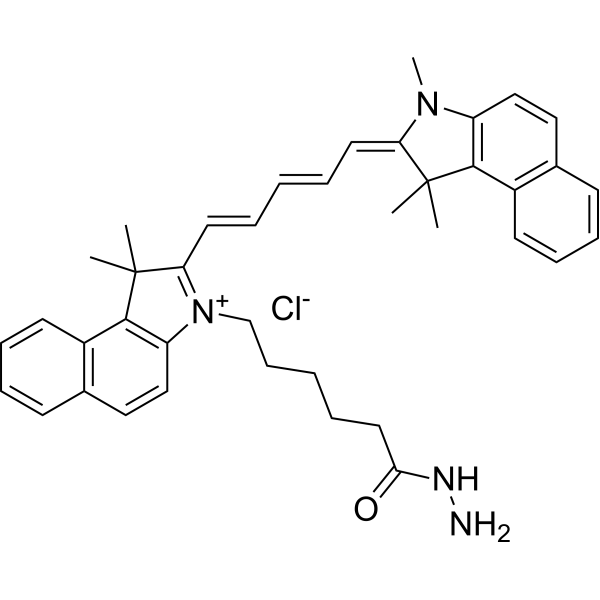
Physicochemical Properties
| Molecular Formula | C40H45CLN4O |
| Molecular Weight | 633.3 |
| Exact Mass | 632.3281 |
| PubChem CID | 170902418 |
| Appearance | Typically exists as solid at room temperature |
| Hydrogen Bond Donor Count | 2 |
| Hydrogen Bond Acceptor Count | 4 |
| Rotatable Bond Count | 9 |
| Heavy Atom Count | 46 |
| Complexity | 1190 |
| Defined Atom Stereocenter Count | 0 |
| SMILES | CC1(C(=[N+](C2=C1C3=CC=CC=C3C=C2)C)/C=C/C=C/C=C\4/C(C5=C(N4CCCCCC(=O)NN)C=CC6=CC=CC=C65)(C)C)C.[Cl-] |
| InChi Key | VXIABZZQCOGYIY-UHFFFAOYSA-N |
| InChi Code | InChI=1S/C40H44N4O.ClH/c1-39(2)34(43(5)32-25-23-28-16-11-13-18-30(28)37(32)39)20-8-6-9-21-35-40(3,4)38-31-19-14-12-17-29(31)24-26-33(38)44(35)27-15-7-10-22-36(45)42-41;/h6,8-9,11-14,16-21,23-26H,7,10,15,22,27,41H2,1-5H3;1H |
| Chemical Name | 6-[(2Z)-1,1-dimethyl-2-[(2E,4E)-5-(1,1,3-trimethylbenzo[e]indol-3-ium-2-yl)penta-2,4-dienylidene]benzo[e]indol-3-yl]hexanehydrazide;chloride |
| HS Tariff Code | 2934.99.9001 |
| Storage |
Powder-20°C 3 years 4°C 2 years In solvent -80°C 6 months -20°C 1 month |
| Shipping Condition | Room temperature (This product is stable at ambient temperature for a few days during ordinary shipping and time spent in Customs) |
Biological Activity
| Targets | Fluorescent dye |
| ln Vitro | The covalent binding of Cy5.5 did not affect significantly the size and surface charge of the nanogels at 125.1 ± 3.2 nm and -57.6 ± 6.2 mV respectively after labelling. Studies of biocompatibility showed that the nanogels were non-toxic to Caco-2 cells up to the concentration of 0.1 mg∙mL-1. The presence of mucus affected the nanogel uptake and highlighted the importance of considering mucus-producing cells in in vitro intestinal models. The uptake or adsorption to a Caco-2/HT29-MTX co-culture (8.1%) was higher than with single Caco-2 cell cultures (4.3%). Interestingly, both models led to minute (<0.5%) permeation of the nanogels across the intestinal barrier. Conclusion: The HyA nanogels demonstrated to be mucoadhesive and effectively uptaken by intestinal cells. Both are determinant features for sustained release, but if systemic delivery is envisaged further modification with targeting moieties could be important to improve the nanogel permeability [1]. |
| Cell Assay | HyA nanogels were prepared by self-assembly from amphiphilic HyA conjugates produced by grafting hydrophobic alkyl chains to the HyA backbone. The dye Cy5.5 was covalently bonded and used for tracking. The nanogels were characterised according to their structure, size and zeta potential, as well as biocompatibility towards an intestinal epithelial cell line. The uptake and intestinal permeability of the nanogels were assessed using in vitro models, which physiological relevance was verified regarding the morphology of the epithelium, the production of mucus, the expression of occludin and the transepithelial electrical resistance[1]. |
| References |
[1]. In Vitro Intestinal Uptake And Permeability Of Fluorescently-Labelled Hyaluronic Acid Nanogels. Int J Nanomedicine. 2019 Nov 21;14:9077-9088. |
| Additional Infomation | Oral administration remains the most common mode of drug delivery. However, orally administered bioactive compounds must first survive digestion and then be absorbed at the intestine in order to reach other tissues or organs. The efficiency of both processes can be improved by encapsulation or conjugation with polymeric nanoparticles. Here we report the synthesis of amphiphilic hyaluronic acid (HyA) nanogels as nanocarriers for drug delivery. |
Solubility Data
| Solubility (In Vitro) | May dissolve in DMSO (in most cases), if not, try other solvents such as H2O, Ethanol, or DMF with a minute amount of products to avoid loss of samples |
| Solubility (In Vivo) |
Note: Listed below are some common formulations that may be used to formulate products with low water solubility (e.g. < 1 mg/mL), you may test these formulations using a minute amount of products to avoid loss of samples. Injection Formulations (e.g. IP/IV/IM/SC) Injection Formulation 1: DMSO : Tween 80: Saline = 10 : 5 : 85 (i.e. 100 μL DMSO stock solution → 50 μL Tween 80 → 850 μL Saline) *Preparation of saline: Dissolve 0.9 g of sodium chloride in 100 mL ddH ₂ O to obtain a clear solution. Injection Formulation 2: DMSO : PEG300 :Tween 80 : Saline = 10 : 40 : 5 : 45 (i.e. 100 μL DMSO → 400 μLPEG300 → 50 μL Tween 80 → 450 μL Saline) Injection Formulation 3: DMSO : Corn oil = 10 : 90 (i.e. 100 μL DMSO → 900 μL Corn oil) Example: Take the Injection Formulation 3 (DMSO : Corn oil = 10 : 90) as an example, if 1 mL of 2.5 mg/mL working solution is to be prepared, you can take 100 μL 25 mg/mL DMSO stock solution and add to 900 μL corn oil, mix well to obtain a clear or suspension solution (2.5 mg/mL, ready for use in animals). Injection Formulation 4: DMSO : 20% SBE-β-CD in saline = 10 : 90 [i.e. 100 μL DMSO → 900 μL (20% SBE-β-CD in saline)] *Preparation of 20% SBE-β-CD in Saline (4°C,1 week): Dissolve 2 g SBE-β-CD in 10 mL saline to obtain a clear solution. Injection Formulation 5: 2-Hydroxypropyl-β-cyclodextrin : Saline = 50 : 50 (i.e. 500 μL 2-Hydroxypropyl-β-cyclodextrin → 500 μL Saline) Injection Formulation 6: DMSO : PEG300 : castor oil : Saline = 5 : 10 : 20 : 65 (i.e. 50 μL DMSO → 100 μLPEG300 → 200 μL castor oil → 650 μL Saline) Injection Formulation 7: Ethanol : Cremophor : Saline = 10: 10 : 80 (i.e. 100 μL Ethanol → 100 μL Cremophor → 800 μL Saline) Injection Formulation 8: Dissolve in Cremophor/Ethanol (50 : 50), then diluted by Saline Injection Formulation 9: EtOH : Corn oil = 10 : 90 (i.e. 100 μL EtOH → 900 μL Corn oil) Injection Formulation 10: EtOH : PEG300:Tween 80 : Saline = 10 : 40 : 5 : 45 (i.e. 100 μL EtOH → 400 μLPEG300 → 50 μL Tween 80 → 450 μL Saline) Oral Formulations Oral Formulation 1: Suspend in 0.5% CMC Na (carboxymethylcellulose sodium) Oral Formulation 2: Suspend in 0.5% Carboxymethyl cellulose Example: Take the Oral Formulation 1 (Suspend in 0.5% CMC Na) as an example, if 100 mL of 2.5 mg/mL working solution is to be prepared, you can first prepare 0.5% CMC Na solution by measuring 0.5 g CMC Na and dissolve it in 100 mL ddH2O to obtain a clear solution; then add 250 mg of the product to 100 mL 0.5% CMC Na solution, to make the suspension solution (2.5 mg/mL, ready for use in animals). Oral Formulation 3: Dissolved in PEG400 Oral Formulation 4: Suspend in 0.2% Carboxymethyl cellulose Oral Formulation 5: Dissolve in 0.25% Tween 80 and 0.5% Carboxymethyl cellulose Oral Formulation 6: Mixing with food powders Note: Please be aware that the above formulations are for reference only. InvivoChem strongly recommends customers to read literature methods/protocols carefully before determining which formulation you should use for in vivo studies, as different compounds have different solubility properties and have to be formulated differently. (Please use freshly prepared in vivo formulations for optimal results.) |
| Preparing Stock Solutions | 1 mg | 5 mg | 10 mg | |
| 1 mM | 1.5790 mL | 7.8952 mL | 15.7903 mL | |
| 5 mM | 0.3158 mL | 1.5790 mL | 3.1581 mL | |
| 10 mM | 0.1579 mL | 0.7895 mL | 1.5790 mL |