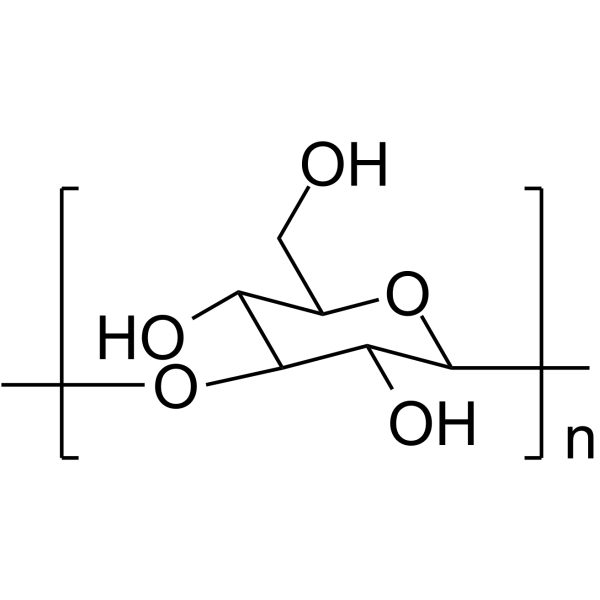
Physicochemical Properties
| Molecular Formula | (C6H10O5)N |
| Molecular Weight | 504.43708 |
| Exact Mass | 504.169 |
| CAS # | 54724-00-4 |
| Related CAS # | 26874-89-5;133947-06-5 |
| PubChem CID | 64689 |
| Appearance | White to yellow solid powder |
| Density | 1.8±0.1 g/cm3 |
| Boiling Point | 902.8±65.0 °C at 760 mmHg |
| Flash Point | 499.8±34.3 °C |
| Vapour Pressure | 0.0±0.6 mmHg at 25°C |
| Index of Refraction | 1.673 |
| LogP | -6.08 |
| Hydrogen Bond Donor Count | 5 |
| Hydrogen Bond Acceptor Count | 6 |
| Rotatable Bond Count | 1 |
| Heavy Atom Count | 12 |
| Complexity | 151 |
| Defined Atom Stereocenter Count | 5 |
| SMILES | C([C@@H]1[C@H]([C@@H]([C@H]([C@@H](O1)O)O)O)O)O |
| InChi Key | WQZGKKKJIJFFOK-VFUOTHLCSA-N |
| InChi Code | InChI=1S/C6H12O6/c7-1-2-3(8)4(9)5(10)6(11)12-2/h2-11H,1H2/t2-,3-,4+,5-,6-/m1/s1 |
| Chemical Name | (2R,3R,4S,5S,6R)-6-(hydroxymethyl)oxane-2,3,4,5-tetrol |
| HS Tariff Code | 2934.99.9001 |
| Storage |
Powder-20°C 3 years 4°C 2 years In solvent -80°C 6 months -20°C 1 month |
| Shipping Condition | Room temperature (This product is stable at ambient temperature for a few days during ordinary shipping and time spent in Customs) |
Biological Activity
| References |
[1]. Food Applications of Curdlan. Food Hydrocolloids pp 119-124. |
| Additional Infomation |
Beta-D-glucose is d-Glucopyranose with beta configuration at the anomeric centre. It has a role as an epitope and a mouse metabolite. It is an enantiomer of a beta-L-glucose. A primary source of energy for living organisms. It is naturally occurring and is found in fruits and other parts of plants in its free state. It is used therapeutically in fluid and nutrient replacement. Glucose oxidase has been investigated for the treatment of Upper Respiratory Tract Infections. b-D-Glucose is a metabolite found in or produced by Escherichia coli (strain K12, MG1655). (2R,3R,4S,5S,6R)-6-(hydroxymethyl)oxane-2,3,4,5-tetrol has been reported in Humulus lupulus, Maclura pomifera, and other organisms with data available. Beta-D-Glucopyranose is the beta isoform of D-glucopyranose, a synthetic simple monosaccharide as an energy source. D-glucopyranose is oxidized in various tissues either under aerobic or anaerobic conditions through glycolysis, and the oxidation reaction produces carbon dioxide, water and ATP. Zymosan is an insoluble beta-1,3-glucan polysaccharide derived from, and structural component of, yeast cell walls, with potential immunostimulating activity. Upon administration, zymosan targets, binds to and activates certain Toll-like receptors, primarily TLR type 2 (TLR-2), on leukocytes and dectin-1 on macrophages. Activation of TLR2 and dectin-1 stimulates the release of pro-inflammatory mediators, and enhances innate immune responses. Beta-D-Glucose is a metabolite found in or produced by Saccharomyces cerevisiae. See also: Zymosans (annotation moved to). |
Solubility Data
| Solubility (In Vitro) |
DMSO: 10 mg/mL 0.1 M NaOH: 1 mg/mL |
| Solubility (In Vivo) |
Solubility in Formulation 1: ≥ 1 mg/mL (Infinity mM) (saturation unknown) in 10% DMSO + 40% PEG300 + 5% Tween80 + 45% Saline (add these co-solvents sequentially from left to right, and one by one), clear solution. For example, if 1 mL of working solution is to be prepared, you can add 100 μL of 10.0 mg/mL clear DMSO stock solution to 400 μL of PEG300 and mix evenly; then add 50 μL of Tween-80 to the above solution and mix evenly; then add 450 μL of normal saline to adjust the volume to 1 mL. Preparation of saline: Dissolve 0.9 g of sodium chloride in 100 mL ddH₂ O to obtain a clear solution. Solubility in Formulation 2: ≥ 1 mg/mL (Infinity mM) (saturation unknown) in 10% DMSO + 90% Corn Oil (add these co-solvents sequentially from left to right, and one by one), clear solution. For example, if 1 mL of working solution is to be prepared, you can add 100 μL of 10.0 mg/mL clear DMSO stock solution to 900 μL of corn oil and mix evenly. (Please use freshly prepared in vivo formulations for optimal results.) |
| Preparing Stock Solutions | 1 mg | 5 mg | 10 mg | |
| 1 mM | 1.9824 mL | 9.9120 mL | 19.8240 mL | |
| 5 mM | 0.3965 mL | 1.9824 mL | 3.9648 mL | |
| 10 mM | 0.1982 mL | 0.9912 mL | 1.9824 mL |