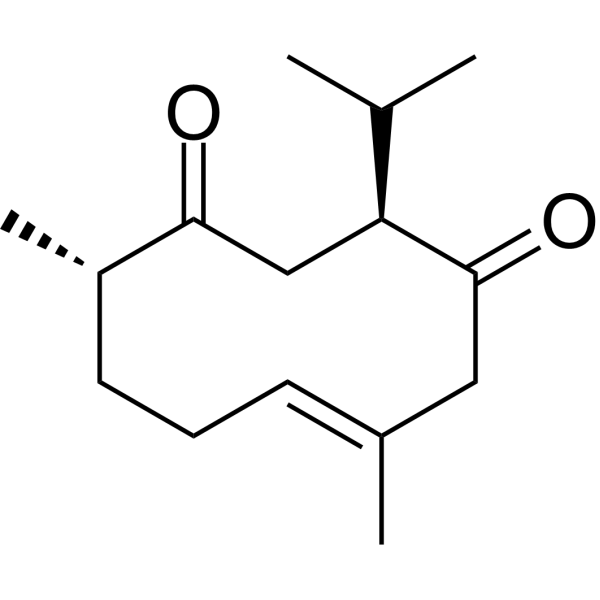
Physicochemical Properties
| Molecular Formula | C15H24O2 |
| Molecular Weight | 236.3499 |
| Exact Mass | 236.177 |
| CAS # | 13657-68-6 |
| PubChem CID | 5362828 |
| Appearance | White to off-white solid powder |
| Density | 0.9±0.1 g/cm3 |
| Boiling Point | 347.6±42.0 °C at 760 mmHg |
| Melting Point | 61 - 62 °C |
| Flash Point | 130.4±24.9 °C |
| Vapour Pressure | 0.0±0.8 mmHg at 25°C |
| Index of Refraction | 1.458 |
| LogP | 3.12 |
| Hydrogen Bond Donor Count | 0 |
| Hydrogen Bond Acceptor Count | 2 |
| Rotatable Bond Count | 1 |
| Heavy Atom Count | 17 |
| Complexity | 326 |
| Defined Atom Stereocenter Count | 0 |
| SMILES | CC1CC/C=C(\CC(=O)C(CC1=O)C(C)C)/C |
| InChi Key | KDPFMRXIVDLQKX-WDZFZDKYSA-N |
| InChi Code | InChI=1S/C15H24O2/c1-10(2)13-9-14(16)12(4)7-5-6-11(3)8-15(13)17/h6,10,12-13H,5,7-9H2,1-4H3/b11-6- |
| Chemical Name | (6Z)-6,10-dimethyl-3-propan-2-ylcyclodec-6-ene-1,4-dione |
| HS Tariff Code | 2934.99.9001 |
| Storage |
Powder-20°C 3 years 4°C 2 years In solvent -80°C 6 months -20°C 1 month |
| Shipping Condition | Room temperature (This product is stable at ambient temperature for a few days during ordinary shipping and time spent in Customs) |
Biological Activity
| Targets |
Inhibition of platelet aggregation induced by platelet-activating factor (PAF) (IC₅₀ ≈ 60 μM) and thrombin (IC₅₀ ≈ 60–80 μM) Inhibition of P-selectin expression on activated platelets Attenuation of intracellular Ca²⁺ mobilization in PAF-activated platelets Increase in intracellular cAMP levels in platelets[2] |
| ln Vitro |
Curdione preferentially inhibited PAF-induced (0.375 μg/mL) and thrombin-induced (0.3 U/mL) human platelet aggregation in a concentration-dependent manner, with IC₅₀ values around 60–80 μM. It showed much weaker inhibition against ADP-induced (10 μM) and arachidonic acid-induced (0.1 mg/mL) aggregation. Curdione significantly inhibited P-selectin expression on the surface of PAF-activated platelets in a concentration-dependent manner (40–500 μM). Curdione attenuated the rise in intracellular Ca²⁺ concentration triggered by PAF (0.75 μg/mL) in human washed platelets. Curdione increased intracellular cAMP levels in resting platelets and reversed the decrease in cAMP levels observed in PAF-activated platelets.[2] |
| ln Vivo |
In a carrageenan-induced tail thrombosis mouse model, oral administration of curdione (50, 100, and 200 mg/kg) significantly inhibited thrombus formation in a dose-dependent manner, as measured by reduced relative thrombosis length in the tail. The effect was comparable to that of aspirin (100 mg/kg) used as a positive control.[2] |
| Cell Assay |
Platelet aggregation was measured turbidimetrically. Human platelet-rich plasma (PRP) was incubated with curdione for 8 minutes at 37°C with stirring, then stimulated with agonists (PAF, thrombin, ADP, or AA). Aggregation was recorded as the change in light transmission, with inhibition calculated relative to control. P-selectin expression was analyzed by flow cytometry. PRP samples were preincubated with curdione, stimulated with PAF, then stained with fluorescently labeled antibodies against CD41 and CD62p (P-selectin). Intracellular Ca²⁺ concentration was monitored using fura-2/AM-loaded washed platelets. Fluorescence was measured after stimulation with PAF following preincubation with curdione. cAMP levels were measured using a commercial enzyme immunoassay kit. Washed platelets were incubated with curdione, stimulated with PAF, and then processed for cAMP extraction and quantification.[2] |
| Animal Protocol |
A carrageenan-induced tail thrombosis model was used. Male Kunming mice were randomly divided into groups: negative control (10% Tween 80), curdione (50, 100, 200 mg/kg, orally), and positive control (aspirin 100 mg/kg, orally). One hour after administration, mice were subcutaneously injected with 0.1% carrageenan into the back. The ambient temperature was maintained below 17°C to promote thrombosis. At 24 hours post-injection, tail thrombosis length and degree were measured and recorded.[2] |
| References |
[1]. Effect of curdione on hemorheological indexs in rats with blood stasis syndrome. Anhui Medical and Pharmaceutical Journal, 2012-09. [2]. Inhibition of platelet aggregation by curdione from Curcuma wenyujin essential Oil. Thrombosis Research Volume 130, Issue 3, September 2012, Pages 409–414. |
| Additional Infomation |
Curdione is a major sesquiterpene compound isolated from the essential oil of Curcuma wenyujin (Rhizoma Curcumae), a traditional Chinese medicine used for promoting blood circulation and removing blood stasis. This study is the first to report the anti-platelet aggregation and antithrombotic activities of curdione. The proposed mechanism involves elevation of cAMP, subsequent inhibition of intracellular Ca²⁺ mobilization, and down-regulation of P-selectin expression, leading to suppression of platelet activation and aggregation. The antithrombotic effect observed in vivo may also be attributed to increased vasodilation.[2] |
Solubility Data
| Solubility (In Vitro) | DMSO : ~100 mg/mL (~423.10 mM) |
| Solubility (In Vivo) |
Solubility in Formulation 1: ≥ 2.75 mg/mL (11.64 mM) (saturation unknown) in 10% DMSO + 40% PEG300 + 5% Tween80 + 45% Saline (add these co-solvents sequentially from left to right, and one by one), clear solution. For example, if 1 mL of working solution is to be prepared, you can add 100 μL of 27.5 mg/mL clear DMSO stock solution to 400 μL PEG300 and mix evenly; then add 50 μL Tween-80 to the above solution and mix evenly; then add 450 μL normal saline to adjust the volume to 1 mL. Preparation of saline: Dissolve 0.9 g of sodium chloride in 100 mL ddH₂ O to obtain a clear solution. Solubility in Formulation 2: ≥ 2.75 mg/mL (11.64 mM) (saturation unknown) in 10% DMSO + 90% (20% SBE-β-CD in Saline) (add these co-solvents sequentially from left to right, and one by one), clear solution. For example, if 1 mL of working solution is to be prepared, you can add 100 μL of 27.5 mg/mL clear DMSO stock solution to 900 μL of 20% SBE-β-CD physiological saline solution and mix evenly. Preparation of 20% SBE-β-CD in Saline (4°C,1 week): Dissolve 2 g SBE-β-CD in 10 mL saline to obtain a clear solution. Solubility in Formulation 3: ≥ 2.75 mg/mL (11.64 mM) (saturation unknown) in 10% DMSO + 90% Corn Oil (add these co-solvents sequentially from left to right, and one by one), clear solution. For example, if 1 mL of working solution is to be prepared, you can add 100 μL of 27.5 mg/mL clear DMSO stock solution to 900 μL of corn oil and mix evenly. (Please use freshly prepared in vivo formulations for optimal results.) |
| Preparing Stock Solutions | 1 mg | 5 mg | 10 mg | |
| 1 mM | 4.2310 mL | 21.1551 mL | 42.3101 mL | |
| 5 mM | 0.8462 mL | 4.2310 mL | 8.4620 mL | |
| 10 mM | 0.4231 mL | 2.1155 mL | 4.2310 mL |