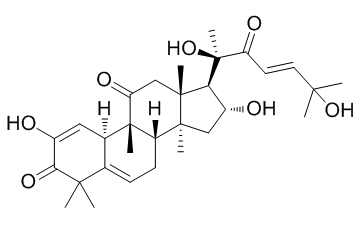
Cucurbitacin I, a naturally occurring triterpene analog, is a novel, potent and selective inhibitor of JAK2/STAT3 with potent anti-cancer activity on a variety of cancer cell types. autophagy and apoptosis were induced by cucurbitacin I. Exposure of GBM (glioblastoma multiform) cells to cucurbitacin I resulted in pronounced apoptotic cell death through activating bcl-2 family proteins. Cells treatment with cucurbitacin I up-regulated Beclin 1 and triggered autophagosome formation and accumulation as well as conversion of LC3I to LC3II. Activation of the AMP-activated protein kinase/mammalian target of rapamycin/p70S6K pathway, but not the PI3K/AKT pathway, occurred in autophagy induced by cucurbitacin I, which was accompanied by decreased hypoxia-inducible factor 1α. Stable overexpression of hypoxia-inducible factor 1α induced by FG-4497 prevented cucurbitacin I-induced autophagy and down-regulation of bcl-2. Knockdown of beclin 1 or treatment with the autophagy inhibitor 3-methyladenine also inhibited autophagy induced by cucurbitacin I. A coimmunoprecipitation assay showed that the interaction of Bcl-2 and Beclin 1/hVps34 decreased markedly in cells treated with cucurbitacin I. Furthermore, knockdown of beclin 1 or treatment with the lysosome inhibitor chloroquine sensitized cancer cells to cucurbitacin I-induced apoptosis. Finally, a xenograft model provided additional evidence for the occurrence of cucurbitacin I-induced apoptosis and autophagy in vitro. These findings provide new insights into the molecular mechanisms underlying cucurbitacin I-mediated GBM cell death and may provide an efficacious therapy for patients harboring GBM.
Physicochemical Properties
| Molecular Formula | C30H42O7 |
| Molecular Weight | 514.6503 |
| Exact Mass | 514.293 |
| CAS # | 2222-07-3 |
| Related CAS # | Cucurbitacin B;6199-67-3;Cucurbitacin E;18444-66-1 |
| PubChem CID | 5281321 |
| Appearance | White to yellow solid powder |
| Density | 1.3±0.1 g/cm3 |
| Boiling Point | 716.9±60.0 °C at 760 mmHg |
| Melting Point | 148-150ºC |
| Flash Point | 401.3±29.4 °C |
| Vapour Pressure | 0.0±5.2 mmHg at 25°C |
| Index of Refraction | 1.594 |
| LogP | 2.06 |
| Hydrogen Bond Donor Count | 4 |
| Hydrogen Bond Acceptor Count | 7 |
| Rotatable Bond Count | 4 |
| Heavy Atom Count | 37 |
| Complexity | 1160 |
| Defined Atom Stereocenter Count | 8 |
| SMILES | C[C@@]12C[C@H]([C@@H]([C@]1(CC(=O)[C@@]3([C@H]2CC=C4[C@H]3C=C(C(=O)C4(C)C)O)C)C)[C@](C)(C(=O)/C=C/C(C)(C)O)O)O |
| InChi Key | NISPVUDLMHQFRQ-MKIKIEMVSA-N |
| InChi Code | InChI=1S/C30H42O7/c1-25(2,36)12-11-21(33)30(8,37)23-19(32)14-27(5)20-10-9-16-17(13-18(31)24(35)26(16,3)4)29(20,7)22(34)15-28(23,27)6/h9,11-13,17,19-20,23,31-32,36-37H,10,14-15H2,1-8H3/b12-11+/t17-,19-,20+,23+,27+,28-,29+,30+/m1/s1 |
| Chemical Name | 8S,9R,10R,13R,14S,16R,17R)-17-[(E,2R)-2,6-dihydroxy-6-methyl-3-oxohept-4-en-2-yl]-2,16-dihydroxy-4,4,9,13,14-pentamethyl-8,10,12,15,16,17-hexahydro-7H-cyclopenta[a]phenanthrene-3,11-dione |
| Synonyms | Cucurbitacin I; Elatericin B; JSI-124; JSI 124; JSI124; NSC 521777; NSC-521777; NSC521777; |
| HS Tariff Code | 2934.99.9001 |
| Storage |
Powder-20°C 3 years 4°C 2 years In solvent -80°C 6 months -20°C 1 month |
| Shipping Condition | Room temperature (This product is stable at ambient temperature for a few days during ordinary shipping and time spent in Customs) |
Biological Activity
| ln Vitro | The viability of COLO205 cells was considerably decreased upon exposure to cucurbitacin I. Cucurbitacin I inhibits p-STAT3 and MMP-9 expression to produce its anti-cancer effects [1]. Cucurbitacin I pretreatment of cardiomyocytes significantly reduced PE-induced cell expansion and β-MHC and ANF expression. It is noteworthy that cucurbitacin I also inhibits pro-hypertrophic factors, TGF-β/Smad signaling, connective tissue growth factor (CTGF) and MAPK signaling, and these are significant variables impacting fibrosis [2]. When the Jak/Stat3 inhibitor cucurbitacin I was added to Seax cell lines, P-Stat3 and Stat3 levels decreased in a manner that was dependent on both time and concentration. Cucurbitacin I caused a concentration-dependent reduction in Stat3 expression in newly separated Sz cells (n=3), but P-Stat3 was not detected. Ultimately, most (73–91%) tumor cells underwent apoptosis after being incubated with 30 μM cucurbitacin I for 6 hours on newly obtained Sz cells (n=4) [3]. |
| ln Vivo | Throughout the trial, no significant side effects were reported. At the conclusion of the study, the mean tumor volumes were as follows: CQ, 580 mm3 (±107); Cucurbitacin I, 346 mm3 (±79); Combination, 220 mm3 (±62); Control, 616 mm3 (±130). There were notable variations in tumor volume between the groups receiving cucurbitacin I and control, combination and control, and combination and cucurbitacin I. Furthermore, at the conclusion of the study, the average tumor weights of the tumors treated with the combination were significantly lower than those of the control group. Furthermore, the mice's body weight was unaffected [4]. |
| References |
[1]. Cucurbitacin I inhibits cell migration and invasion and enhances chemosensitivity in colon cancer. Oncol Rep. 2015 Apr;33(4):1867-71. [2]. Cucurbitacin I Attenuates Cardiomyocyte Hypertrophy via Inhibition of Connective Tissue Growth Factor (CCN2) and TGF- β/Smads Signalings. PLoS One. 2015 Aug 21;10(8):e0136236. |
| Additional Infomation |
Cucurbitacin I is a cucurbitacin that is 9,10,14-trimethyl-4,9-cyclo-9,10-secocholesta-2,5,23-triene substituted by hydroxy groups at positions 2, 16, 20 and 25 and oxo groups at positions 1, 11 and 22. It has a role as a plant metabolite and an antineoplastic agent. It is a cucurbitacin and a tertiary alpha-hydroxy ketone. Cucurbitacin I has been reported in Elaeocarpus chinensis, Hemsleya endecaphylla, and other organisms with data available. |
Solubility Data
| Solubility (In Vitro) | DMSO : ≥ 100 mg/mL (~194.31 mM) |
| Solubility (In Vivo) |
Solubility in Formulation 1: ≥ 3 mg/mL (5.83 mM) (saturation unknown) in 10% DMSO + 40% PEG300 + 5% Tween80 + 45% Saline (add these co-solvents sequentially from left to right, and one by one), clear solution. For example, if 1 mL of working solution is to be prepared, you can add 100 μL of 30.0 mg/mL clear DMSO stock solution to 400 μL PEG300 and mix evenly; then add 50 μL Tween-80 to the above solution and mix evenly; then add 450 μL normal saline to adjust the volume to 1 mL. Preparation of saline: Dissolve 0.9 g of sodium chloride in 100 mL ddH₂ O to obtain a clear solution. Solubility in Formulation 2: ≥ 3 mg/mL (5.83 mM) (saturation unknown) in 10% DMSO + 90% (20% SBE-β-CD in Saline) (add these co-solvents sequentially from left to right, and one by one), clear solution. For example, if 1 mL of working solution is to be prepared, you can add 100 μL of 30.0 mg/mL clear DMSO stock solution to 900 μL of 20% SBE-β-CD physiological saline solution and mix evenly. Preparation of 20% SBE-β-CD in Saline (4°C,1 week): Dissolve 2 g SBE-β-CD in 10 mL saline to obtain a clear solution. Solubility in Formulation 3: ≥ 3 mg/mL (5.83 mM) (saturation unknown) in 10% DMSO + 90% Corn Oil (add these co-solvents sequentially from left to right, and one by one), clear solution. For example, if 1 mL of working solution is to be prepared, you can add 100 μL of 30.0 mg/mL clear DMSO stock solution to 900 μL of corn oil and mix evenly. (Please use freshly prepared in vivo formulations for optimal results.) |
| Preparing Stock Solutions | 1 mg | 5 mg | 10 mg | |
| 1 mM | 1.9431 mL | 9.7153 mL | 19.4307 mL | |
| 5 mM | 0.3886 mL | 1.9431 mL | 3.8861 mL | |
| 10 mM | 0.1943 mL | 0.9715 mL | 1.9431 mL |