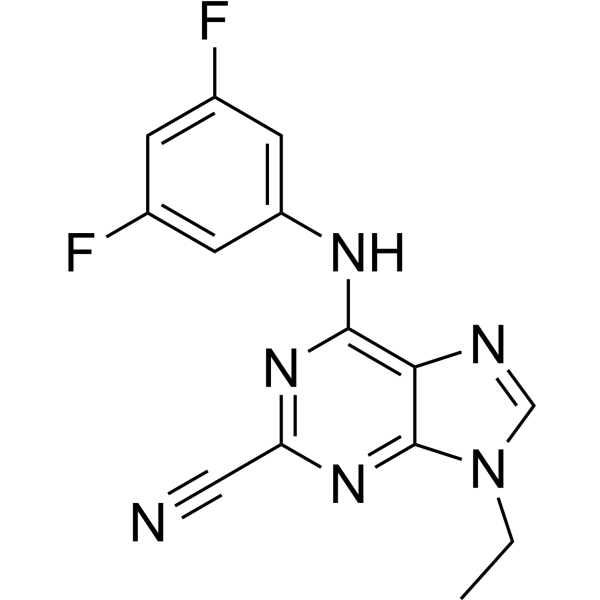
Physicochemical Properties
| Molecular Formula | C14H10F2N6 |
| Molecular Weight | 300.266208171844 |
| Exact Mass | 300.094 |
| CAS # | 1199523-24-4 |
| Related CAS # | 1199523-24-4 |
| PubChem CID | 44143088 |
| Appearance | White to off-white solid |
| LogP | 2.812 |
| Hydrogen Bond Donor Count | 1 |
| Hydrogen Bond Acceptor Count | 7 |
| Rotatable Bond Count | 3 |
| Heavy Atom Count | 22 |
| Complexity | 430 |
| Defined Atom Stereocenter Count | 0 |
| SMILES | FC1C=C(C=C(C=1)NC1=C2C(=NC(C#N)=N1)N(C=N2)CC)F |
| InChi Key | SZYYBVWPURUFRR-UHFFFAOYSA-N |
| InChi Code | InChI=1S/C14H10F2N6/c1-2-22-7-18-12-13(20-11(6-17)21-14(12)22)19-10-4-8(15)3-9(16)5-10/h3-5,7H,2H2,1H3,(H,19,20,21) |
| Chemical Name | 6-(3,5-difluoroanilino)-9-ethylpurine-2-carbonitrile |
| Synonyms | Cruzain-IN-1 |
| HS Tariff Code | 2934.99.9001 |
| Storage |
Powder-20°C 3 years 4°C 2 years In solvent -80°C 6 months -20°C 1 month |
| Shipping Condition | Room temperature (This product is stable at ambient temperature for a few days during ordinary shipping and time spent in Customs) |
Biological Activity
| Targets |
Trypanosoma (IC50 = 10 nM) Cruzain (Cysteine protease from Trypanosoma cruzi; IC₅₀ = 0.01 μM) [1] |
| ln Vitro |
NMR-based titration experiments with selectively ¹⁵N-Cys, ¹⁵N-His, and ¹³C-Met labeled cruzain showed that Cruzain-IN-1 (compound 2) binds covalently and reversibly to the catalytic Cys25 residue. The chemical shift perturbation profiles were similar to those of the irreversible vinyl sulfone inhibitor K777, confirming active site binding. Significant perturbations were observed for residues at or near the active site (e.g., Cys25, His162, Met68, Met145). Precipitate formation occurred in the NMR tube during titration, suggesting the compound itself may aggregate in solution. [1] The binding mode was verified by comparing the nitrile derivative (compound 2) with its chlorinated analog (compound 3). The nitrile group is necessary for covalent binding to Cys25, whereas the chloro derivative showed only weak, transient non-covalent interaction. [1] |
| Enzyme Assay | NMR-based inhibitor binding assays were performed. Samples contained 0.025–0.050 mM selectively ¹⁵N-His, ¹⁵N-Cys, or ¹³C-Met labeled cruzain in NMR buffer. Inhibitors were dissolved in deuterated DMSO to make 10 mM stock solutions. Titrations were performed by adding aliquots of the stock solution stepwise until a 10–20 fold stoichiometric excess relative to cruzain was achieved. Five titration points (apo, 2.5x, 5x, 10x, and 20x molar excess) were acquired for each inhibitor. ¹⁵N-¹H HSQC and ¹³C-¹H HSQC spectra were recorded to monitor chemical shift perturbations of cysteine, histidine, and methionine residues. Total chemical shift perturbation values were calculated. [1] |
| References |
[1]. Mapping inhibitor binding modes on an active cysteine protease via nuclear magnetic resonance spectroscopy. Biochemistry. 2012 Dec 18;51(50):10087-98. |
| Additional Infomation |
6-(3,5-difluoroanilino)-9-ethyl-2-purinecarbonitrile is a member of 6-aminopurines. Cruzain-IN-1 (compound 2) is a nitrile-based covalent reversible inhibitor of cruzain. [1] It shares the same chemical scaffold as compound 3 (a chlorinated intermediate), but the nitrile functional group is critical for covalent interaction with the catalytic cysteine (Cys25) thiol. [1] The study demonstrates the utility of NMR spectroscopy with selective isotopic labeling to rapidly verify and characterize inhibitor binding modes, distinguishing between covalent, non-covalent, and non-interacting compounds. [1] |
Solubility Data
| Solubility (In Vitro) | DMSO: 60~80 mg/mL (199.8~266.4 mM) |
| Solubility (In Vivo) |
Solubility in Formulation 1: 2.67 mg/mL (8.89 mM) in 10% DMSO + 40% PEG300 + 5% Tween80 + 45% Saline (add these co-solvents sequentially from left to right, and one by one), suspension solution; with sonication. For example, if 1 mL of working solution is to be prepared, you can add 100 μL of 26.7 mg/mL clear DMSO stock solution to 400 μL PEG300 and mix evenly; then add 50 μL Tween-80 to the above solution and mix evenly; then add 450 μL normal saline to adjust the volume to 1 mL. Preparation of saline: Dissolve 0.9 g of sodium chloride in 100 mL ddH₂ O to obtain a clear solution. Solubility in Formulation 2: ≥ 2.67 mg/mL (8.89 mM) (saturation unknown) in 10% DMSO + 90% Corn Oil (add these co-solvents sequentially from left to right, and one by one), clear solution. For example, if 1 mL of working solution is to be prepared, you can add 100 μL of 26.7 mg/mL clear DMSO stock solution to 900 μL of corn oil and mix evenly. (Please use freshly prepared in vivo formulations for optimal results.) |
| Preparing Stock Solutions | 1 mg | 5 mg | 10 mg | |
| 1 mM | 3.3303 mL | 16.6517 mL | 33.3034 mL | |
| 5 mM | 0.6661 mL | 3.3303 mL | 6.6607 mL | |
| 10 mM | 0.3330 mL | 1.6652 mL | 3.3303 mL |