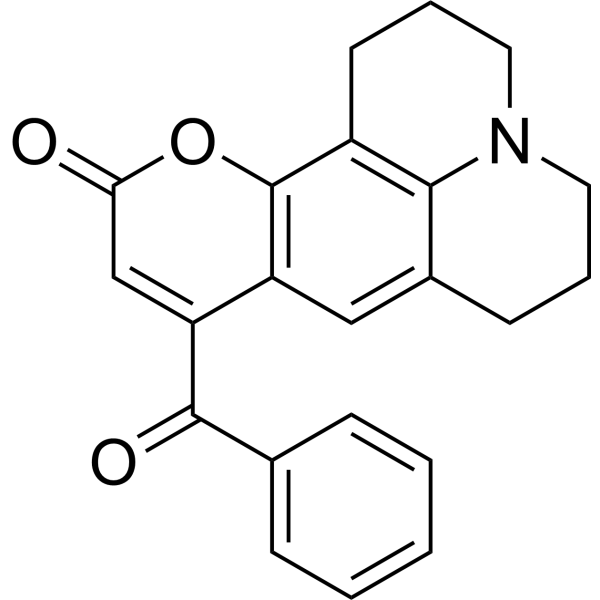
Physicochemical Properties
| Molecular Formula | C22H19NO3 |
| Molecular Weight | 345.39 |
| Exact Mass | 345.136 |
| CAS # | 878019-47-7 |
| PubChem CID | 11588246 |
| Appearance | Light yellow to yellow solid powder |
| LogP | 3.787 |
| Hydrogen Bond Donor Count | 0 |
| Hydrogen Bond Acceptor Count | 4 |
| Rotatable Bond Count | 2 |
| Heavy Atom Count | 26 |
| Complexity | 621 |
| Defined Atom Stereocenter Count | 0 |
| InChi Key | DGJJSADMDWUKOJ-UHFFFAOYSA-N |
| InChi Code | InChI=1S/C22H19NO3/c24-19-13-17(21(25)14-6-2-1-3-7-14)18-12-15-8-4-10-23-11-5-9-16(20(15)23)22(18)26-19/h1-3,6-7,12-13H,4-5,8-11H2 |
| Chemical Name | 6-benzoyl-3-oxa-13-azatetracyclo[7.7.1.02,7.013,17]heptadeca-1(17),2(7),5,8-tetraen-4-one |
| HS Tariff Code | 2934.99.9001 |
| Storage |
Powder-20°C 3 years 4°C 2 years In solvent -80°C 6 months -20°C 1 month |
| Shipping Condition | Room temperature (This product is stable at ambient temperature for a few days during ordinary shipping and time spent in Customs) |
Biological Activity
| ln Vitro | The maximum rates of coumberone (30 μM; 24 hours; HCT116 cells) are observed in AKR1C3 substrates [1]. One can utilize coumberone (5 μM; 24 hours; COS-1 cells) to selectively read out either isoform, AKR1C2 or AKR1C3 optically [2]. For IMR32 cells, coumberone (5 μM; 24 hours) allows for real-time imaging of AKR1C induction [2]. Coumberone did, in fact, boost metabolism (80 hours; IMR-32 cells). Ten times more catalytically efficient than AKR1C2 is cumberone for AKR1C3 in vitro [2]. |
| Cell Assay |
Immunofluorescence[2] Cell Types: IMR32 cells Tested Concentrations: 5 μM Incubation Duration: 24 hrs (hours) Experimental Results: Enabled real-time imaging of AKR1C induction. |
| References |
[1]. A novel fluorometric assay for aldo-keto reductase 1C3 predicts metabolic activation of the nitrogen mustard prodrug PR-104A in human leukaemia cells. Biochem Pharmacol. 2014;88(1):36-45. [2]. Imaging induction of cytoprotective enzymes in intact human cells: coumberone, a metabolic reporter for human AKR1C enzymes reveals activation by panaxytriol, an active component of red ginseng. J Am Chem Soc. 2008;130(43):14123-14128. |
Solubility Data
| Solubility (In Vitro) | DMSO: 16.67 mg/mL (48.26 mM ) |
| Solubility (In Vivo) |
Solubility in Formulation 1: ≥ 1.67 mg/mL (4.84 mM) (saturation unknown) in 10% DMSO + 90% (20% SBE-β-CD in Saline) (add these co-solvents sequentially from left to right, and one by one), clear solution. For example, if 1 mL of working solution is to be prepared, you can add 100 μL of 16.7 mg/mL clear DMSO stock solution to 900 μL of 20% SBE-β-CD physiological saline solution and mix evenly. Preparation of 20% SBE-β-CD in Saline (4°C,1 week): Dissolve 2 g SBE-β-CD in 10 mL saline to obtain a clear solution. (Please use freshly prepared in vivo formulations for optimal results.) |
| Preparing Stock Solutions | 1 mg | 5 mg | 10 mg | |
| 1 mM | 2.8953 mL | 14.4764 mL | 28.9528 mL | |
| 5 mM | 0.5791 mL | 2.8953 mL | 5.7906 mL | |
| 10 mM | 0.2895 mL | 1.4476 mL | 2.8953 mL |