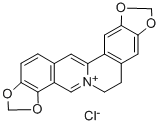
Physicochemical Properties
| Molecular Formula | C19H14CLNO4 |
| Molecular Weight | 355.7718 |
| Exact Mass | 355.061 |
| CAS # | 6020-18-4 |
| Related CAS # | Coptisine;3486-66-6 |
| PubChem CID | 72321 |
| Appearance | Brown to orange solid powder |
| Density | 1.51g/cm3 |
| Boiling Point | 601.5ºC at 760 mmHg |
| Melting Point | >258ºC (dec.) |
| Flash Point | 190.4ºC |
| Index of Refraction | 1.749 |
| Hydrogen Bond Donor Count | 0 |
| Hydrogen Bond Acceptor Count | 5 |
| Rotatable Bond Count | 0 |
| Heavy Atom Count | 25 |
| Complexity | 502 |
| Defined Atom Stereocenter Count | 0 |
| InChi Key | LUXPUVKJHVUJAV-UHFFFAOYSA-M |
| InChi Code | InChI=1S/C19H14NO4.ClH/c1-2-16-19(24-10-21-16)14-8-20-4-3-12-6-17-18(23-9-22-17)7-13(12)15(20)5-11(1)14;/h1-2,5-8H,3-4,9-10H2;1H/q+1;/p-1 |
| Chemical Name | 5,7,17,19-tetraoxa-13-azoniahexacyclo[11.11.0.02,10.04,8.015,23.016,20]tetracosa-1(13),2,4(8),9,14,16(20),21,23-octaene;chloride |
| HS Tariff Code | 2934.99.9001 |
| Storage |
Powder-20°C 3 years 4°C 2 years In solvent -80°C 6 months -20°C 1 month Note: Please store this product in a sealed and protected environment, avoid exposure to moisture. |
| Shipping Condition | Room temperature (This product is stable at ambient temperature for a few days during ordinary shipping and time spent in Customs) |
Biological Activity
| ln Vitro | Coptisine has an IC50 value of 6.3 μM and a Ki value of 5.8 μM, making it a very effective non-competitive IDO inhibitor[1]. The growth of A549, H460, H2170, MDA-MB-231, and HT-29 cells is inhibited by copoxine (0.1-100 μM), with IC50 values of 18.09, 29.50, 21.60, 20.15, and 26.60 μM, in that order. In A549 cells, coptisine (12.5, 25, and 50 μM) concentration-dependently causes G2/M arrest and apoptosis, downregulates the expression of cyclin B1, cdc2, and cdc25C, and increases the expression of pH2AX and p21. In A549 cells, copoposite (12.5, 25, 50 μM) likewise causes mitochondrial dysfunction and triggers caspase activation. Additionally, ROS levels are raised by coptisine (50 μM) in a time-dependent manner (0.5, 1, 2, 4, 12, and 24 hours) [3]. |
| ln Vivo | Mice's LD50 value for coptisine was 880.18 mg/kg, and its toxicity increased with concentration. The dosage of 154 mg/kg/day for 90 days did not cause toxicity in SD rats. In addition to increasing HDL-c content to varied degrees and slowing down the weight gain brought on by the HFHC diet, copoxine (23.35, 46.7, 70.05 mg/kg, po) increased fecal cholesterol and TBA levels in hamsters in a dose-dependent manner. It also reduced TC, TG, and LDL-c levels in the serum of the animals. Inducing the expression of SREBP-2, LDLR, and CYP7A1 proteins involved in cholesterol metabolism, coptisine (70.05 mg/kg, po) lowers the level of HMGCR protein expression [2]. |
| References |
[1]. The IDO inhibitor coptisine ameliorates cognitive impairment in a mouse model of Alzheimer's disease. J Alzheimers Dis. 2015;43(1):291-302. [2]. The safety and anti-hypercholesterolemic effect of coptisine in Syrian golden hamsters. Lipids. 2015 Feb;50(2):185-94. [3]. Coptisine-induced cell cycle arrest at G2/M phase and reactive oxygen species-dependent mitochondria-mediated apoptosis in non-small-cell lung cancer A549 cells. Tumour Biol. 2017 Mar;39(3):1010428317694565. [4]. Inhibition activity of a traditional Chinese herbal formula Huang-Lian-Jie-Du-Tang and its major components found in its plasma profile on neuraminidase-1. Sci Rep. 2017 Nov 14;7(1):15549. |
| Additional Infomation | Coptisine chloride is an alkaloid. |
Solubility Data
| Solubility (In Vitro) | DMSO : ~10.42 mg/mL (~29.29 mM) |
| Solubility (In Vivo) |
Solubility in Formulation 1: ≥ 1.04 mg/mL (2.92 mM) (saturation unknown) in 10% DMSO + 90% (20% SBE-β-CD in Saline) (add these co-solvents sequentially from left to right, and one by one), clear solution. For example, if 1 mL of working solution is to be prepared, you can add 100 μL of 10.4 mg/mL clear DMSO stock solution to 900 μL of 20% SBE-β-CD physiological saline solution and mix evenly. Preparation of 20% SBE-β-CD in Saline (4°C,1 week): Dissolve 2 g SBE-β-CD in 10 mL saline to obtain a clear solution. Solubility in Formulation 2: ≥ 0.5 mg/mL (1.41 mM) (saturation unknown) in 10% DMSO + 40% PEG300 + 5% Tween80 + 45% Saline (add these co-solvents sequentially from left to right, and one by one), clear solution. For example, if 1 mL of working solution is to be prepared, you can add 100 μL of 5.0 mg/mL clear DMSO stock solution to 400 μL PEG300 and mix evenly; then add 50 μL Tween-80 to the above solution and mix evenly; then add 450 μL normal saline to adjust the volume to 1 mL. Preparation of saline: Dissolve 0.9 g of sodium chloride in 100 mL ddH₂ O to obtain a clear solution. (Please use freshly prepared in vivo formulations for optimal results.) |
| Preparing Stock Solutions | 1 mg | 5 mg | 10 mg | |
| 1 mM | 2.8108 mL | 14.0540 mL | 28.1080 mL | |
| 5 mM | 0.5622 mL | 2.8108 mL | 5.6216 mL | |
| 10 mM | 0.2811 mL | 1.4054 mL | 2.8108 mL |