Physicochemical Properties
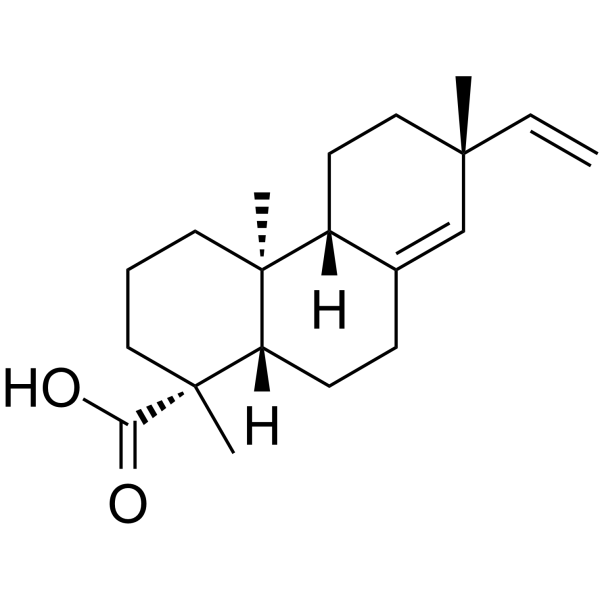
| Molecular Formula | C20H30O2 |
| Molecular Weight | 302.4510 |
| Exact Mass | 302.224 |
| CAS # | 19889-23-7 |
| PubChem CID | 10086296 |
| Appearance | White to off-white solid powder |
| LogP | 5.5 |
| Hydrogen Bond Donor Count | 1 |
| Hydrogen Bond Acceptor Count | 2 |
| Rotatable Bond Count | 2 |
| Heavy Atom Count | 22 |
| Complexity | 534 |
| Defined Atom Stereocenter Count | 5 |
| SMILES | O([H])C([C@@]1(C([H])([H])[H])C([H])([H])C([H])([H])C([H])([H])[C@]2(C([H])([H])[H])[C@@]3([H])C([H])([H])C([H])([H])[C@](C([H])=C([H])[H])(C([H])([H])[H])C([H])=C3C([H])([H])C([H])([H])[C@]21[H])=O |
| InChi Key | MHVJRKBZMUDEEV-XIHRTOKZSA-N |
| InChi Code | InChI=1S/C20H30O2/c1-5-18(2)12-9-15-14(13-18)7-8-16-19(15,3)10-6-11-20(16,4)17(21)22/h5,13,15-16H,1,6-12H2,2-4H3,(H,21,22)/t15-,16+,18+,19+,20-/m1/s1 |
| Chemical Name | (1R,4aS,4bR,7R,10aS)-7-ethenyl-1,4a,7-trimethyl-3,4,4b,5,6,9,10,10a-octahydro-2H-phenanthrene-1-carboxylic acid |
| HS Tariff Code | 2934.99.9001 |
| Storage |
Powder-20°C 3 years 4°C 2 years In solvent -80°C 6 months -20°C 1 month Note: This product requires protection from light (avoid light exposure) during transportation and storage. |
| Shipping Condition | Room temperature (This product is stable at ambient temperature for a few days during ordinary shipping and time spent in Customs) |
Biological Activity
| ln Vitro |
Continentalic acid exhibits potent antibacterial activity against methicillin-resistant Staphylococcus aureus (MRSA) and methicillin-sensitive Staphylococcus aureus (MSSA) strains. [1] Minimum Inhibitory Concentration (MIC) values determined by the microbroth dilution method: For MRSA strains (including ATCC 33591 and clinical isolates), the MIC range of Continentalic acid is 8-16 μg/mL; for MSSA strain ATCC 25923, the MIC is 4-8 μg/mL. [1] It shows comparable antibacterial efficacy to reference antibiotics: The MIC of Continentalic acid against MRSA is similar to that of erythromycin (8-16 μg/mL) and clindamycin (4-16 μg/mL), and slightly higher than that of vancomycin (1-2 μg/mL). [1] |
| Cell Assay |
Microbroth dilution assay for antibacterial activity: Staphylococcus aureus strains (MRSA: ATCC 33591, clinical isolates; MSSA: ATCC 25923) were cultured in Mueller-Hinton (MH) broth at 37°C overnight to reach the logarithmic growth phase. Continentalic acid was serially diluted in MH broth to concentrations ranging from 0.5 μg/mL to 128 μg/mL, and 100 μL of each dilution was added to 96-well microtiter plates. Bacterial suspensions (adjusted to 5×10⁵ CFU/mL) were added to each well, resulting in a final bacterial concentration of 2.5×10⁵ CFU/mL. The plates were incubated at 37°C for 24 hours, and the MIC was defined as the lowest concentration of Continentalic acid that completely inhibited bacterial growth (no visible turbidity). Reference antibiotics (vancomycin, erythromycin, clindamycin) were tested under the same conditions as positive controls. [1] |
| References |
[1]. Continentalic acid from Aralia continentalis shows activity against methicillin-resistant Staphylococcus aureus. Phytother Res. 2006 Jun;20(6):511-4. |
| Additional Infomation |
Continentalic acid has been reported in Herbertus norenus, Eleutherococcus trifoliatus, and other organisms with data available. See also: Ent-pimara-8(14),15-diene (annotation moved to). Continentalic acid is a triterpenoid compound isolated from the roots of Aralia continentalis (a traditional Chinese medicinal plant), which has been used in folk medicine for treating inflammatory and infectious diseases. [1] |
Solubility Data
| Solubility (In Vitro) | DMSO : ~100 mg/mL (~330.63 mM) |
| Solubility (In Vivo) |
Solubility in Formulation 1: 2.5 mg/mL (8.27 mM) in 10% DMSO + 40% PEG300 + 5% Tween80 + 45% Saline (add these co-solvents sequentially from left to right, and one by one), suspension solution; with sonication. For example, if 1 mL of working solution is to be prepared, you can add 100 μL of 25.0 mg/mL clear DMSO stock solution to 400 μL PEG300 and mix evenly; then add 50 μL Tween-80 to the above solution and mix evenly; then add 450 μL normal saline to adjust the volume to 1 mL. Preparation of saline: Dissolve 0.9 g of sodium chloride in 100 mL ddH₂ O to obtain a clear solution. Solubility in Formulation 2: ≥ 2.5 mg/mL (8.27 mM) (saturation unknown) in 10% DMSO + 90% (20% SBE-β-CD in Saline) (add these co-solvents sequentially from left to right, and one by one), clear solution. For example, if 1 mL of working solution is to be prepared, you can add 100 μL of 25.0 mg/mL clear DMSO stock solution to 900 μL of 20% SBE-β-CD physiological saline solution and mix evenly. Preparation of 20% SBE-β-CD in Saline (4°C,1 week): Dissolve 2 g SBE-β-CD in 10 mL saline to obtain a clear solution. Solubility in Formulation 3: ≥ 2.5 mg/mL (8.27 mM) (saturation unknown) in 10% DMSO + 90% Corn Oil (add these co-solvents sequentially from left to right, and one by one), clear solution. For example, if 1 mL of working solution is to be prepared, you can add 100 μL of 25.0 mg/mL clear DMSO stock solution to 900 μL of corn oil and mix evenly. (Please use freshly prepared in vivo formulations for optimal results.) |
| Preparing Stock Solutions | 1 mg | 5 mg | 10 mg | |
| 1 mM | 3.3063 mL | 16.5317 mL | 33.0633 mL | |
| 5 mM | 0.6613 mL | 3.3063 mL | 6.6127 mL | |
| 10 mM | 0.3306 mL | 1.6532 mL | 3.3063 mL |