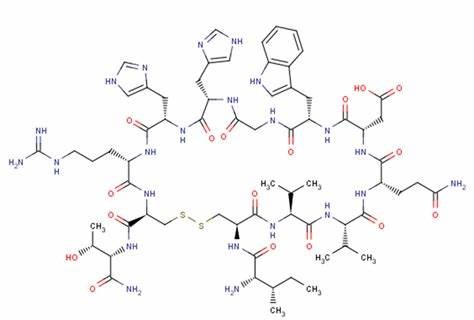
Compstatin is a novel and potent 13-residue cyclic peptide acting as a potent inhibitor of the complement system C3 with species specificity. Compstatin binds to baboon C3 and is resistant to proteolytic cleavage in baboon blood (similar to humans).
Physicochemical Properties
| Molecular Formula | C66H99N23O17S2 |
| Molecular Weight | 1550.7662 |
| Exact Mass | 1549.7 |
| CAS # | 206645-99-0 |
| Related CAS # | Compstatin TFA |
| PubChem CID | 25082538 |
| Appearance | White to off-white solid powder |
| LogP | 1.402 |
| Hydrogen Bond Donor Count | 22 |
| Hydrogen Bond Acceptor Count | 23 |
| Rotatable Bond Count | 25 |
| Heavy Atom Count | 108 |
| Complexity | 3180 |
| Defined Atom Stereocenter Count | 14 |
| HS Tariff Code | 2934.99.9001 |
| Storage |
Powder-20°C 3 years 4°C 2 years In solvent -80°C 6 months -20°C 1 month Note: Please store this product in a sealed and protected environment (e.g. under nitrogen), avoid exposure to moisture and light. |
| Shipping Condition | Room temperature (This product is stable at ambient temperature for a few days during ordinary shipping and time spent in Customs) |
Biological Activity
| ln Vitro | Comprestatin in human blood has an in vitro half-life of roughly two hours [2]. Comprestatin creates pearl clusters in solution when it rotates β on the Gln-5-Gly-8 residue with the disulfide bridge Cys-2-Cys12, residues Ile-1-Val-4 and Thr-13 [3]. |
| ln Vivo | When compstatin (21 mg/kg) was administered as a combination bolus and infusion medication, total suppression was seen. Compstatin fully prevents heart rate, systemic, central, and pulmonary arterial pressure from being negatively impacted by heparin/protamine-induced complement activation in vivo [1]. In baboons smoking, paroxetine remains constant for almost twenty-four hours [1]. Pig xenografts in the comprestatin-infused group had a substantially longer transitory period than those in the saline group [2]. |
| Animal Protocol |
Animal/Disease Models: Juvenile baboons (P. Anubis) weigh 10.5-28.8 kg [1]. Doses: 50, 25 mg/kg, 60 minutes after heparin injection, 2 minutes before protamine injection. Route of Administration: Push Note. Experimental Results: Complete inhibition of complement activation induced by heparin-protamine complex. |
| References |
[1]. Inhibition of heparin/protamine complex-induced complement activation by Compstatin in baboons. Clin Immunol. 2000 Sep;96(3):212-21. [2]. Compstatin, a peptide inhibitor of C3, prolongs survival of ex vivo perfused pig xenografts. Xenotransplantation. 1999 Feb;6(1):52-65. [3]. Structure of compstatin in complex with complement component C3c reveals a new mechanism of complement inhibition. J Biol Chem. 2007 Oct 5;282(40):29241-7. [4]. Inhibition of human complement by a C3-binding peptide isolated from a phage-displayed random peptide library. J Immunol. 1996 Jul 15;157(2):884-91. |
Solubility Data
| Solubility (In Vitro) | H2O : ~100 mg/mL (~64.48 mM) |
| Solubility (In Vivo) |
Solubility in Formulation 1: 100 mg/mL (64.48 mM) in PBS (add these co-solvents sequentially from left to right, and one by one), clear solution; with sonication. (Please use freshly prepared in vivo formulations for optimal results.) |
| Preparing Stock Solutions | 1 mg | 5 mg | 10 mg | |
| 1 mM | 0.6448 mL | 3.2242 mL | 6.4484 mL | |
| 5 mM | 0.1290 mL | 0.6448 mL | 1.2897 mL | |
| 10 mM | 0.0645 mL | 0.3224 mL | 0.6448 mL |