Physicochemical Properties
| Molecular Formula | C68H100F3N23O19S2 |
| Molecular Weight | 1664.79 |
| Related CAS # | Compstatin;206645-99-0 |
| Appearance | White to off-white solid powder |
| HS Tariff Code | 2934.99.9001 |
| Storage |
Powder-20°C 3 years 4°C 2 years In solvent -80°C 6 months -20°C 1 month Note: Please store this product in a sealed and protected environment (e.g. under nitrogen), avoid exposure to moisture and light. |
| Shipping Condition | Room temperature (This product is stable at ambient temperature for a few days during ordinary shipping and time spent in Customs) |
Biological Activity
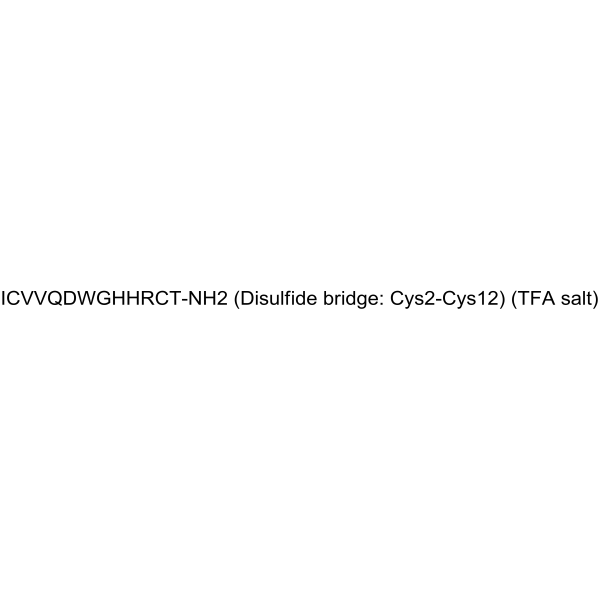
| ln Vitro | In vitro, compstatin has a half-life of roughly two hours in human blood[2]. Compstatin creates a hydrophobic cluster in solution by producing a β-turn at residues Gln-5–Gly-8, Ile–1–Val–4, and Thr–13, along with the disulfide bridge Cys-2–Cys12[3]. |
| ln Vivo | When administered as a bolus injection plus infusion, compstatin (21 mg/kg) results in total suppression. Compstatin completely prevents complement activation generated by heparin and prostamine in vivo, however without changing heart rate or pulmonary, central venous, or systemic artery pressures [1]. In baboon plasma, compstatin is stable for more than 24 hours[1]. The group that received Compstatin perfusion had a considerably longer survival rate for pig xenografts than the control group [2]. |
| Animal Protocol |
Animal/Disease Models: Juvenile baboons (P. Anubis) weighing 10.5-28.8 kg[1]. Doses: 50, 25 mg/kg 60 min after heparin and 2 min before protamine. Route of Administration: A bolus injection. Experimental Results: Completely inhibited complement activation induced by heparin–protamine complexes. |
| References |
[1]. Inhibition of heparin/protamine complex-induced complement activation by Compstatin in baboons. Clin Immunol. 2000 Sep;96(3):212-21. [2]. Compstatin, a peptide inhibitor of C3, prolongs survival of ex vivo perfused pig xenografts. Xenotransplantation. 1999 Feb;6(1):52-65. [3]. Structure of compstatin in complex with complement component C3c reveals a new mechanism of complement inhibition. J Biol Chem. 2007 Oct 5;282(40):29241-7. [4]. Inhibition of human complement by a C3-binding peptide isolated from a phage-displayed random peptide library. J Immunol. 1996 Jul 15;157(2):884-91. |
Solubility Data
| Solubility (In Vitro) |
DMSO :~100 mg/mL (~60.07 mM) H2O :~50 mg/mL (~30.03 mM) |
| Solubility (In Vivo) |
Solubility in Formulation 1: ≥ 2.75 mg/mL (1.65 mM) (saturation unknown) in 10% DMSO + 40% PEG300 + 5% Tween80 + 45% Saline (add these co-solvents sequentially from left to right, and one by one), clear solution. For example, if 1 mL of working solution is to be prepared, you can add 100 μL of 27.5 mg/mL clear DMSO stock solution to 400 μL PEG300 and mix evenly; then add 50 μL Tween-80 to the above solution and mix evenly; then add 450 μL normal saline to adjust the volume to 1 mL. Preparation of saline: Dissolve 0.9 g of sodium chloride in 100 mL ddH₂ O to obtain a clear solution. Solubility in Formulation 2: ≥ 2.75 mg/mL (1.65 mM) (saturation unknown) in 10% DMSO + 90% (20% SBE-β-CD in Saline) (add these co-solvents sequentially from left to right, and one by one), clear solution. For example, if 1 mL of working solution is to be prepared, you can add 100 μL of 27.5 mg/mL clear DMSO stock solution to 900 μL of 20% SBE-β-CD physiological saline solution and mix evenly. Preparation of 20% SBE-β-CD in Saline (4°C,1 week): Dissolve 2 g SBE-β-CD in 10 mL saline to obtain a clear solution. Solubility in Formulation 3: ≥ 2.75 mg/mL (1.65 mM) (saturation unknown) in 10% DMSO + 90% Corn Oil (add these co-solvents sequentially from left to right, and one by one), clear solution. For example, if 1 mL of working solution is to be prepared, you can add 100 μL of 27.5 mg/mL clear DMSO stock solution to 900 μL of corn oil and mix evenly. (Please use freshly prepared in vivo formulations for optimal results.) |
| Preparing Stock Solutions | 1 mg | 5 mg | 10 mg | |
| 1 mM | 0.6007 mL | 3.0034 mL | 6.0068 mL | |
| 5 mM | 0.1201 mL | 0.6007 mL | 1.2014 mL | |
| 10 mM | 0.0601 mL | 0.3003 mL | 0.6007 mL |