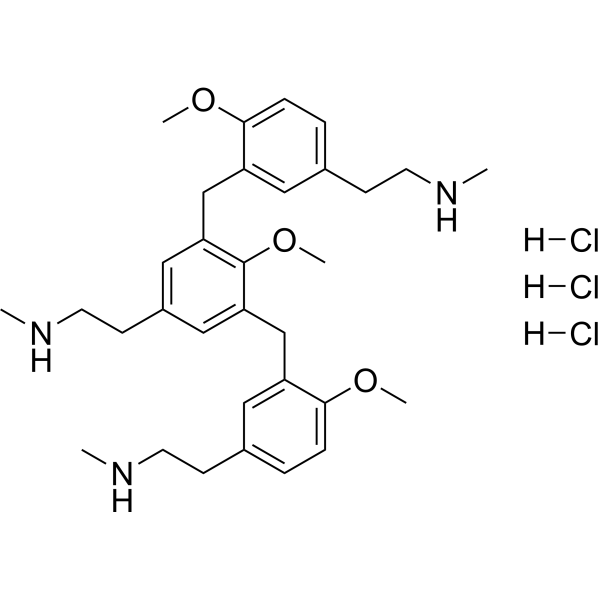
Physicochemical Properties
| Molecular Formula | C32H48CL3N3O3 |
| Molecular Weight | 629.100826263428 |
| Exact Mass | 627.276 |
| CAS # | 848035-21-2 |
| Related CAS # | Compound 48/80;94724-12-6 |
| PubChem CID | 118797323 |
| Appearance | White to off-white solid powder |
| Hydrogen Bond Donor Count | 6 |
| Hydrogen Bond Acceptor Count | 6 |
| Rotatable Bond Count | 16 |
| Heavy Atom Count | 41 |
| Complexity | 577 |
| Defined Atom Stereocenter Count | 0 |
| SMILES | Cl.Cl.Cl.O(C)C1C(=CC(CCNC)=CC=1CC1C(=CC=C(CCNC)C=1)OC)CC1C(=CC=C(CCNC)C=1)OC |
| InChi Key | KIAWAQJORBNOIF-UHFFFAOYSA-N |
| InChi Code | InChI=1S/C32H45N3O3.3ClH/c1-33-14-11-23-7-9-30(36-4)26(17-23)21-28-19-25(13-16-35-3)20-29(32(28)38-6)22-27-18-24(12-15-34-2)8-10-31(27)37-5;;;/h7-10,17-20,33-35H,11-16,21-22H2,1-6H3;3*1H |
| Chemical Name | 2-[4-methoxy-3-[[2-methoxy-3-[[2-methoxy-5-[2-(methylamino)ethyl]phenyl]methyl]-5-[2-(methylamino)ethyl]phenyl]methyl]phenyl]-N-methylethanamine;trihydrochloride |
| HS Tariff Code | 2934.99.9001 |
| Storage |
Powder-20°C 3 years 4°C 2 years In solvent -80°C 6 months -20°C 1 month Note: Please store this product in a sealed and protected environment, avoid exposure to moisture. |
| Shipping Condition | Room temperature (This product is stable at ambient temperature for a few days during ordinary shipping and time spent in Customs) |
Biological Activity
| ln Vitro | Compound 48/80 trihydrochloride, also known as C48/80 trihydrochloride, exhibits a comparable level of efficacy in inhibiting phosphatidylphospholipidase C activity in the cytosol; its IC50 values are 2.1 μg/mL for the supernatant and 5.0 μg/mL for the granular compound. Additionally, it has been observed that C48/80 trihydrochloride inhibits human focal aggregation induced by ADP and PAF ether [1]. |
| ln Vivo | Serotonin, histamine, and corticosterone levels are increased by compound 48/80 trihydrochloride (0.75 mg/kg; intraperitoneal; killed after 0.5, 3, or 6 h); however, the amount of these increases decreases after 0.5 h [3]. Compound 48/80 trihydrochloride induces redox through mast cell degranulation [3]. |
| Animal Protocol |
Animal/Disease Models: 7weeks old Wistar male rats (fasted for 24 hrs (hrs (hours))) [3] Doses: 0.75 mg/kg]. Route of Administration: intraperitoneal (ip) injection; sacrificed after 0.5, 3 or 6 hrs (hrs (hours)). Experimental Results: 0.5 hrs (hrs (hours)) after treatment, serum histamine and serotonin concentrations were Dramatically higher than untreated control rats. Serum histamine and serotonin concentrations increased in rats and subsequently diminished in a time-dependent manner. |
| References |
[1]. Compound 48/80 is a potent inhibitor of phospholipase C and a dual modulator of phospholipase A2 from human platelet. Biochim Biophys Acta. 1987 Aug 15;920(3):301-5. [2]. The mast cell degranulator compound 48/80 directly activates neurons. PLoS One. 2012;7(12):e52104. [3]. Compound 48/80 causes oxidative stress in the adrenal gland of rats through mast cell degranulation. Free Radic Res. 2010 Feb;44(2):171-80. |
Solubility Data
| Solubility (In Vitro) |
H2O : ~25 mg/mL (~39.74 mM) DMSO : ~10 mg/mL (~15.90 mM) |
| Solubility (In Vivo) |
Solubility in Formulation 1: ≥ 2.5 mg/mL (3.97 mM) (saturation unknown) in 10% DMSO + 40% PEG300 + 5% Tween80 + 45% Saline (add these co-solvents sequentially from left to right, and one by one), clear solution. For example, if 1 mL of working solution is to be prepared, you can add 100 μL of 25.0 mg/mL clear DMSO stock solution to 400 μL PEG300 and mix evenly; then add 50 μL Tween-80 to the above solution and mix evenly; then add 450 μL normal saline to adjust the volume to 1 mL. Preparation of saline: Dissolve 0.9 g of sodium chloride in 100 mL ddH₂ O to obtain a clear solution. Solubility in Formulation 2: ≥ 2.5 mg/mL (3.97 mM) (saturation unknown) in 10% DMSO + 90% (20% SBE-β-CD in Saline) (add these co-solvents sequentially from left to right, and one by one), clear solution. For example, if 1 mL of working solution is to be prepared, you can add 100 μL of 25.0 mg/mL clear DMSO stock solution to 900 μL of 20% SBE-β-CD physiological saline solution and mix evenly. Preparation of 20% SBE-β-CD in Saline (4°C,1 week): Dissolve 2 g SBE-β-CD in 10 mL saline to obtain a clear solution. (Please use freshly prepared in vivo formulations for optimal results.) |
| Preparing Stock Solutions | 1 mg | 5 mg | 10 mg | |
| 1 mM | 1.5896 mL | 7.9479 mL | 15.8957 mL | |
| 5 mM | 0.3179 mL | 1.5896 mL | 3.1791 mL | |
| 10 mM | 0.1590 mL | 0.7948 mL | 1.5896 mL |