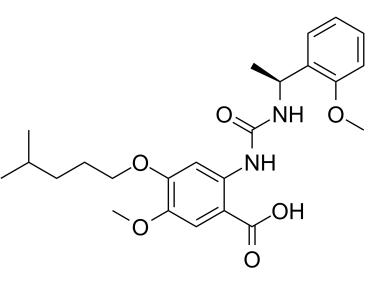
Complement C5-IN-1 is a novel, potent small-molecule inhibitor of complement component 5 protein (C5). Complement C5-IN-1 interacts with C5 to prevent its cleavage by the C5 convertase and blocks zymosan-induced the membrane-attack complex (MAC) deposition in 50% human whole blood with an IC50 of 0.77 µM.
Physicochemical Properties
| Molecular Formula | C24H32N2O6 |
| Molecular Weight | 444.520687103271 |
| Exact Mass | 444.226 |
| CAS # | 2365402-67-9 |
| PubChem CID | 138059708 |
| Appearance | White to off-white solid powder |
| LogP | 4.9 |
| Hydrogen Bond Donor Count | 3 |
| Hydrogen Bond Acceptor Count | 6 |
| Rotatable Bond Count | 11 |
| Heavy Atom Count | 32 |
| Complexity | 587 |
| Defined Atom Stereocenter Count | 1 |
| SMILES | N(C1C=C(OCCCC(C)C)C(OC)=CC=1C(=O)O)C(=O)N[C@H](C1C=CC=CC=1OC)C |
| InChi Key | UFAFCKVYKJIJTR-INIZCTEOSA-N |
| InChi Code | InChI=1S/C24H32N2O6/c1-15(2)9-8-12-32-22-14-19(18(23(27)28)13-21(22)31-5)26-24(29)25-16(3)17-10-6-7-11-20(17)30-4/h6-7,10-11,13-16H,8-9,12H2,1-5H3,(H,27,28)(H2,25,26,29)/t16-/m0/s1 |
| Chemical Name | 5-methoxy-2-[[(1S)-1-(2-methoxyphenyl)ethyl]carbamoylamino]-4-(4-methylpentoxy)benzoic acid |
| HS Tariff Code | 2934.99.9001 |
| Storage |
Powder-20°C 3 years 4°C 2 years In solvent -80°C 6 months -20°C 1 month |
| Shipping Condition | Room temperature (This product is stable at ambient temperature for a few days during ordinary shipping and time spent in Customs) |
Biological Activity
| Targets |
Complement C5 (human C5: IC50 = 11 nM; rat C5: IC50 = 45 nM; mouse C5: IC50 = 2.3 μM) [1] |
| ln Vitro |
1. C5 cleavage inhibition: - Complement C5-IN-1 selectively inhibits cleavage of human C5 by C5 convertase, with an IC50 of 11 nM [1] - It inhibits rat C5 cleavage with an IC50 of 45 nM, while showing weaker activity against mouse C5 (IC50 = 2.3 μM) [1] - The drug does not inhibit cleavage of other complement components (C3, C4) even at concentrations up to 10 μM [1] 2. Membrane Attack Complex (MAC) formation inhibition: - Complement C5-IN-1 blocks MAC (C5b-9) formation in human serum-activated complement system, with an IC50 of 15 nM [1] - In rat serum, it inhibits MAC formation with an IC50 of 52 nM, consistent with its rat C5 binding affinity [1] - It does not interfere with C3a or C4a generation, confirming selectivity for C5 [1] 3. Cell protection against complement-mediated lysis: - Complement C5-IN-1 protects K562 cells from human complement-mediated cytotoxicity, with an EC50 of 19 nM [1] - At 100 nM, it reduces complement-dependent cell lysis by >90% compared to the control group [1] |
| ln Vivo |
1. Xenograft rejection prevention in rats: - Complement C5-IN-1 (10 mg/kg, i.v. bolus followed by 5 mg/kg/h infusion for 7 days) significantly prolongs survival of human erythrocyte xenografts in rats [1] - Median graft survival time increased from 1.2 hours (control) to 16.8 hours (drug-treated group), with >80% reduction in MAC deposition on erythrocytes [1] 2. Complement-mediated tissue injury inhibition: - In rat model of complement-dependent lung injury, Complement C5-IN-1 (20 mg/kg, i.v.) reduces pulmonary vascular permeability by 65% and neutrophil infiltration by 58% compared to controls [1] - It inhibits MAC deposition in lung tissue (detected by immunohistochemistry) and decreases serum levels of soluble C5b-9 (sC5b-9) by 72% [1] |
| Enzyme Assay |
1. C5 cleavage inhibition assay: - Purified human/rat/mouse C5 is diluted in complement buffer to a final concentration of 100 nM [1] - Complement C5-IN-1 is serially diluted (0.1 nM to 10 μM) and mixed with C5, followed by incubation at 37°C for 30 minutes [1] - Human C5 convertase (C3bBbC3b) or rat C5 convertase is added to initiate C5 cleavage, and the reaction is incubated for 1 hour at 37°C [1] - Cleavage products (C5a and C5b) are detected by SDS-PAGE and Western blot using anti-C5a antibodies, and IC50 values are calculated by quantifying the reduction in cleavage products [1] 2. Surface plasmon resonance (SPR) binding assay: - Human C5 is immobilized on a CM5 sensor chip via amine coupling to a density of ~1000 resonance units (RU) [1] - Complement C5-IN-1 is serially diluted (0.3 nM to 300 nM) in running buffer (PBS with 0.05% Tween-20) and injected over the chip at a flow rate of 30 μl/min [1] - Association and dissociation phases are monitored for 120 seconds and 300 seconds, respectively, and the chip is regenerated with 10 mM glycine-HCl (pH 2.5) [1] - Binding affinity (KD) is calculated using a 1:1 Langmuir binding model, with a measured KD of 8.7 nM for human C5 [1] 3. MAC formation assay: - Normal human serum is diluted 1:10 in complement buffer and mixed with serial dilutions of Complement C5-IN-1 (0.5 nM to 500 nM) [1] - The mixture is added to wells coated with zymosan (complement activator) and incubated at 37°C for 2 hours [1] - MAC (C5b-9) formation is detected using a specific anti-C5b-9 antibody and a horseradish peroxidase (HRP)-conjugated secondary antibody [1] - Absorbance at 450 nm is measured, and IC50 is calculated by fitting the dose-response curve [1] |
| Cell Assay |
1. Complement-mediated cytotoxicity protection assay: - K562 cells are seeded in 96-well plates at a density of 2×10^4 cells per well and incubated overnight in RPMI 1640 medium [1] - Complement C5-IN-1 is serially diluted (1 nM to 1000 nM) and added to the cells, followed by incubation at 37°C for 30 minutes [1] - Normal human serum (complement source) is added at a final dilution of 1:8, and the plates are incubated for 1 hour at 37°C with 5% CO2 [1] - Cell viability is measured using a lactate dehydrogenase (LDH) release assay, and EC50 is determined by the concentration that inhibits 50% of LDH release [1] 2. MAC deposition immunofluorescence assay: - HUVECs are seeded on glass coverslips and cultured until confluent [1] - Cells are pre-treated with Complement C5-IN-1 (50 nM) for 30 minutes, then exposed to human serum (1:10 dilution) and TNF-α (10 ng/ml) for 4 hours [1] - Cells are fixed with 4% paraformaldehyde, permeabilized with 0.1% Triton X-100, and incubated with anti-C5b-9 primary antibody and Alexa Fluor-conjugated secondary antibody [1] - Nuclei are stained with DAPI, and MAC deposition is visualized using confocal microscopy; fluorescence intensity is quantified using image analysis software [1] |
| Animal Protocol |
1. Rat xenograft survival model: - Male Wistar rats (250-300 g) are anesthetized with isoflurane [1] - Human erythrocytes (5×10^8 cells) are injected via the tail vein as xenografts [1] - Complement C5-IN-1 is dissolved in 10% DMSO + 90% saline, administered as an intravenous bolus (10 mg/kg) immediately after xenograft injection, followed by continuous infusion (5 mg/kg/h) via osmotic minipumps for 7 days [1] - Blood samples are collected at 1, 4, 8, 12, and 24 hours to measure human erythrocyte counts and serum sC5b-9 levels [1] - Graft survival time is defined as the time when human erythrocyte count drops to <10% of the initial value [1] 2. Rat complement-mediated lung injury model: - Male Sprague-Dawley rats (200-250 g) are randomized into control and drug-treated groups [1] - Complement C5-IN-1 is dissolved in 5% DMSO + 95% saline and administered intravenously at a dose of 20 mg/kg 30 minutes before injury induction [1] - Lung injury is induced by intravenous injection of cobra venom factor (CVF, 10 U/kg) [1] - Six hours after CVF injection, rats are euthanized, and lung tissues are collected for histopathological analysis, MAC deposition detection, and myeloperoxidase (MPO) activity assay [1] - Bronchoalveolar lavage fluid (BALF) is collected to measure protein concentration (vascular permeability marker) [1] |
| ADME/Pharmacokinetics |
- Complement C5-IN-1 shows a plasma half-life (t1/2) of 2.8 hours in rats after intravenous administration (10 mg/kg) [1] - Volume of distribution (Vd) is 0.35 L/kg, and total body clearance (CL) is 89 ml/kg/h [1] - Oral bioavailability is 12% (rats, 20 mg/kg p.o.), with peak plasma concentration (Cmax) of 320 ng/ml achieved at 1 hour post-administration [1] - Plasma protein binding rate is 92% (human plasma) and 88% (rat plasma) [1] |
| References |
[1]. A small-molecule inhibitor of C5 complement protein. Nat Chem Biol. 2019 Jul;15(7):666-668. |
Solubility Data
| Solubility (In Vitro) | DMSO : ≥ 100 mg/mL (~224.96 mM) |
| Solubility (In Vivo) |
Solubility in Formulation 1: ≥ 2.5 mg/mL (5.62 mM) (saturation unknown) in 10% DMSO + 40% PEG300 + 5% Tween80 + 45% Saline (add these co-solvents sequentially from left to right, and one by one), clear solution. For example, if 1 mL of working solution is to be prepared, you can add 100 μL of 25.0 mg/mL clear DMSO stock solution to 400 μL PEG300 and mix evenly; then add 50 μL Tween-80 to the above solution and mix evenly; then add 450 μL normal saline to adjust the volume to 1 mL. Preparation of saline: Dissolve 0.9 g of sodium chloride in 100 mL ddH₂ O to obtain a clear solution. Solubility in Formulation 2: ≥ 2.5 mg/mL (5.62 mM) (saturation unknown) in 10% DMSO + 90% Corn Oil (add these co-solvents sequentially from left to right, and one by one), clear solution. For example, if 1 mL of working solution is to be prepared, you can add 100 μL of 25.0 mg/mL clear DMSO stock solution to 900 μL of corn oil and mix evenly. (Please use freshly prepared in vivo formulations for optimal results.) |
| Preparing Stock Solutions | 1 mg | 5 mg | 10 mg | |
| 1 mM | 2.2496 mL | 11.2481 mL | 22.4962 mL | |
| 5 mM | 0.4499 mL | 2.2496 mL | 4.4992 mL | |
| 10 mM | 0.2250 mL | 1.1248 mL | 2.2496 mL |