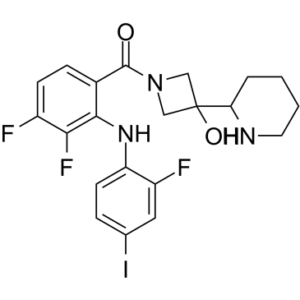
Cobimetinib racemate is the racemic mixture of Cobimetinib (GDC-0973, RG7420; XL-518; Cotellic), which is a novel, orally bioavailable, highly potent and selective small-molecule MEK1 inhibitor with antitumor activity. With an IC50 of 4.2 nM, it inhibits MEK1. In order to treat melanoma, cobimetinib was approved in 2015 as an anti-cancer drug to be used alone, in combination with vemurafenib, or in combination with both vemurafenib and atezolizumab. Extracellular signal-related kinase 2 (ERK2) phosphorylation and activation are inhibited, and tumor cell proliferation is decreased as a result of GDC-0973's specific binding to and inhibition of the catalytic activity of MEK1.
Physicochemical Properties
| Molecular Formula | C21H21F3IN3O2 | |
| Molecular Weight | 531.31 | |
| Exact Mass | 531.063 | |
| CAS # | 934662-91-6 | |
| Related CAS # | Cobimetinib;934660-93-2;Cobimetinib hemifumarate;1369665-02-0;Cobimetinib (R-enantiomer);934660-94-3;Cobimetinib-13C6 racemate | |
| PubChem CID | 51038893 | |
| Appearance | White to off-white solid | |
| LogP | 4.12 | |
| Hydrogen Bond Donor Count | 3 | |
| Hydrogen Bond Acceptor Count | 7 | |
| Rotatable Bond Count | 4 | |
| Heavy Atom Count | 30 | |
| Complexity | 624 | |
| Defined Atom Stereocenter Count | 0 | |
| SMILES | O=C(N1CC(C2CCCCN2)(O)C1)C1C(NC2C(F)=CC(I)=CC=2)=C(F)C(F)=CC=1 |
|
| InChi Key | BSMCAPRUBJMWDF-UHFFFAOYSA-N | |
| InChi Code | InChI=1S/C21H21F3IN3O2/c22-14-6-5-13(19(18(14)24)27-16-7-4-12(25)9-15(16)23)20(29)28-10-21(30,11-28)17-3-1-2-8-26-17/h4-7,9,17,26-27,30H,1-3,8,10-11H2 | |
| Chemical Name | [3,4-difluoro-2-(2-fluoro-4-iodoanilino)phenyl]-(3-hydroxy-3-piperidin-2-ylazetidin-1-yl)methanone | |
| Synonyms |
|
|
| HS Tariff Code | 2934.99.9001 | |
| Storage |
Powder-20°C 3 years 4°C 2 years In solvent -80°C 6 months -20°C 1 month |
|
| Shipping Condition | Room temperature (This product is stable at ambient temperature for a few days during ordinary shipping and time spent in Customs) |
Biological Activity
| ln Vitro | Cobimetinib shows strong activity on cell growth inhibtion in a broad panel of tumor types, particularly in BRAF or KRAS mutant cancer cell lines. GDC-0973 causes 888MEL and A2058 cells to undergo more apoptosis, pathway inhibition, and reduced viability when combined with GDC-0941. All BRAFV600E lines have increased levels of GLUT-1 on the cellular membrane following coadministration of GDC-0973 and vemurafenib. | ||
| ln Vivo | Cobimetinib (10 mg/kg, p.o.) and GDC-0973 and GDC-0941 together exhibit improved antitumor efficacy in mice with BRAFV600E and KRAS mutant tumors. Combining GDC-0973 and GDC-0941 results in lower levels of hexokinase II, c-RAF, Ksr, and p-MEK protein in mice with drug-resistant A375 xenografts. | ||
| Enzyme Assay | Cobimetinib (GDC-0973, RG7420) is a potent, selective and oral MEK1 inhibitor with an IC50 of 4.2 nM for MEK1. | ||
| Cell Assay | For 888MEL and A2058 cells, cobimetinib (GDC-0973) has EC50 values of 0.2 M and 10 M, respectively. Treatment of melanoma cells with EC50 concentrations of MEK and PI3K inhibitors (888MEL: 0.05 μM GDC-0973, 2.5 μM GDC-0941; A2058: 2.5 μM GDC-0973, 2.5 μM GDC-0941) lasts for 24 hours. In melanoma with constitutive MAPK activation in A375 cells, mitochondrial OXPHOS regulates the amount of cell death brought on by cobimetinib (100 nM). | ||
| Animal Protocol |
|
||
| References |
[1]. Intermittent administration of MEK inhibitor GDC-0973 plus PI3K inhibitor GDC-0941 triggers robust apoptosis and tumor growth inhibition. Cancer Res. 2012 Jan 1;72(1):210-9. |
||
| Additional Infomation | See also: Cobimetinib (annotation moved to). |
Solubility Data
| Solubility (In Vitro) |
|
|||
| Solubility (In Vivo) |
Solubility in Formulation 1: ≥ 2.5 mg/mL (4.71 mM) (saturation unknown) in 10% DMSO + 40% PEG300 + 5% Tween80 + 45% Saline (add these co-solvents sequentially from left to right, and one by one), clear solution. For example, if 1 mL of working solution is to be prepared, you can add 100 μL of 25.0 mg/mL clear DMSO stock solution to 400 μL PEG300 and mix evenly; then add 50 μL Tween-80 to the above solution and mix evenly; then add 450 μL normal saline to adjust the volume to 1 mL. Preparation of saline: Dissolve 0.9 g of sodium chloride in 100 mL ddH₂ O to obtain a clear solution. Solubility in Formulation 2: ≥ 2.5 mg/mL (4.71 mM) (saturation unknown) in 10% DMSO + 90% (20% SBE-β-CD in Saline) (add these co-solvents sequentially from left to right, and one by one), clear solution. For example, if 1 mL of working solution is to be prepared, you can add 100 μL of 25.0 mg/mL clear DMSO stock solution to 900 μL of 20% SBE-β-CD physiological saline solution and mix evenly. Preparation of 20% SBE-β-CD in Saline (4°C,1 week): Dissolve 2 g SBE-β-CD in 10 mL saline to obtain a clear solution. Solubility in Formulation 3: ≥ 2.5 mg/mL (4.71 mM) (saturation unknown) in 10% DMSO + 90% Corn Oil (add these co-solvents sequentially from left to right, and one by one), clear solution. For example, if 1 mL of working solution is to be prepared, you can add 100 μL of 25.0 mg/mL clear DMSO stock solution to 900 μL of corn oil and mix evenly. Solubility in Formulation 4: 5% DMSO+30% PEG 300+5% Tween 80+ddH2O: 5mg/mL (Please use freshly prepared in vivo formulations for optimal results.) |
| Preparing Stock Solutions | 1 mg | 5 mg | 10 mg | |
| 1 mM | 1.8821 mL | 9.4107 mL | 18.8214 mL | |
| 5 mM | 0.3764 mL | 1.8821 mL | 3.7643 mL | |
| 10 mM | 0.1882 mL | 0.9411 mL | 1.8821 mL |