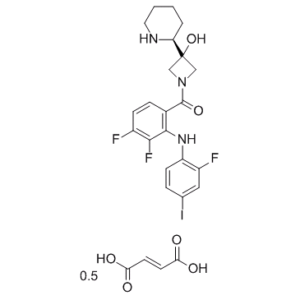
Cobimetinib hemifumarate (formerly also known as RG7420; XL518; GDC0973), the hemifumarate salt of cobimetinib, is an oral, highly potent and selective MEK1 inhibitor with potential antineoplastic activity. IWith an IC50 of 4.2 nM, it blocks MEK1.
Physicochemical Properties
| Molecular Formula | C₂₅H₂₅F₃IN₃O₆ | |
| Molecular Weight | 647.38 | |
| Exact Mass | 647.074 | |
| Elemental Analysis | C, 46.87; H, 3.93; F, 9.67; I, 21.53; N, 7.13; O, 10.86 | |
| CAS # | 1369665-02-0 | |
| Related CAS # | Cobimetinib;934660-93-2;Cobimetinib racemate;934662-91-6;Cobimetinib (R-enantiomer);934660-94-3 | |
| PubChem CID | 71491931 | |
| Appearance | White to off-white solid powder | |
| LogP | 3.832 | |
| Hydrogen Bond Donor Count | 8 | |
| Hydrogen Bond Acceptor Count | 18 | |
| Rotatable Bond Count | 10 | |
| Heavy Atom Count | 68 | |
| Complexity | 743 | |
| Defined Atom Stereocenter Count | 2 | |
| SMILES | IC1C=CC(=C(C=1)F)NC1=C(C(=CC=C1C(N1CC(C1)([C@@H]1CCCCN1)O)=O)F)F.IC1C=CC(=C(C=1)F)NC1=C(C(=CC=C1C(N1CC(C1)([C@@H]1CCCCN1)O)=O)F)F.OC(/C=C/C(=O)O)=O |
|
| InChi Key | RESIMIUSNACMNW-BXRWSSRYSA-N | |
| InChi Code | InChI=1S/2C21H21F3IN3O2.C4H4O4/c2*22-14-6-5-13(19(18(14)24)27-16-7-4-12(25)9-15(16)23)20(29)28-10-21(30,11-28)17-3-1-2-8-26-17;5-3(6)1-2-4(7)8/h2*4-7,9,17,26-27,30H,1-3,8,10-11H2;1-2H,(H,5,6)(H,7,8)/b;;2-1+/t2*17-;/m00./s1 | |
| Chemical Name | (E)-but-2-enedioic acid;[3,4-difluoro-2-(2-fluoro-4-iodoanilino)phenyl]-[3-hydroxy-3-[(2S)-piperidin-2-yl]azetidin-1-yl]methanone | |
| Synonyms |
|
|
| HS Tariff Code | 2934.99.9001 | |
| Storage |
Powder-20°C 3 years 4°C 2 years In solvent -80°C 6 months -20°C 1 month Note: Please store this product in a sealed and protected environment, avoid exposure to moisture. |
|
| Shipping Condition | Room temperature (This product is stable at ambient temperature for a few days during ordinary shipping and time spent in Customs) |
Biological Activity
| Targets | MEK1 (IC50 = 4.2 nM) |
| ln Vitro | Cobimetinib (GDC-0973) has an EC50 of 0.2 μM and 10 μM for 888MEL and A2058 cells, respectively. (888MEL: 0.05 μM GDC-0973, 2.5 μM GDC-0941; A2058: 2.5 μM GDC-0973, 2.5 μM GDC-0941)[1] Melanoma cells are treated with EC50 concentrations of MEK and PI3K inhibitors for 24 hours. When cobimetinib (100 nM) is used to treat melanoma cells in A375 cells, mitochondrial OXPHOS limits the amount of cell death that is induced[4]. |
| ln Vivo | Treatment with Cobimetinib (GDC-0973) up to 5 mg/kg causes moderate TGI in the NCI-H2122 KRASG12C mutant non-small cell lung carcinoma (NSCLC) xenograft model, and at 10 mg/kg approaches tumor stasis[1]. GDC-0973 and GDC-0941 are given to mice with the A2058 tumor daily (QD) or every third day (Q3D), either separately or together. For GDC-0973 and GDC-0941, the population rate constants linked to tumor growth inhibition are 0.00102 and 0000651 μM-1 h-1, respectively[2]. Based on tumor concentrations in xenografted mice, the estimated in vivo IC50 values of %pERK decrease are 0.78 (WM-266-4) and 0.52 μM (A375) after single doses of GDC-0973 (1, 3, or 10 mg/kg, p.o.)[3]. |
| Enzyme Assay | Cobimetinib (GDC-0973, RG7420) is a potent, selective and oral MEK1 inhibitor with an IC50 of 4.2 nM for MEK1. |
| Animal Protocol | Female NCR nude mice have had 5 million WM-266-4 melanoma cells intradermally implanted into the hind flank. The cells were resuspended in Hank balanced salt solution. Xenograft mice with tumor volumes of roughly 100 to 120 mm3 are randomly assigned to 4 single dose groups and 4 multiple dose groups on days 11 or 13 following the implantation. Mice in the single dose groups receive a single oral dose of the drug Cobimetinib (GDC-0973, expressed as free base equivalents), vehicle (water for injection USP), 1, 3, or 10 mg/kg one day after randomization and group assignment. For 14 days, mice in the multiple dose groups receive daily oral doses of the GDC-0973 1, 3, or 10 mg/kg, vehicle (water for injection USP), or both. On day 1 (single dose groups) or day 14 (multiple dose groups), plasma and tumor samples (n=3 per time point) are taken from euthanized mice predose and at 2, 4, 8, 16, 24, 72, and 168 hours postdose. Samples are kept until analysis at 80°C. Liquid chromatography/tandem mass spectrometry (LC/MS-MS) is used to assess the concentrations of GDC-0973 in tumor lysates and plasma. The assay's dynamic range is 0.004 to 35 μM. |
| References |
[1]. Intermittent administration of MEK inhibitor GDC-0973 plus PI3K inhibitor GDC-0941 triggers robust apoptosis and tumor growth inhibition. Cancer Res. 2012 Jan 1;72(1):210-9. [2]. PK-PD modeling of combination efficacy effect from administration of the MEK inhibitor GDC-0973 and PI3K inhibitor GDC-0941 in A2058 xenografts. Cancer Chemother Pharmacol. 2013 Jan;71(1):133-43. [3]. Bridging the gap between preclinical and clinical studies using pharmacokinetic-pharmacodynamic modeling: an analysis of GDC-0973, a MEK inhibitor. Clin Cancer Res. 2012 Jun 1;18(11):3090-9. [4]. Mitochondrial oxidative phosphorylation controls cancer cell's life and death decisions upon exposure to MAPK inhibitors. Oncotarget. 2016 Feb 29. doi: 10.18632/oncotarget.7790. |
| Additional Infomation |
Cobimetinib fumarate is a fumarate salt prepared from cobimetinib by reaction of one molecule of fumaric acid for every two molecules of cobimetinib. An inhibitor of mitogen-activated protein kinase that is used in combination with vemurafenib for the treatment of patients with unresectable or metastatic melanoma. It has a role as an EC 2.7.11.24 (mitogen-activated protein kinase) inhibitor and an antineoplastic agent. It is a fumarate salt and an organoammonium salt. It contains a cobimetinib(1+). See also: Cobimetinib (has active moiety). Drug Indication Cotellic is indicated for use in combination with vemurafenib for the treatment of adult patients with unresectable or metastatic melanoma with a BRAF V600 mutation. |
Solubility Data
| Solubility (In Vitro) |
|
|||
| Solubility (In Vivo) |
Solubility in Formulation 1: ≥ 2.5 mg/mL (4.24 mM) (saturation unknown) in 10% DMSO + 40% PEG300 + 5% Tween80 + 45% Saline (add these co-solvents sequentially from left to right, and one by one), clear solution. For example, if 1 mL of working solution is to be prepared, you can add 100 μL of 25.0 mg/mL clear DMSO stock solution to 400 μL PEG300 and mix evenly; then add 50 μL Tween-80 to the above solution and mix evenly; then add 450 μL normal saline to adjust the volume to 1 mL. Preparation of saline: Dissolve 0.9 g of sodium chloride in 100 mL ddH₂ O to obtain a clear solution. Solubility in Formulation 2: ≥ 2.5 mg/mL (4.24 mM) (saturation unknown) in 10% DMSO + 90% (20% SBE-β-CD in Saline) (add these co-solvents sequentially from left to right, and one by one), clear solution. For example, if 1 mL of working solution is to be prepared, you can add 100 μL of 25.0 mg/mL clear DMSO stock solution to 900 μL of 20% SBE-β-CD physiological saline solution and mix evenly. Preparation of 20% SBE-β-CD in Saline (4°C,1 week): Dissolve 2 g SBE-β-CD in 10 mL saline to obtain a clear solution. Solubility in Formulation 3: ≥ 2.5 mg/mL (4.24 mM) (saturation unknown) in 10% DMSO + 90% Corn Oil (add these co-solvents sequentially from left to right, and one by one), clear solution. For example, if 1 mL of working solution is to be prepared, you can add 100 μL of 25.0 mg/mL clear DMSO stock solution to 900 μL of corn oil and mix evenly. Solubility in Formulation 4: ≥ 2.5 mg/mL (4.24 mM) (saturation unknown) in 5% DMSO + 40% PEG300 + 5% Tween80 + 50% Saline (add these co-solvents sequentially from left to right, and one by one), clear solution. Preparation of saline: Dissolve 0.9 g of sodium chloride in 100 mL ddH₂ O to obtain a clear solution. Solubility in Formulation 5: ≥ 2.5 mg/mL (4.24 mM) (saturation unknown) in 5% DMSO + 95% (20% SBE-β-CD in Saline) (add these co-solvents sequentially from left to right, and one by one), clear solution. Preparation of 20% SBE-β-CD in Saline (4°C,1 week): Dissolve 2 g SBE-β-CD in 10 mL saline to obtain a clear solution. Solubility in Formulation 6: 5% DMSO+30% PEG 300+5% Tween 80+ddH2O: 5mg/mL (Please use freshly prepared in vivo formulations for optimal results.) |
| Preparing Stock Solutions | 1 mg | 5 mg | 10 mg | |
| 1 mM | 1.5447 mL | 7.7234 mL | 15.4469 mL | |
| 5 mM | 0.3089 mL | 1.5447 mL | 3.0894 mL | |
| 10 mM | 0.1545 mL | 0.7723 mL | 1.5447 mL |