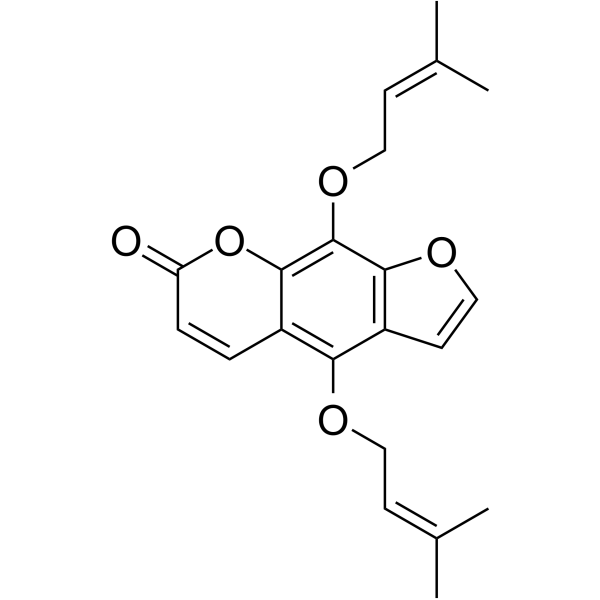
Physicochemical Properties
| Molecular Formula | C21H22O5 |
| Molecular Weight | 354.3964 |
| Exact Mass | 354.146 |
| CAS # | 14348-21-1 |
| PubChem CID | 10043694 |
| Appearance | Off-white to light yellow solid powder |
| Density | 1.2±0.1 g/cm3 |
| Boiling Point | 519.0±50.0 °C at 760 mmHg |
| Flash Point | 267.7±30.1 °C |
| Vapour Pressure | 0.0±1.4 mmHg at 25°C |
| Index of Refraction | 1.580 |
| LogP | 6.07 |
| Hydrogen Bond Donor Count | 0 |
| Hydrogen Bond Acceptor Count | 5 |
| Rotatable Bond Count | 6 |
| Heavy Atom Count | 26 |
| Complexity | 598 |
| Defined Atom Stereocenter Count | 0 |
| InChi Key | HJMDOAWWVCOEDW-UHFFFAOYSA-N |
| InChi Code | InChI=1S/C21H22O5/c1-13(2)7-10-23-18-15-5-6-17(22)26-20(15)21(25-11-8-14(3)4)19-16(18)9-12-24-19/h5-9,12H,10-11H2,1-4H3 |
| Chemical Name | 4,9-bis(3-methylbut-2-enoxy)furo[3,2-g]chromen-7-one |
| HS Tariff Code | 2934.99.9001 |
| Storage |
Powder-20°C 3 years 4°C 2 years In solvent -80°C 6 months -20°C 1 month Note: Please store this product in a sealed and protected environment (e.g. under nitrogen), avoid exposure to moisture and light. |
| Shipping Condition | Room temperature (This product is stable at ambient temperature for a few days during ordinary shipping and time spent in Customs) |
Biological Activity
| ln Vitro |
In a dose-dependent manner, cnidicin significantly inhibits the production of nitric oxide in activated RAW264.7 cells (IC50=7.5 μM) and β-hexosaminidase release in cultured RBL-2H3 cells (IC50= 25 μM). 1]. Cnidicin demonstrated a significant, dose-dependent inhibition of β-hexosaminidase release from IgE-sensitized RBL-2H3 mast cells with an IC50 value of 25 ± 2.1 μM, which was comparable to the anti-allergic drug azelastine (IC50 26 ± 3.2 μM). [1] Cnidicin significantly inhibited nitric oxide (NO) production in lipopolysaccharide (LPS)-activated RAW264.7 murine macrophage cells in a dose-dependent manner with an IC50 value of 7.5 ± 1.4 μM. Dexamethasone, used as a positive control, had an IC50 of approximately 0.1 μM under the same conditions. [1] Immunoblot analysis confirmed that cnidicin inhibited the expression of inducible nitric oxide synthase (iNOS) protein in LPS-stimulated RAW264.7 cells. [1] Five other coumarins (isoimperatorin, imperatorin, oxypeucedanin, byakangelicol, and oxypeucedanin hydrate) isolated alongside cnidicin did not show significant inhibition of β-hexosaminidase release at 30 μM. [1] |
| Cell Assay |
β-hexosaminidase release assay: RBL-2H3 cells were treated with 0.5 μg/ml IgE overnight. The next morning, cells were treated with 1 μg/ml DNP-BSA to stimulate degranulation in the presence or absence of test compounds. The release of β-hexosaminidase into the supernatant was measured. Percent inhibition was calculated as: (Treated – Blank – Spontaneous) / (Control – Blank – Spontaneous). Control: allergen-IgE response without test material. Treated: allergen-IgE response with test material. Blank: only test material and substrate. Spontaneous: no allergen-IgE stimulation and no test material. Test compounds were dissolved in DMSO, with the final DMSO concentration adjusted to 0.05%. [1] Nitric oxide production assay: RAW264.7 cells were stimulated with 1 μg/ml LPS for 24 hours in the presence or absence of test compounds. The amount of nitrite (NO2-) in the culture supernatant, indicative of NO production, was measured using the Griess reagent. Percent NO production was calculated as: (Treated – Blank – Spontaneous) / (Control – Blank – Spontaneous). Control: cells treated with LPS only. Treated: cells treated with LPS and test material. Blank: only test material and Griess reagent. Spontaneous: only Griess reagent. Test compounds were dissolved in DMSO, with the final DMSO concentration adjusted to 0.025%. [1] Immunoblotting for iNOS: RAW264.7 cells were stimulated with 1 μg/ml LPS alone or with cnidicin for 24 hours. Cells were lysed by freeze-thaw cycles and centrifuged. The supernatant containing 20 μg of protein was analyzed by 8% SDS-PAGE gel electrophoresis, followed by immunoblotting using antibodies against iNOS. [1] |
| References |
[1]. Cnidicin, a coumarin, from the root of Angelica koreana, inhibits the degranulation of mast cell and the NO generation in RAW 264.7 cells. Planta Med. 2001 Mar;67(2):172-4. |
| Additional Infomation |
Cnidicin has been reported in Ostericum grosseserratum with data available. Cnidicin is a coumarin compound isolated from the hexane-soluble fraction of a methanol extract of the root of Angelica koreana (Umbelliferae). [1] The study was activity-guided, starting from the observation that the root extract inhibited degranulation in cultured mast cells. [1] Cnidicin was identified as the active principle responsible for the anti-allergic (inhibiting mast cell degranulation) and anti-inflammatory (inhibiting NO production and iNOS expression) effects observed in vitro. [1] The chemical structures of cnidicin and five related coumarins isolated from the same plant are provided in the literature. [1] |
Solubility Data
| Solubility (In Vitro) | DMSO : ~100 mg/mL (~282.17 mM) |
| Solubility (In Vivo) |
Note: Listed below are some common formulations that may be used to formulate products with low water solubility (e.g. < 1 mg/mL), you may test these formulations using a minute amount of products to avoid loss of samples. Injection Formulations (e.g. IP/IV/IM/SC) Injection Formulation 1: DMSO : Tween 80: Saline = 10 : 5 : 85 (i.e. 100 μL DMSO stock solution → 50 μL Tween 80 → 850 μL Saline) *Preparation of saline: Dissolve 0.9 g of sodium chloride in 100 mL ddH ₂ O to obtain a clear solution. Injection Formulation 2: DMSO : PEG300 :Tween 80 : Saline = 10 : 40 : 5 : 45 (i.e. 100 μL DMSO → 400 μLPEG300 → 50 μL Tween 80 → 450 μL Saline) Injection Formulation 3: DMSO : Corn oil = 10 : 90 (i.e. 100 μL DMSO → 900 μL Corn oil) Example: Take the Injection Formulation 3 (DMSO : Corn oil = 10 : 90) as an example, if 1 mL of 2.5 mg/mL working solution is to be prepared, you can take 100 μL 25 mg/mL DMSO stock solution and add to 900 μL corn oil, mix well to obtain a clear or suspension solution (2.5 mg/mL, ready for use in animals). Injection Formulation 4: DMSO : 20% SBE-β-CD in saline = 10 : 90 [i.e. 100 μL DMSO → 900 μL (20% SBE-β-CD in saline)] *Preparation of 20% SBE-β-CD in Saline (4°C,1 week): Dissolve 2 g SBE-β-CD in 10 mL saline to obtain a clear solution. Injection Formulation 5: 2-Hydroxypropyl-β-cyclodextrin : Saline = 50 : 50 (i.e. 500 μL 2-Hydroxypropyl-β-cyclodextrin → 500 μL Saline) Injection Formulation 6: DMSO : PEG300 : castor oil : Saline = 5 : 10 : 20 : 65 (i.e. 50 μL DMSO → 100 μLPEG300 → 200 μL castor oil → 650 μL Saline) Injection Formulation 7: Ethanol : Cremophor : Saline = 10: 10 : 80 (i.e. 100 μL Ethanol → 100 μL Cremophor → 800 μL Saline) Injection Formulation 8: Dissolve in Cremophor/Ethanol (50 : 50), then diluted by Saline Injection Formulation 9: EtOH : Corn oil = 10 : 90 (i.e. 100 μL EtOH → 900 μL Corn oil) Injection Formulation 10: EtOH : PEG300:Tween 80 : Saline = 10 : 40 : 5 : 45 (i.e. 100 μL EtOH → 400 μLPEG300 → 50 μL Tween 80 → 450 μL Saline) Oral Formulations Oral Formulation 1: Suspend in 0.5% CMC Na (carboxymethylcellulose sodium) Oral Formulation 2: Suspend in 0.5% Carboxymethyl cellulose Example: Take the Oral Formulation 1 (Suspend in 0.5% CMC Na) as an example, if 100 mL of 2.5 mg/mL working solution is to be prepared, you can first prepare 0.5% CMC Na solution by measuring 0.5 g CMC Na and dissolve it in 100 mL ddH2O to obtain a clear solution; then add 250 mg of the product to 100 mL 0.5% CMC Na solution, to make the suspension solution (2.5 mg/mL, ready for use in animals). Oral Formulation 3: Dissolved in PEG400 Oral Formulation 4: Suspend in 0.2% Carboxymethyl cellulose Oral Formulation 5: Dissolve in 0.25% Tween 80 and 0.5% Carboxymethyl cellulose Oral Formulation 6: Mixing with food powders Note: Please be aware that the above formulations are for reference only. InvivoChem strongly recommends customers to read literature methods/protocols carefully before determining which formulation you should use for in vivo studies, as different compounds have different solubility properties and have to be formulated differently. (Please use freshly prepared in vivo formulations for optimal results.) |
| Preparing Stock Solutions | 1 mg | 5 mg | 10 mg | |
| 1 mM | 2.8217 mL | 14.1084 mL | 28.2167 mL | |
| 5 mM | 0.5643 mL | 2.8217 mL | 5.6433 mL | |
| 10 mM | 0.2822 mL | 1.4108 mL | 2.8217 mL |