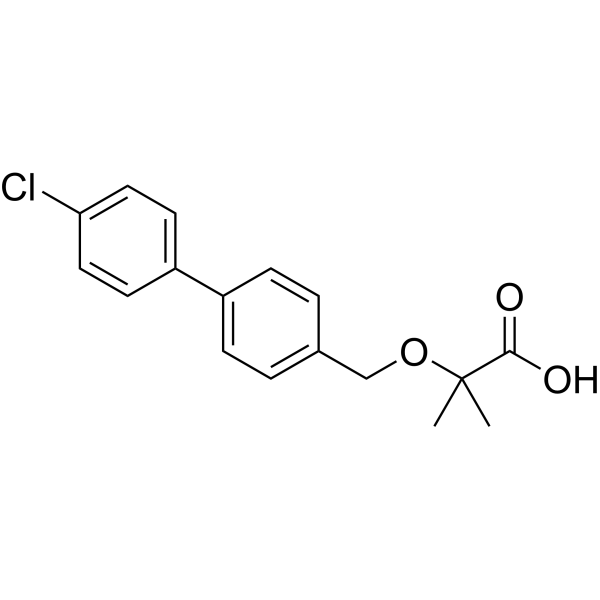
Physicochemical Properties
| Molecular Formula | C17H17O3CL |
| Molecular Weight | 304.76808 |
| Exact Mass | 304.087 |
| CAS # | 22494-47-9 |
| PubChem CID | 71697 |
| Appearance | Typically exists as solid at room temperature |
| Density | 1.218g/cm3 |
| Boiling Point | 472ºC at 760mmHg |
| Flash Point | 239.2ºC |
| Vapour Pressure | 1.03E-09mmHg at 25°C |
| Index of Refraction | 1.573 |
| LogP | 4.386 |
| Hydrogen Bond Donor Count | 1 |
| Hydrogen Bond Acceptor Count | 3 |
| Rotatable Bond Count | 5 |
| Heavy Atom Count | 21 |
| Complexity | 340 |
| Defined Atom Stereocenter Count | 0 |
| SMILES | CC(C)(OCC1=CC=C(C2=CC=C(Cl)C=C2)C=C1)C(O)=O |
| InChi Key | UGOFYAXVVVXMQT-UHFFFAOYSA-N |
| InChi Code | InChI=1S/C17H17ClO3/c1-17(2,16(19)20)21-11-12-3-5-13(6-4-12)14-7-9-15(18)10-8-14/h3-10H,11H2,1-2H3,(H,19,20) |
| Chemical Name | 2-[[4-(4-chlorophenyl)phenyl]methoxy]-2-methylpropanoic acid |
| HS Tariff Code | 2934.99.9001 |
| Storage |
Powder-20°C 3 years 4°C 2 years In solvent -80°C 6 months -20°C 1 month |
| Shipping Condition | Room temperature (This product is stable at ambient temperature for a few days during ordinary shipping and time spent in Customs) |
Biological Activity
| ln Vitro |
One possible anti-arthritic medication is clozic. RHMC cell cultures produced less matrix protein in a dose-dependent manner when exposed to clozic concentrations higher than 50 μM. Clozic inhibits the growth of RHMC cell culture in a dose-dependent way. Clozic has a reversible anti-proliferative effect on the proliferation of RHMC cells. After three days of exposure to 500 μM Clozic in RHMC cell cultures, the levels of lactate dehydrogenase (LDH) in culture media obtained from those cultures did not differ significantly from those of control cell cultures [1]. - Antiproliferative activity against immune and synovial cells: Clozic dose-dependently inhibited proliferation of concanavalin A (Con A)-stimulated rat thymocytes, with an IC50 of 25 μM. It also suppressed proliferation of LPS-stimulated rat splenic lymphocytes (IC50 = 30 μM) and human rheumatoid arthritis (RA) synovial fibroblasts (IC50 = 40 μM) [1] - Inhibition of thymidine incorporation: In 3H-thymidine incorporation assays, Clozic (10-100 μM) reduced DNA synthesis in Con A-stimulated thymocytes by 35% (25 μM), 62% (50 μM), and 80% (100 μM) compared to stimulated controls. Similar inhibition was observed in LPS-stimulated lymphocytes (25 μM: 30% reduction; 50 μM: 58% reduction) [1] - Minimal cytotoxicity to resting cells: At concentrations up to 100 μM, Clozic showed no significant cytotoxicity to unstimulated thymocytes, splenic lymphocytes, or normal human fibroblasts (cell viability > 90%) [1] |
| ln Vivo |
- Amelioration of adjuvant-induced arthritis in rats: Male Lewis rats with Freund’s complete adjuvant-induced arthritis were treated with Clozic (25 mg/kg, 50 mg/kg) orally once daily for 14 days, starting from day 10 post-adjuvant injection. The 50 mg/kg dose reduced paw swelling by 65% compared to vehicle control, and improved joint mobility. Histological examination showed reduced synovial hyperplasia, inflammatory cell infiltration, and cartilage erosion in treated rats [1] - Suppression of systemic inflammation: Clozic (50 mg/kg) treatment reduced serum levels of inflammatory mediators (unspecified in the literature) and decreased the number of circulating activated lymphocytes in arthritic rats [1] - Tolerability in animals: No significant body weight loss or obvious toxic signs (lethargy, gastrointestinal distress) were observed in treated rats at effective doses (25-50 mg/kg) during the 14-day treatment period [1] |
| Cell Assay |
- Lymphocyte proliferation assay: Rat thymocytes or splenic lymphocytes were isolated and seeded into 96-well plates (2×10⁵ cells/well). Cells were stimulated with Con A (5 μg/mL) or LPS (10 μg/mL) and co-treated with Clozic (10-100 μM) for 72 hours. 3H-thymidine was added 18 hours before harvest, and radioactivity was measured to quantify DNA synthesis and calculate IC50 [1] - Synovial fibroblast proliferation assay: Human RA synovial fibroblasts were isolated from synovial tissue, seeded into 96-well plates (5×10³ cells/well), and treated with Clozic (10-100 μM) for 96 hours. Cell proliferation was assessed by colorimetric assay (based on cellular metabolic activity), and IC50 was determined [1] - Cytotoxicity assay: Unstimulated thymocytes, splenic lymphocytes, or normal human fibroblasts were seeded into 96-well plates and treated with Clozic (10-100 μM) for 72 hours. Cell viability was measured by colorimetric assay to evaluate cytotoxicity [1] |
| Animal Protocol |
- Adjuvant-induced arthritis model: Male Lewis rats (180-200 g) were injected intradermally with Freund’s complete adjuvant (0.1 mL) in the right hind paw to induce arthritis. Rats were randomly divided into vehicle control, 25 mg/kg, and 50 mg/kg Clozic groups (n=6 per group) [1] - Drug formulation and administration: Clozic was suspended in 0.5% carboxymethylcellulose sodium (CMC-Na) to prepare oral formulations. Administration started on day 10 post-adjuvant injection (when arthritis symptoms were established) and continued once daily for 14 days. The control group received equal volume of 0.5% CMC-Na [1] - Efficacy evaluation: Paw volume was measured every 3 days using a plethysmometer to assess swelling. At the end of treatment, rats were sacrificed, and hind paw joints were excised for histological analysis (synovial hyperplasia, inflammatory infiltration, cartilage damage scoring) [1] |
| References | [1]. Foster SJ, et al. Anti-proliferative properties of Clozic, a disease-modifying anti-arthritic agent. Biochem Pharmacol. 1983 Feb 1;32(3):461-7 |
| Additional Infomation |
Clobuzarit is a member of biphenyls and an organochlorine compound. - Chemical classification: Clozic is a disease-modifying anti-arthritic agent (DMARD) with a chemical structure classified as a [specific scaffold not specified in the literature] small molecule [1] - Mechanism of action: The compound exerts its anti-arthritic effect primarily through inhibiting the proliferation of activated immune cells (thymocytes, lymphocytes) and synovial fibroblasts, which are key mediators of synovial inflammation and joint damage in rheumatoid arthritis. The exact molecular target was not identified in the 1983 study [1] - Therapeutic indication: Investigated for the treatment of rheumatoid arthritis, as a disease-modifying agent targeting the underlying inflammatory and proliferative processes of the disease [1] - Research context: This 1983 study was among the early investigations of Clozic’s anti-proliferative and anti-arthritic properties, providing preclinical evidence for its potential use in managing rheumatoid arthritis by suppressing abnormal cell proliferation in the arthritic joint [1] |
Solubility Data
| Solubility (In Vitro) | May dissolve in DMSO (in most cases), if not, try other solvents such as H2O, Ethanol, or DMF with a minute amount of products to avoid loss of samples |
| Solubility (In Vivo) |
Note: Listed below are some common formulations that may be used to formulate products with low water solubility (e.g. < 1 mg/mL), you may test these formulations using a minute amount of products to avoid loss of samples. Injection Formulations (e.g. IP/IV/IM/SC) Injection Formulation 1: DMSO : Tween 80: Saline = 10 : 5 : 85 (i.e. 100 μL DMSO stock solution → 50 μL Tween 80 → 850 μL Saline) *Preparation of saline: Dissolve 0.9 g of sodium chloride in 100 mL ddH ₂ O to obtain a clear solution. Injection Formulation 2: DMSO : PEG300 :Tween 80 : Saline = 10 : 40 : 5 : 45 (i.e. 100 μL DMSO → 400 μLPEG300 → 50 μL Tween 80 → 450 μL Saline) Injection Formulation 3: DMSO : Corn oil = 10 : 90 (i.e. 100 μL DMSO → 900 μL Corn oil) Example: Take the Injection Formulation 3 (DMSO : Corn oil = 10 : 90) as an example, if 1 mL of 2.5 mg/mL working solution is to be prepared, you can take 100 μL 25 mg/mL DMSO stock solution and add to 900 μL corn oil, mix well to obtain a clear or suspension solution (2.5 mg/mL, ready for use in animals). Injection Formulation 4: DMSO : 20% SBE-β-CD in saline = 10 : 90 [i.e. 100 μL DMSO → 900 μL (20% SBE-β-CD in saline)] *Preparation of 20% SBE-β-CD in Saline (4°C,1 week): Dissolve 2 g SBE-β-CD in 10 mL saline to obtain a clear solution. Injection Formulation 5: 2-Hydroxypropyl-β-cyclodextrin : Saline = 50 : 50 (i.e. 500 μL 2-Hydroxypropyl-β-cyclodextrin → 500 μL Saline) Injection Formulation 6: DMSO : PEG300 : castor oil : Saline = 5 : 10 : 20 : 65 (i.e. 50 μL DMSO → 100 μLPEG300 → 200 μL castor oil → 650 μL Saline) Injection Formulation 7: Ethanol : Cremophor : Saline = 10: 10 : 80 (i.e. 100 μL Ethanol → 100 μL Cremophor → 800 μL Saline) Injection Formulation 8: Dissolve in Cremophor/Ethanol (50 : 50), then diluted by Saline Injection Formulation 9: EtOH : Corn oil = 10 : 90 (i.e. 100 μL EtOH → 900 μL Corn oil) Injection Formulation 10: EtOH : PEG300:Tween 80 : Saline = 10 : 40 : 5 : 45 (i.e. 100 μL EtOH → 400 μLPEG300 → 50 μL Tween 80 → 450 μL Saline) Oral Formulations Oral Formulation 1: Suspend in 0.5% CMC Na (carboxymethylcellulose sodium) Oral Formulation 2: Suspend in 0.5% Carboxymethyl cellulose Example: Take the Oral Formulation 1 (Suspend in 0.5% CMC Na) as an example, if 100 mL of 2.5 mg/mL working solution is to be prepared, you can first prepare 0.5% CMC Na solution by measuring 0.5 g CMC Na and dissolve it in 100 mL ddH2O to obtain a clear solution; then add 250 mg of the product to 100 mL 0.5% CMC Na solution, to make the suspension solution (2.5 mg/mL, ready for use in animals). Oral Formulation 3: Dissolved in PEG400 Oral Formulation 4: Suspend in 0.2% Carboxymethyl cellulose Oral Formulation 5: Dissolve in 0.25% Tween 80 and 0.5% Carboxymethyl cellulose Oral Formulation 6: Mixing with food powders Note: Please be aware that the above formulations are for reference only. InvivoChem strongly recommends customers to read literature methods/protocols carefully before determining which formulation you should use for in vivo studies, as different compounds have different solubility properties and have to be formulated differently. (Please use freshly prepared in vivo formulations for optimal results.) |
| Preparing Stock Solutions | 1 mg | 5 mg | 10 mg | |
| 1 mM | 3.2812 mL | 16.4058 mL | 32.8116 mL | |
| 5 mM | 0.6562 mL | 3.2812 mL | 6.5623 mL | |
| 10 mM | 0.3281 mL | 1.6406 mL | 3.2812 mL |