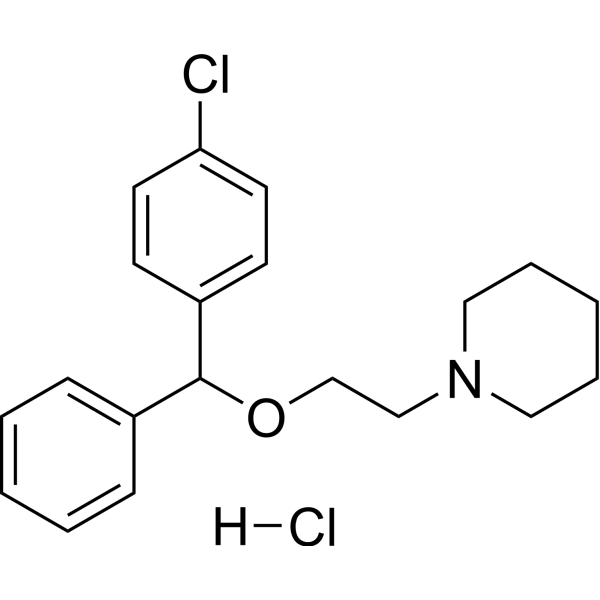
Physicochemical Properties
| Molecular Formula | C20H25CL2NO |
| Molecular Weight | 366.3246 |
| Exact Mass | 365.131 |
| CAS # | 14984-68-0 |
| Related CAS # | Cloperastine fendizoate;85187-37-7 |
| PubChem CID | 161104 |
| Appearance | White to off-white solid powder |
| Boiling Point | 84°C 35mm |
| Flash Point | 210.2ºC |
| Vapour Pressure | 2.15E-07mmHg at 25°C |
| Index of Refraction | 1.414 |
| LogP | 5.671 |
| Hydrogen Bond Donor Count | 1 |
| Hydrogen Bond Acceptor Count | 2 |
| Rotatable Bond Count | 6 |
| Heavy Atom Count | 24 |
| Complexity | 318 |
| Defined Atom Stereocenter Count | 0 |
| InChi Key | UNPLRYRWJLTVAE-UHFFFAOYSA-N |
| InChi Code | InChI=1S/C20H24ClNO.ClH/c21-19-11-9-18(10-12-19)20(17-7-3-1-4-8-17)23-16-15-22-13-5-2-6-14-22;/h1,3-4,7-12,20H,2,5-6,13-16H2;1H |
| Chemical Name | 1-[2-[(4-chlorophenyl)-phenylmethoxy]ethyl]piperidine;hydrochloride |
| HS Tariff Code | 2934.99.9001 |
| Storage |
Powder-20°C 3 years 4°C 2 years In solvent -80°C 6 months -20°C 1 month Note: Please store this product in a sealed and protected environment (e.g. under nitrogen), avoid exposure to moisture. |
| Shipping Condition | Room temperature (This product is stable at ambient temperature for a few days during ordinary shipping and time spent in Customs) |
Biological Activity
| ln Vitro | Cloperastine, whose IC50 value is 27 nM, inhibits hERG K+ current in a concentration-inhibitory manner[1]. The antitussive drug cloperastine hydrochloride shortens ischemic tissue in addition to its antitussive and antiedematous properties. The medication cleopatrastine hydrochloride has antitussive central effects as well as antihistamine and papaverine-like activity that can provide comparable but non-narcotic effects [2]. |
| ln Vivo | In anesthetized guinea pigs, cloperastine hydrochloride at a dose of 1 mg/kg prolongs the QT interval and monophasic action potential (MAP) duration without changing the PR interval or QRS width [1]. The intraperitoneal toxicity of cloperastine hydrochloride to mice and mice is relatively low, while the oral toxicity of cloperastine hydrochloride and findizole preparations is relatively low. Under the two routes, the LD50 of cloperastine hydrochloride in mice surpasses 1000 and 2000 mg/ kg[2]. |
| References |
[1]. Effects of the antitussive drug cloperastine on ventricular repolarization in halothane-anesthetized guinea pigs. J Pharmacol Sci. 2012;120(3):165-75. [2]. Pharmacological and clinical overview of cloperastine in treatment of cough. Ther Clin Risk Manag. 2011;7:83-92. |
| Additional Infomation |
Cloperastine hydrochloride is a diarylmethane. See also: Cloperastine (annotation moved to); Cloperastine Fendizoate (annotation moved to). |
Solubility Data
| Solubility (In Vitro) |
DMSO : ~250 mg/mL (~682.46 mM) H2O : ~100 mg/mL (~272.99 mM) |
| Solubility (In Vivo) |
Solubility in Formulation 1: ≥ 2.08 mg/mL (5.68 mM) (saturation unknown) in 10% DMSO + 40% PEG300 + 5% Tween80 + 45% Saline (add these co-solvents sequentially from left to right, and one by one), clear solution. For example, if 1 mL of working solution is to be prepared, you can add 100 μL of 20.8 mg/mL clear DMSO stock solution to 400 μL PEG300 and mix evenly; then add 50 μL Tween-80 to the above solution and mix evenly; then add 450 μL normal saline to adjust the volume to 1 mL. Preparation of saline: Dissolve 0.9 g of sodium chloride in 100 mL ddH₂ O to obtain a clear solution. Solubility in Formulation 2: ≥ 2.08 mg/mL (5.68 mM) (saturation unknown) in 10% DMSO + 90% (20% SBE-β-CD in Saline) (add these co-solvents sequentially from left to right, and one by one), clear solution. For example, if 1 mL of working solution is to be prepared, you can add 100 μL of 20.8 mg/mL clear DMSO stock solution to 900 μL of 20% SBE-β-CD physiological saline solution and mix evenly. Preparation of 20% SBE-β-CD in Saline (4°C,1 week): Dissolve 2 g SBE-β-CD in 10 mL saline to obtain a clear solution. Solubility in Formulation 3: ≥ 2.08 mg/mL (5.68 mM) (saturation unknown) in 10% DMSO + 90% Corn Oil (add these co-solvents sequentially from left to right, and one by one), clear solution. For example, if 1 mL of working solution is to be prepared, you can add 100 μL of 20.8 mg/mL clear DMSO stock solution to 900 μL of corn oil and mix evenly. Solubility in Formulation 4: 100 mg/mL (272.99 mM) in PBS (add these co-solvents sequentially from left to right, and one by one), clear solution; with ultrasonication. (Please use freshly prepared in vivo formulations for optimal results.) |
| Preparing Stock Solutions | 1 mg | 5 mg | 10 mg | |
| 1 mM | 2.7299 mL | 13.6493 mL | 27.2985 mL | |
| 5 mM | 0.5460 mL | 2.7299 mL | 5.4597 mL | |
| 10 mM | 0.2730 mL | 1.3649 mL | 2.7299 mL |