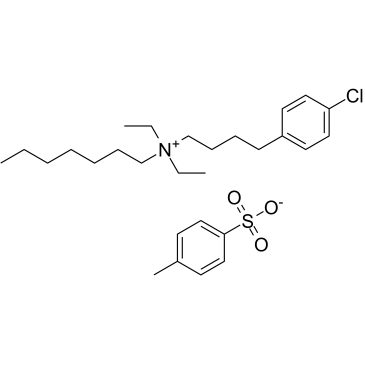
Clofilium tosylate, the tosylate salt of clofilium, is a novel and potent potassium/K+ channel blocker with the potential to be used as a cardiac depressant and anti-arrhythmic agent. It induces apoptosis of human promyelocytic leukemia (HL-60) cells via Bcl-2-insensitive activation of caspase-3.
Physicochemical Properties
| Molecular Formula | C28H44CLNO3S |
| Molecular Weight | 510.1719 |
| Exact Mass | 509.273 |
| CAS # | 92953-10-1 |
| Related CAS # | 68379-02-2;92953-10-1 (Tosylate);68379-03-3 (Phosphate); |
| PubChem CID | 175533 |
| Appearance | White to off-white solid powder |
| LogP | 8.469 |
| Hydrogen Bond Donor Count | 0 |
| Hydrogen Bond Acceptor Count | 3 |
| Rotatable Bond Count | 13 |
| Heavy Atom Count | 34 |
| Complexity | 460 |
| Defined Atom Stereocenter Count | 0 |
| InChi Key | MOQZYUUHIWPDQC-UHFFFAOYSA-M |
| InChi Code | InChI=1S/C21H37ClN.C7H8O3S/c1-4-7-8-9-11-18-23(5-2,6-3)19-12-10-13-20-14-16-21(22)17-15-20;1-6-2-4-7(5-3-6)11(8,9)10/h14-17H,4-13,18-19H2,1-3H3;2-5H,1H3,(H,8,9,10)/q+1;/p-1 |
| Chemical Name | N-(4-(4-chlorophenyl)butyl)-N,N-diethylheptan-1-aminium 4-methylbenzenesulfonate |
| Synonyms | Clofilium Tosylate |
| HS Tariff Code | 2934.99.9001 |
| Storage |
Powder-20°C 3 years 4°C 2 years In solvent -80°C 6 months -20°C 1 month Note: Please store this product in a sealed and protected environment (e.g. under nitrogen), avoid exposure to moisture and light. |
| Shipping Condition | Room temperature (This product is stable at ambient temperature for a few days during ordinary shipping and time spent in Customs) |
Biological Activity
| Targets |
Potassium channel blocker . The apoptotic effect is reported to be independent of its potassium channel blocking activity at the concentrations used (2.5–10 μM). [1] |
| ln Vitro |
Clofilium (0–20 μM) treatment of HL-60 cells for 24, 48, and 72 hours inhibited viability and proliferation in a concentration- and time-dependent manner. When HL-60 cells are exposed to 2.5 μM to 10 μM Clofilium (10 μM, 12 h), the protein preparation of inactive procaspase-3, p34 into its active form, p17, is induced. After two hours, the cells are exposed to 10 mM Clofilium. Cell viability is dramatically decreased by substrate PARP [1]. Clofilium inhibits viability and proliferation of human promyelocytic leukemia (HL-60) cells in a time- and concentration-dependent manner. The IC50 values for cell viability reduction were approximately 6.3 μM (24 h), 3.4 μM (48 h), and 2.4 μM (72 h). [1] Clofilium induces apoptosis in HL-60 cells, as confirmed by nuclear DAPI staining (showing fragmented apoptotic bodies), transmission electron microscopy (revealing marginated chromatin condensation and nuclear fragmentation), and DNA laddering on agarose gel electrophoresis. [1] Flow cytometry with FITC-Annexin V/PI staining showed that the apoptotic cell population (Annexin V⁺/PI⁻) increased from <2% (0 h) to 20% (4 h) and 29% (16 h) after treatment with 10 μM clofilium. [1] Caspase-3 activity increased approximately 10-fold at 2–3 h after exposure to 10 μM clofilium, as measured by fluorometric immunosorbent enzyme assay (FIENA). [1] Immunoblot analysis demonstrated proteolytic cleavage of procaspase-3 (p34 to p17) and subsequent cleavage of PARP, while expression levels of Bcl-2 and Bax proteins remained unchanged. [1] |
| Enzyme Assay |
Caspase-3 activity was measured using a fluorometric immunosorbent enzyme assay (FIENA). Cells were treated with 10 μM clofilium for various time intervals, harvested, and lysed. The lysates were incubated in anti-caspase-3 coated microplate wells, followed by addition of substrate solution. Activity was determined fluorometrically. [1] |
| Cell Assay |
Cell Viability Assay[1] Cell Types: HL-60 cells Tested Concentrations: 0-20 μM Incubation Duration: 24, 48, and 72 hrs (hours) Experimental Results: Inhibition of HL-60 cells, the IC50 at 24 hrs (hours) is 6.3 μM, and the IC50 at 48 hrs (hours) is 3.4 μM, IC50 at 72 hrs (hours) is 2.4 μM. Western Blot Analysis[1] Cell Types: HL-60 Cell Tested Concentrations: 10 μM Incubation Duration: 12 hrs (hours) Experimental Results: Proteolytic cleavage of caspase-3 and its substrate PARP was induced, while Bcl-2 and Bax proteins were unchanged. Cell viability was assessed using the MTT dye reduction method. HL-60 cells were treated with clofilium (0–20 μM) for 24, 48, and 72 h. [1] Nuclear morphology was examined by DAPI staining. Cells were fixed, stained with DAPI, and observed under fluorescence microscopy. [1] Transmission electron microscopy was performed. Cells were fixed in glutaraldehyde, post-fixed in osmium tetroxide, dehydrated, embedded, sectioned, stained with uranyl acetate and lead acetate, and examined under an electron microscope. [1] DNA fragmentation analysis was conducted. DNA was extracted using phenol-chloroform method, electrophoresed on agarose gel, stained with ethidium bromide, and visualized under UV light. [1] Apoptosis was quantified by flow cytometry using FITC-Annexin V and propidium iodide (PI) double staining. Cells were incubated with FITC-Annexin V and PI, then analyzed by flow cytometry. [1] Immunoblot analysis was performed to detect caspase-3, PARP, Bcl-2, and Bax proteins. Cells were lysed, proteins were separated by SDS-PAGE, transferred to nitrocellulose membrane, blocked, incubated with primary and secondary antibodies, and detected by chemiluminescence. [1] |
| References |
[1]. Clofilium, a potassium channel blocker, induces apoptosis of human promyelocytic leukemia (HL-60) cells via Bcl-2-insensitive activation of caspase-3. Cancer Lett. 1999 Dec 1;147(1-2):85-93. |
| Additional Infomation |
Clofilium is a potassium channel blocker previously used as an antiarrhythmic agent. This study suggests its potential as a chemotherapeutic or cytostatic agent in human leukemias and lymphomas, due to its ability to induce apoptosis via a Bcl-2-insensitive, caspase-3-dependent pathway. [1] The apoptosis-inducing effect of clofilium at concentrations of 2.5–10 μM is not related to its potassium channel blocking activity, which typically requires higher concentrations. [1] The proposed mechanism involves plasma membrane receptor-mediated pathways (such as CD95/TNFR-1) that are Crm A-sensitive and Bcl-2-insensitive, leading to caspase-3 activation. [1] |
Solubility Data
| Solubility (In Vitro) |
DMSO : ~100 mg/mL (~196.01 mM) H2O : ~1.59 mg/mL (~3.12 mM) |
| Solubility (In Vivo) |
Solubility in Formulation 1: ≥ 2.08 mg/mL (4.08 mM) (saturation unknown) in 10% DMSO + 40% PEG300 + 5% Tween80 + 45% Saline (add these co-solvents sequentially from left to right, and one by one), clear solution. For example, if 1 mL of working solution is to be prepared, you can add 100 μL of 20.8 mg/mL clear DMSO stock solution to 400 μL PEG300 and mix evenly; then add 50 μL Tween-80 to the above solution and mix evenly; then add 450 μL normal saline to adjust the volume to 1 mL. Preparation of saline: Dissolve 0.9 g of sodium chloride in 100 mL ddH₂ O to obtain a clear solution. Solubility in Formulation 2: ≥ 2.08 mg/mL (4.08 mM) (saturation unknown) in 10% DMSO + 90% (20% SBE-β-CD in Saline) (add these co-solvents sequentially from left to right, and one by one), clear solution. For example, if 1 mL of working solution is to be prepared, you can add 100 μL of 20.8 mg/mL clear DMSO stock solution to 900 μL of 20% SBE-β-CD physiological saline solution and mix evenly. Preparation of 20% SBE-β-CD in Saline (4°C,1 week): Dissolve 2 g SBE-β-CD in 10 mL saline to obtain a clear solution. Solubility in Formulation 3: ≥ 2.08 mg/mL (4.08 mM) (saturation unknown) in 10% DMSO + 90% Corn Oil (add these co-solvents sequentially from left to right, and one by one), clear solution. For example, if 1 mL of working solution is to be prepared, you can add 100 μL of 20.8 mg/mL clear DMSO stock solution to 900 μL of corn oil and mix evenly. Solubility in Formulation 4: 2 mg/mL (3.92 mM) in 8g/L NaCl solution (add these co-solvents sequentially from left to right, and one by one), clear solution; with ultrasonication. (Please use freshly prepared in vivo formulations for optimal results.) |
| Preparing Stock Solutions | 1 mg | 5 mg | 10 mg | |
| 1 mM | 1.9601 mL | 9.8007 mL | 19.6013 mL | |
| 5 mM | 0.3920 mL | 1.9601 mL | 3.9203 mL | |
| 10 mM | 0.1960 mL | 0.9801 mL | 1.9601 mL |