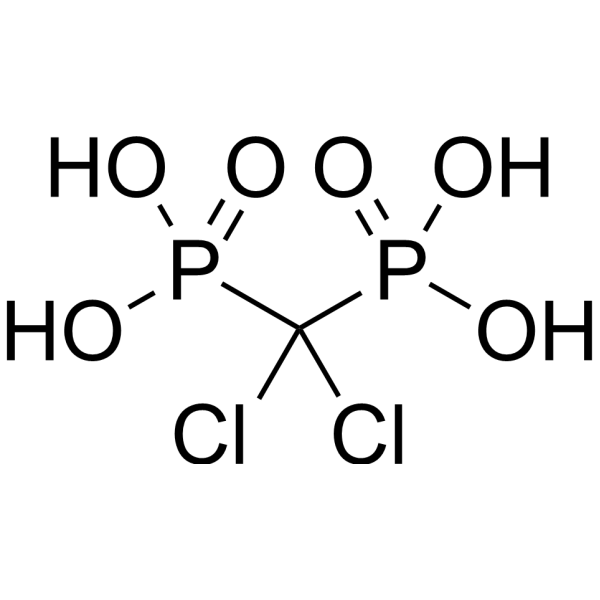
Physicochemical Properties
| Molecular Formula | CH4O6P2CL2 |
| Molecular Weight | 244.89246 |
| Exact Mass | 243.886 |
| CAS # | 10596-23-3 |
| Related CAS # | Clodronate disodium tetrahydrate;88416-50-6;Clodronic acid disodium salt;22560-50-5 |
| PubChem CID | 25419 |
| Appearance | Colorless to light yellow liquid(Density:2.306±0.06 g/cm3) |
| Density | 2.3±0.1 g/cm3 |
| Boiling Point | 474.7±55.0 °C at 760 mmHg |
| Melting Point | 249-251° |
| Flash Point | 240.9±31.5 °C |
| Vapour Pressure | 0.0±2.5 mmHg at 25°C |
| Index of Refraction | 1.598 |
| LogP | -2.38 |
| Hydrogen Bond Donor Count | 4 |
| Hydrogen Bond Acceptor Count | 6 |
| Rotatable Bond Count | 2 |
| Heavy Atom Count | 11 |
| Complexity | 211 |
| Defined Atom Stereocenter Count | 0 |
| SMILES | ClC(P(O)(O)=O)(P(O)(O)=O)Cl |
| InChi Key | ACSIXWWBWUQEHA-UHFFFAOYSA-N |
| InChi Code | InChI=1S/CH4Cl2O6P2/c2-1(3,10(4,5)6)11(7,8)9/h(H2,4,5,6)(H2,7,8,9) |
| Chemical Name | [dichloro(phosphono)methyl]phosphonic acid |
| HS Tariff Code | 2934.99.9001 |
| Storage |
Powder-20°C 3 years 4°C 2 years In solvent -80°C 6 months -20°C 1 month |
| Shipping Condition | Room temperature (This product is stable at ambient temperature for a few days during ordinary shipping and time spent in Customs) |
Biological Activity
| ADME/Pharmacokinetics |
Absorption, Distribution and Excretion Oral clodronic acid has a bioavailability of 1-2%. A 200mg intravenous dose reaches a Cmax of 16.1mg/L with an AUC of 44.2mg\*h/L. A 200mg intramuscular dose reaches a Cmax of 12.8mg/L with an AUC of 47.5mg\*h/L. Further pharmacokinetic data for clodronic acid are not readily available. Clodronate is eliminated unchanged in the urine. The renal clearance of clodronate is approximately 90mL/min. Metabolism / Metabolites Clodronate is not metabolized in humans. Clodronate is not metabolized in humans. It can be metabolized intracellularly to a beta-gamma-methylene (AppCp-type) analog of ATP (AppCCl2p), which is cytotoxic to macrophages in vitro. Half Life: Approximately 13 hours. Biological Half-Life The mean plasma half life of clodronate is 5.6h. |
| Toxicity/Toxicokinetics |
Toxicity Summary The bisphosphonate group binds strongly to the bone mineral, hydroxyapatite. This explains the specific pharmacological action of these compounds on mineralized tissues, especially bone. The exact mechanism of action of clodronate is not known, however it is known that it does not inhibit protein isoprenylation but can be metabolized intracellularly to a β-γ-methylene (AppCp-type) analog of ATP (AppCCl2p), which is cytotoxic to macrophages in vitro. Inhibition of the ADP/ATP translocase by the metabolite AppCCl2p is a likely route by which clodronate causes osteoclast apoptosis and inhibits bone resorption. Recently, the slime mold Dictyostelium discoideum was shown to take up bisphosphonates by pinocytosis. In these cells, clodronate, but not other pharmacologically active bisphosphonates, was incorporated into adenine nucleotides, which could potentially explain why this bisphosphonate sometimes seems to act differently than the other bisphosphonates. Clodronate, like all biphosphonates, also binds protein-tyrosine-phosphatase. Protein Binding Clodronic acid is 36% protein bound in plasma. |
| References |
[1]. Clodronic acid formulations available in Europe and their use in osteoporosis: a review. Clin Drug Investig. 2009;29(6):359-79. |
| Additional Infomation |
Pharmacodynamics Clodronic acid is a first generation bisphosphonate that inhibits osteoclast mediated bone resorption. It has a wide therapeutic index as a large overdose is required for significant toxicity and a long duration of action due to the slow release from bone. Patients should be counselled regarding the risk of hypocalcemia, hypovolemia, renal insufficiency, transient hyperphosphatemia, and transient hyperparathyroidism. |
Solubility Data
| Solubility (In Vitro) | May dissolve in DMSO (in most cases), if not, try other solvents such as H2O, Ethanol, or DMF with a minute amount of products to avoid loss of samples |
| Solubility (In Vivo) |
Note: Listed below are some common formulations that may be used to formulate products with low water solubility (e.g. < 1 mg/mL), you may test these formulations using a minute amount of products to avoid loss of samples. Injection Formulations (e.g. IP/IV/IM/SC) Injection Formulation 1: DMSO : Tween 80: Saline = 10 : 5 : 85 (i.e. 100 μL DMSO stock solution → 50 μL Tween 80 → 850 μL Saline) *Preparation of saline: Dissolve 0.9 g of sodium chloride in 100 mL ddH ₂ O to obtain a clear solution. Injection Formulation 2: DMSO : PEG300 :Tween 80 : Saline = 10 : 40 : 5 : 45 (i.e. 100 μL DMSO → 400 μLPEG300 → 50 μL Tween 80 → 450 μL Saline) Injection Formulation 3: DMSO : Corn oil = 10 : 90 (i.e. 100 μL DMSO → 900 μL Corn oil) Example: Take the Injection Formulation 3 (DMSO : Corn oil = 10 : 90) as an example, if 1 mL of 2.5 mg/mL working solution is to be prepared, you can take 100 μL 25 mg/mL DMSO stock solution and add to 900 μL corn oil, mix well to obtain a clear or suspension solution (2.5 mg/mL, ready for use in animals). Injection Formulation 4: DMSO : 20% SBE-β-CD in saline = 10 : 90 [i.e. 100 μL DMSO → 900 μL (20% SBE-β-CD in saline)] *Preparation of 20% SBE-β-CD in Saline (4°C,1 week): Dissolve 2 g SBE-β-CD in 10 mL saline to obtain a clear solution. Injection Formulation 5: 2-Hydroxypropyl-β-cyclodextrin : Saline = 50 : 50 (i.e. 500 μL 2-Hydroxypropyl-β-cyclodextrin → 500 μL Saline) Injection Formulation 6: DMSO : PEG300 : castor oil : Saline = 5 : 10 : 20 : 65 (i.e. 50 μL DMSO → 100 μLPEG300 → 200 μL castor oil → 650 μL Saline) Injection Formulation 7: Ethanol : Cremophor : Saline = 10: 10 : 80 (i.e. 100 μL Ethanol → 100 μL Cremophor → 800 μL Saline) Injection Formulation 8: Dissolve in Cremophor/Ethanol (50 : 50), then diluted by Saline Injection Formulation 9: EtOH : Corn oil = 10 : 90 (i.e. 100 μL EtOH → 900 μL Corn oil) Injection Formulation 10: EtOH : PEG300:Tween 80 : Saline = 10 : 40 : 5 : 45 (i.e. 100 μL EtOH → 400 μLPEG300 → 50 μL Tween 80 → 450 μL Saline) Oral Formulations Oral Formulation 1: Suspend in 0.5% CMC Na (carboxymethylcellulose sodium) Oral Formulation 2: Suspend in 0.5% Carboxymethyl cellulose Example: Take the Oral Formulation 1 (Suspend in 0.5% CMC Na) as an example, if 100 mL of 2.5 mg/mL working solution is to be prepared, you can first prepare 0.5% CMC Na solution by measuring 0.5 g CMC Na and dissolve it in 100 mL ddH2O to obtain a clear solution; then add 250 mg of the product to 100 mL 0.5% CMC Na solution, to make the suspension solution (2.5 mg/mL, ready for use in animals). Oral Formulation 3: Dissolved in PEG400 Oral Formulation 4: Suspend in 0.2% Carboxymethyl cellulose Oral Formulation 5: Dissolve in 0.25% Tween 80 and 0.5% Carboxymethyl cellulose Oral Formulation 6: Mixing with food powders Note: Please be aware that the above formulations are for reference only. InvivoChem strongly recommends customers to read literature methods/protocols carefully before determining which formulation you should use for in vivo studies, as different compounds have different solubility properties and have to be formulated differently. (Please use freshly prepared in vivo formulations for optimal results.) |
| Preparing Stock Solutions | 1 mg | 5 mg | 10 mg | |
| 1 mM | 4.0835 mL | 20.4173 mL | 40.8347 mL | |
| 5 mM | 0.8167 mL | 4.0835 mL | 8.1669 mL | |
| 10 mM | 0.4083 mL | 2.0417 mL | 4.0835 mL |