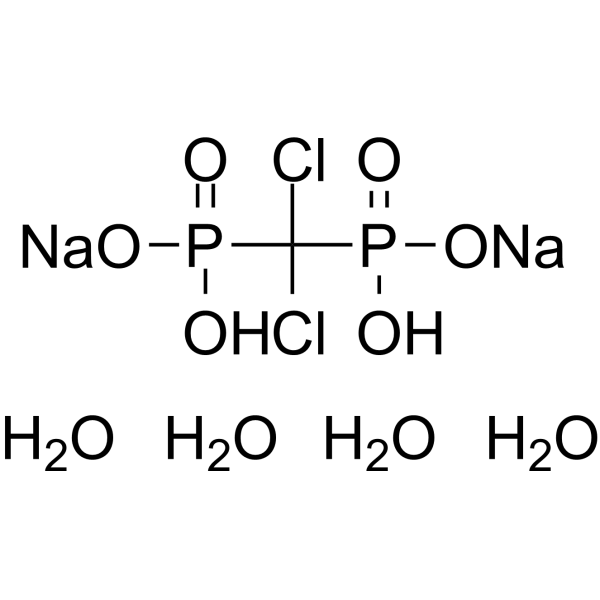
Physicochemical Properties
| Molecular Formula | CH2CL2NA2O6P2 |
| Molecular Weight | 288.8560 |
| Exact Mass | 359.892 |
| CAS # | 88416-50-6 |
| Related CAS # | Clodronic acid disodium salt;22560-50-5;Clodronic acid;10596-23-3 |
| PubChem CID | 23724874 |
| Appearance | White to off-white solid powder |
| LogP | 1.049 |
| Hydrogen Bond Donor Count | 6 |
| Hydrogen Bond Acceptor Count | 10 |
| Rotatable Bond Count | 2 |
| Heavy Atom Count | 17 |
| Complexity | 206 |
| Defined Atom Stereocenter Count | 0 |
| InChi Key | XWHPUCFOTRBMGS-UHFFFAOYSA-L |
| InChi Code | InChI=1S/CH4Cl2O6P2.2Na.4H2O/c2-1(3,10(4,5)6)11(7,8)9;;;;;;/h(H2,4,5,6)(H2,7,8,9);;;4*1H2/q;2*+1;;;;/p-2 |
| Chemical Name | disodium;[dichloro-[hydroxy(oxido)phosphoryl]methyl]-hydroxyphosphinate;tetrahydrate |
| HS Tariff Code | 2934.99.9001 |
| Storage |
Powder-20°C 3 years 4°C 2 years In solvent -80°C 6 months -20°C 1 month Note: Please store this product in a sealed and protected environment, avoid exposure to moisture. |
| Shipping Condition | Room temperature (This product is stable at ambient temperature for a few days during ordinary shipping and time spent in Customs) |
Biological Activity
| ln Vitro | Clodronate disodium tetrahydrate is a first-generation bisphosphonate that acts by blocking VNUT, a crucial molecule that starts purinergic chemical events, to greatly reduce neuropathic and neuropathic pain unrelated to disruptive disorders [1]. connection as a medication that resists bone absorption [2]. |
| ln Vivo | By blocking VNUT, clodronate tetrahydrate (10 mg/kg; IV) reduces accommodative discomfort [1]. Disodium clodronate tetrahydrate inhibits VNUT, which reduces accommodative pain [1]. |
| Animal Protocol |
Animal/Disease Models: C57BL/6 mice (22-30 g) [1] Doses: 10 mg/kg Route of Administration: intravenous (iv) (iv)injection Experimental Results: Reduce inflammatory pain caused by carrageenan or complete Freund's adjuvant (CFA) . |
| References |
[1]. Identification of a vesicular ATP release inhibitor for the treatment of neuropathic and inflammatory pain. Proc Natl Acad Sci U S A. 2017 Aug 1;114(31):E6297-E6305. [2]. Clodronate: A Vesicular ATP Release Blocker. Trends Pharmacol Sci. 2018 Jan;39(1):13-23. |
| Additional Infomation |
Disodium clodronate tetrahydrate is the tetrahydrate of the disodium salt of clodronic acid. It inhibits bone resorption and soft tissue calcification, and is used as an adjunct in the treatment of severe hypercalcaemia associated with malignancy, and in the management of osteolytic lesions and bone pain associated with skeletal metastases. It has a role as a bone density conservation agent. It is a hydrate and a one-carbon compound. It contains a clodronic acid disodium salt. Clodronate Disodium is the disodium salt of a nitrogen-free bisphosphonate analog of naturally occurring pyrophosphate. Clodronate binds to calcium and inhibits osteoclastic bone resorption and hydroxyapatite crystal formation and dissolution, resulting in a reduction of bone turnover. This agent may control malignancy-associated hypercalcemia, inhibit osteolytic bone metastasis and decrease pain. A diphosphonate which affects calcium metabolism. It inhibits bone resorption and soft tissue calcification. |
Solubility Data
| Solubility (In Vitro) | H2O : ~125 mg/mL (~346.34 mM) |
| Solubility (In Vivo) |
Solubility in Formulation 1: 25 mg/mL (69.27 mM) in PBS (add these co-solvents sequentially from left to right, and one by one), clear solution; with heating and sonication. (Please use freshly prepared in vivo formulations for optimal results.) |
| Preparing Stock Solutions | 1 mg | 5 mg | 10 mg | |
| 1 mM | 3.4619 mL | 17.3094 mL | 34.6188 mL | |
| 5 mM | 0.6924 mL | 3.4619 mL | 6.9238 mL | |
| 10 mM | 0.3462 mL | 1.7309 mL | 3.4619 mL |