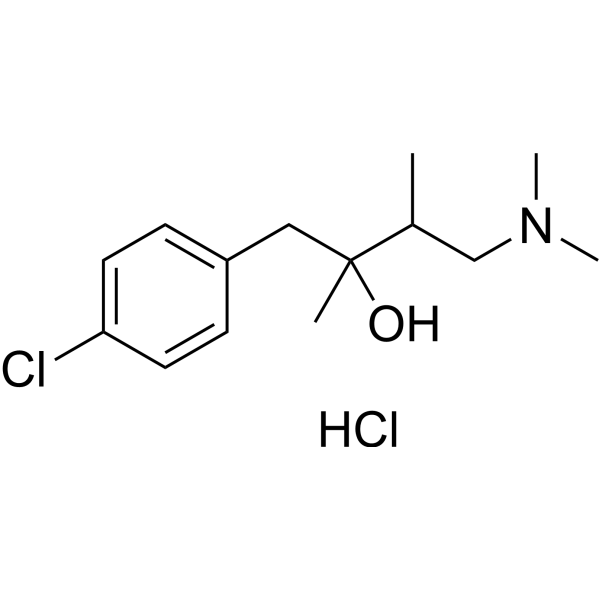
Physicochemical Properties
| Molecular Formula | C14H23CL2NO |
| Molecular Weight | 292.24 |
| Exact Mass | 291.116 |
| Elemental Analysis | C, 57.54; H, 7.93; Cl, 24.26; N, 4.79; O, 5.47 |
| CAS # | 1215-83-4 |
| Related CAS # | Clobutinol;14860-49-2 |
| PubChem CID | 92876 |
| Appearance | White to off-white solid powder |
| Density | 1.072g/cm3 |
| Boiling Point | 356.8ºC at 760 mmHg |
| Flash Point | 169.6ºC |
| Vapour Pressure | 1.04E-05mmHg at 25°C |
| LogP | 3.633 |
| Hydrogen Bond Donor Count | 2 |
| Hydrogen Bond Acceptor Count | 2 |
| Rotatable Bond Count | 5 |
| Heavy Atom Count | 18 |
| Complexity | 226 |
| Defined Atom Stereocenter Count | 0 |
| InChi Key | ZMROYCGIWPNZNJ-UHFFFAOYSA-N |
| InChi Code | InChI=1S/C14H22ClNO.ClH/c1-11(10-16(3)4)14(2,17)9-12-5-7-13(15)8-6-12;/h5-8,11,17H,9-10H2,1-4H3;1H |
| Chemical Name | 1-(4-chlorophenyl)-4-(dimethylamino)-2,3-dimethylbutan-2-ol;hydrochloride |
| Synonyms | Clobutinol hydrochloride; 1215-83-4; Silomat; Clobutinol HCl; KAT 256; |
| HS Tariff Code | 2934.99.9001 |
| Storage |
Powder-20°C 3 years 4°C 2 years In solvent -80°C 6 months -20°C 1 month Note: Please store this product in a sealed and protected environment, avoid exposure to moisture. |
| Shipping Condition | Room temperature (This product is stable at ambient temperature for a few days during ordinary shipping and time spent in Customs) |
Biological Activity
| Targets |
- hERG (human Ether-à-go-go-Related Gene) potassium channel (IC₅₀ = 32.7 μM in whole-cell patch-clamp assay) [1] - Cardiac potassium channels (inhibits IKr current, contributing to repolarization delay) [3] |
| ln Vitro |
- hERG Channel Inhibition: Clobutinol (10–100 μM) dose-dependently inhibited hERG potassium currents in HEK293 cells stably expressing hERG. At 30 μM, current amplitude was reduced by 52%, with maximal inhibition (85%) at 100 μM. The inhibition was reversible upon washout [1] - IKr Current Suppression: In guinea pig ventricular myocytes, clobutinol (10–50 μM) suppressed the rapid delayed rectifier potassium current (IKr) by 30–60%, similar to the effect of E-4031 (a specific IKr inhibitor) [3] |
| ln Vivo |
- Pulmonary Mechanics Modulation: In guinea pigs, clobutinol (10 mg/kg, i.v.) reduced histamine-induced bronchoconstriction by 40% and decreased respiratory resistance by 35%, as measured by whole-body plethysmography [2] - Cardiac Repolarization Delay: In guinea pig hearts, clobutinol (30 mg/kg, i.v.) prolonged the QT interval by 25% and increased the action potential duration at 90% repolarization (APD₉₀) by 30% compared to vehicle controls, effects comparable to E-4031 (1 mg/kg) [3] |
| Enzyme Assay |
- hERG Current Recording: HEK293 cells expressing hERG were voltage-clamped using the whole-cell patch-clamp technique. Clobutinol (10–100 μM) was applied via perfusion, and currents were elicited by a voltage protocol (holding potential -80 mV, test pulse to +20 mV for 2 s, repolarization to -50 mV). Current amplitudes were measured to calculate inhibition percentage, yielding an IC₅₀ of 32.7 μM [1] |
| Cell Assay |
- Ventricular Myocyte Patch-Clamp: Isolated guinea pig ventricular myocytes were voltage-clamped, and IKr currents were recorded before and after clobutinol (10–50 μM) application. The compound reduced IKr tail currents in a concentration-dependent manner, with 50 μM causing a 60% reduction [3] |
| Animal Protocol |
- Bronchoconstriction Model: Guinea pigs (n=6/group) were anesthetized, and clobutinol (10 mg/kg) or saline was administered intravenously. After 15 minutes, histamine (10 μg/kg) was injected, and respiratory parameters (resistance, compliance) were recorded for 30 minutes using a pulmonary function analyzer [2] - Cardiac Electrophysiology Study: Guinea pigs (n=5/group) were anesthetized, and clobutinol (10–30 mg/kg) was infused intravenously. ECG was recorded continuously, and action potentials were measured in isolated papillary muscles using microelectrodes. APD₉₀ and QT intervals were analyzed at 15-minute intervals post-administration [3] |
| Toxicity/Toxicokinetics |
- Cardiac Toxicity: Clobutinol (100 μM) showed no cytotoxicity in HEK293 cells (MTT assay) but induced arrhythmias in 20% of guinea pigs at 50 mg/kg (i.v.), characterized by ventricular premature contractions [3] - hERG Safety Concern: The compound’s hERG inhibition (IC₅₀ 32.7 μM) suggests a potential risk of QT prolongation and torsades de pointes, particularly at high doses [1,3] 92876 rat LD50 oral 802 mg/kg Drugs in Japan, 6(241), 1982 92876 rat LD50 intraperitoneal 151 mg/kg Drugs in Japan, 6(241), 1982 92876 rat LD50 subcutaneous 702 mg/kg Drugs in Japan, 6(241), 1982 92876 rat LD50 intravenous 63 mg/kg Drugs in Japan, 6(241), 1982 92876 rat LD50 intramuscular 151 mg/kg LUNGS, THORAX, OR RESPIRATION: DYSPNEA; GASTROINTESTINAL: CHANGES IN STRUCTURE OR FUNCTION OF SALIVARY GLANDS Gekkan Yakuji. Pharmaceuticals Monthly., 17(149), 1975 |
| References |
[1]. Effects of common antitussive drugs on the hERG potassium channel current. J Cardiovasc Pharmacol. 2008 Dec;52(6):494-9. [2]. Salonen RO. Comparison of the effects of two opioid antitussives, vadocaine hydrochloride, clobutinol and lidocaine on lung mechanics in guinea-pigs. Arzneimittelforschung. 1988 Apr;38(4A):609-12. [3]. Clobutinol delays ventricular repolarization in the guinea pig heart: comparison with cardiac effects of HERG K+ channel inhibitor E-4031. J Cardiovasc Pharmacol. 2009 Dec;54(6):552-9. |
| Additional Infomation |
- Pharmacological Class: Clobutinol is an opioid antitussive agent, though its mechanism of action is not fully elucidated, likely involving suppression of the cough center in the medulla oblongata [2] - Clinical Relevance: Due to its hERG inhibitory effect and QT-prolonging potential, clobutinol has been restricted in some regions to avoid cardiac adverse events [3] Clobutinol hydrochloride is a member of benzenes and an organic amino compound. |
Solubility Data
| Solubility (In Vitro) | May dissolve in DMSO (in most cases), if not, try other solvents such as H2O, Ethanol, or DMF with a minute amount of products to avoid loss of samples |
| Solubility (In Vivo) |
Note: Listed below are some common formulations that may be used to formulate products with low water solubility (e.g. < 1 mg/mL), you may test these formulations using a minute amount of products to avoid loss of samples. Injection Formulations (e.g. IP/IV/IM/SC) Injection Formulation 1: DMSO : Tween 80: Saline = 10 : 5 : 85 (i.e. 100 μL DMSO stock solution → 50 μL Tween 80 → 850 μL Saline) *Preparation of saline: Dissolve 0.9 g of sodium chloride in 100 mL ddH ₂ O to obtain a clear solution. Injection Formulation 2: DMSO : PEG300 :Tween 80 : Saline = 10 : 40 : 5 : 45 (i.e. 100 μL DMSO → 400 μLPEG300 → 50 μL Tween 80 → 450 μL Saline) Injection Formulation 3: DMSO : Corn oil = 10 : 90 (i.e. 100 μL DMSO → 900 μL Corn oil) Example: Take the Injection Formulation 3 (DMSO : Corn oil = 10 : 90) as an example, if 1 mL of 2.5 mg/mL working solution is to be prepared, you can take 100 μL 25 mg/mL DMSO stock solution and add to 900 μL corn oil, mix well to obtain a clear or suspension solution (2.5 mg/mL, ready for use in animals). Injection Formulation 4: DMSO : 20% SBE-β-CD in saline = 10 : 90 [i.e. 100 μL DMSO → 900 μL (20% SBE-β-CD in saline)] *Preparation of 20% SBE-β-CD in Saline (4°C,1 week): Dissolve 2 g SBE-β-CD in 10 mL saline to obtain a clear solution. Injection Formulation 5: 2-Hydroxypropyl-β-cyclodextrin : Saline = 50 : 50 (i.e. 500 μL 2-Hydroxypropyl-β-cyclodextrin → 500 μL Saline) Injection Formulation 6: DMSO : PEG300 : castor oil : Saline = 5 : 10 : 20 : 65 (i.e. 50 μL DMSO → 100 μLPEG300 → 200 μL castor oil → 650 μL Saline) Injection Formulation 7: Ethanol : Cremophor : Saline = 10: 10 : 80 (i.e. 100 μL Ethanol → 100 μL Cremophor → 800 μL Saline) Injection Formulation 8: Dissolve in Cremophor/Ethanol (50 : 50), then diluted by Saline Injection Formulation 9: EtOH : Corn oil = 10 : 90 (i.e. 100 μL EtOH → 900 μL Corn oil) Injection Formulation 10: EtOH : PEG300:Tween 80 : Saline = 10 : 40 : 5 : 45 (i.e. 100 μL EtOH → 400 μLPEG300 → 50 μL Tween 80 → 450 μL Saline) Oral Formulations Oral Formulation 1: Suspend in 0.5% CMC Na (carboxymethylcellulose sodium) Oral Formulation 2: Suspend in 0.5% Carboxymethyl cellulose Example: Take the Oral Formulation 1 (Suspend in 0.5% CMC Na) as an example, if 100 mL of 2.5 mg/mL working solution is to be prepared, you can first prepare 0.5% CMC Na solution by measuring 0.5 g CMC Na and dissolve it in 100 mL ddH2O to obtain a clear solution; then add 250 mg of the product to 100 mL 0.5% CMC Na solution, to make the suspension solution (2.5 mg/mL, ready for use in animals). Oral Formulation 3: Dissolved in PEG400 Oral Formulation 4: Suspend in 0.2% Carboxymethyl cellulose Oral Formulation 5: Dissolve in 0.25% Tween 80 and 0.5% Carboxymethyl cellulose Oral Formulation 6: Mixing with food powders Note: Please be aware that the above formulations are for reference only. InvivoChem strongly recommends customers to read literature methods/protocols carefully before determining which formulation you should use for in vivo studies, as different compounds have different solubility properties and have to be formulated differently. (Please use freshly prepared in vivo formulations for optimal results.) |
| Preparing Stock Solutions | 1 mg | 5 mg | 10 mg | |
| 1 mM | 3.4218 mL | 17.1092 mL | 34.2185 mL | |
| 5 mM | 0.6844 mL | 3.4218 mL | 6.8437 mL | |
| 10 mM | 0.3422 mL | 1.7109 mL | 3.4218 mL |