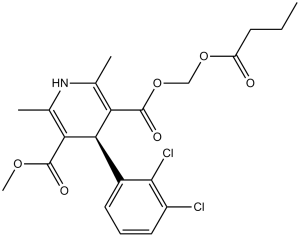
Clevidipine (Cleviprex) is a potent and short acting, dihydropyridine-based L-type calcium channel blocker used for reducing blood pressure when oral therapy is not feasible or not desirable. Clevidipine is highly selective for vascular, as opposed to myocardial, smooth muscle and, therefore, has little or no effect on myocardial contractility or cardiac conduction. It was approved by the FDA on August 1, 2008 as an antihypertensive agent for the reduction of blood pressure.
Physicochemical Properties
| Molecular Formula | C21H23CL2NO6 | |
| Molecular Weight | 456.32 | |
| Exact Mass | 455.09 | |
| CAS # | 167221-71-8 | |
| Related CAS # | Clevidipine-d7;(R)-Clevidipine-13C,d3 | |
| PubChem CID | 153994 | |
| Appearance | White to off-white solid powder | |
| Density | 1.3±0.1 g/cm3 | |
| Boiling Point | 539.7±50.0 °C at 760 mmHg | |
| Melting Point | 128-130°C | |
| Flash Point | 280.2±30.1 °C | |
| Vapour Pressure | 0.0±1.4 mmHg at 25°C | |
| Index of Refraction | 1.543 | |
| LogP | 5.46 | |
| Hydrogen Bond Donor Count | 1 | |
| Hydrogen Bond Acceptor Count | 7 | |
| Rotatable Bond Count | 10 | |
| Heavy Atom Count | 30 | |
| Complexity | 748 | |
| Defined Atom Stereocenter Count | 0 | |
| InChi Key | KPBZROQVTHLCDU-UHFFFAOYSA-N | |
| InChi Code | InChI=1S/C21H23Cl2NO6/c1-5-7-15(25)29-10-30-21(27)17-12(3)24-11(2)16(20(26)28-4)18(17)13-8-6-9-14(22)19(13)23/h6,8-9,18,24H,5,7,10H2,1-4H3 | |
| Chemical Name | methyl 5-{[(butanoyloxy)methoxy]carbonyl}-4-(2,3-dichlorophenyl)-2,6-dimethyl-1,4-dihydropyridine-3-carboxylate | |
| Synonyms |
|
|
| HS Tariff Code | 2934.99.9001 | |
| Storage |
Powder-20°C 3 years 4°C 2 years In solvent -80°C 6 months -20°C 1 month Note: This product requires protection from light (avoid light exposure) during transportation and storage. |
|
| Shipping Condition | Room temperature (This product is stable at ambient temperature for a few days during ordinary shipping and time spent in Customs) |
Biological Activity
| ln Vitro |
|
||
| ln Vivo |
|
||
| Animal Protocol |
|
||
| ADME/Pharmacokinetics |
Absorption, Distribution and Excretion urine 63-74%, feces 7-22% Metabolism / Metabolites Clevidipine is rapidly hydrolyzed to inactive metabolites by esterases in arterial blood. Biological Half-Life 1 minute |
||
| Toxicity/Toxicokinetics |
Protein Binding >99.5% |
||
| References | J Pediatr Pharmacol Ther.2015Jan-Feb;20(1):54-60. | ||
| Additional Infomation |
Clevidipine is a dihydropyridine. Clevidipine is a dihydropyridine L-type calcium channel blocker that is selective for vascular smooth muscle and is indicated for blood pressure reduction when oral therapy is not an option. Clevidipine is a Dihydropyridine Calcium Channel Blocker. The mechanism of action of clevidipine is as a Calcium Channel Antagonist. Drug Indication For the reduction of blood pressure when when oral antihypertensive therapy is not feasible or not desirable. FDA Label Treatment of hypertensive disease Mechanism of Action Possibly by deforming the channel, inhibiting ion-control gating mechanisms, and/or interfering with the release of calcium from the sarcoplasmic reticulum, clevidipine inhibits the influx of extracellular calcium across both the myocardial and vascular smooth muscle cell membranes. The resultant inhibition of the contractile processes of the myocardial smooth muscle cells leads to dilation of the coronary and systemic arteries and improved oxygen delivery to the myocardial tissue. Pharmacodynamics Clevidipine belongs to a well-known class of drugs called dihydropyridine calcium channel antagonists. Clevidpine is the first third generation intravenous dihydropyridine calcium channel blocker. In vitro studies demonstrated that clevidipine acts by selectively relaxing the smooth muscle cells that line small arteries, resulting in arterial dilation, widening of the artery opening, and without reducing central venous pressure or reducing cardiac output. |
Solubility Data
| Solubility (In Vitro) |
|
|||
| Solubility (In Vivo) |
Solubility in Formulation 1: ≥ 2.5 mg/mL (5.48 mM) (saturation unknown) in 10% DMSO + 40% PEG300 + 5% Tween80 + 45% Saline (add these co-solvents sequentially from left to right, and one by one), clear solution. For example, if 1 mL of working solution is to be prepared, you can add 100 μL of 25.0 mg/mL clear DMSO stock solution to 400 μL PEG300 and mix evenly; then add 50 μL Tween-80 to the above solution and mix evenly; then add 450 μL normal saline to adjust the volume to 1 mL. Preparation of saline: Dissolve 0.9 g of sodium chloride in 100 mL ddH₂ O to obtain a clear solution. Solubility in Formulation 2: ≥ 2.5 mg/mL (5.48 mM) (saturation unknown) in 10% DMSO + 90% Corn Oil (add these co-solvents sequentially from left to right, and one by one), clear solution. For example, if 1 mL of working solution is to be prepared, you can add 100 μL of 25.0 mg/mL clear DMSO stock solution to 900 μL of corn oil and mix evenly. (Please use freshly prepared in vivo formulations for optimal results.) |
| Preparing Stock Solutions | 1 mg | 5 mg | 10 mg | |
| 1 mM | 2.1914 mL | 10.9572 mL | 21.9144 mL | |
| 5 mM | 0.4383 mL | 2.1914 mL | 4.3829 mL | |
| 10 mM | 0.2191 mL | 1.0957 mL | 2.1914 mL |