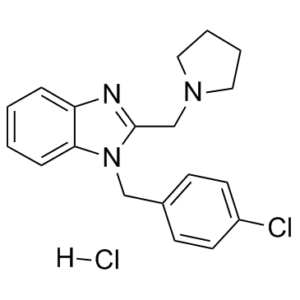
Clemizole hydrochloride (also known as AL 20 HCl, P 48 HCl, and/or Reactrol), is a potent inhibitor of transient receptor potential channel TRPC5 (Canonical transient receptor potential channel 5) and also an H1 histamine receptor antagonist. It has been discovered to significantly impede HCV replication. Clemizole's IC50 for RNA binding by NS4B is 24±1 nM, while its EC50 for viral replication is 8 µM. At low micromolar concentrations (IC50 = 1.0-1.3 µM), clemizole effectively inhibits TRPC5 currents and Ca(2+) entry. In the U-87 glioblastoma cell line, clemizole was not only successful in preventing native TRPC5-like currents but also heterologously expressed TRPC5 homomers and TRPC1:TRPC5 heteromers.
Physicochemical Properties
| Molecular Formula | C19H21CL2N3 | |
| Molecular Weight | 362.298 | |
| Exact Mass | 361.111 | |
| Elemental Analysis | C, 62.99; H, 5.84; Cl, 19.57; N, 11.60 | |
| CAS # | 1163-36-6 | |
| Related CAS # | Clemizole; 442-52-4; Clemizole-d4; 6011-39-8 (penicillin); 17162-20-8 (sulfate) | |
| PubChem CID | 2782 | |
| Appearance | White to off-white solid powder | |
| Density | 1.25 g/cm3 | |
| Boiling Point | 506.1ºC at 760 mmHg | |
| Melting Point | 241 °C | |
| Flash Point | 259.9ºC | |
| Vapour Pressure | 2.29E-10mmHg at 25°C | |
| LogP | 5.073 | |
| Hydrogen Bond Donor Count | 0 | |
| Hydrogen Bond Acceptor Count | 2 | |
| Rotatable Bond Count | 4 | |
| Heavy Atom Count | 23 | |
| Complexity | 377 | |
| Defined Atom Stereocenter Count | 0 | |
| SMILES | ClC1C([H])=C([H])C(=C([H])C=1[H])C([H])([H])N1C2=C([H])C([H])=C([H])C([H])=C2N=C1C([H])([H])N1C([H])([H])C([H])([H])C([H])([H])C1([H])[H].Cl[H] |
|
| InChi Key | DNFMJYXRIMLMBZ-UHFFFAOYSA-N | |
| InChi Code | InChI=1S/C19H20ClN3.ClH/c20-16-9-7-15(8-10-16)13-23-18-6-2-1-5-17(18)21-19(23)14-22-11-3-4-12-22;/h1-2,5-10H,3-4,11-14H2;1H | |
| Chemical Name | 1-[(4-chlorophenyl)methyl]-2-(pyrrolidin-1-ylmethyl)benzimidazole;hydrochloride | |
| Synonyms |
|
|
| HS Tariff Code | 2934.99.9001 | |
| Storage |
Powder-20°C 3 years 4°C 2 years In solvent -80°C 6 months -20°C 1 month Note: Please store this product in a sealed and protected environment, avoid exposure to moisture. |
|
| Shipping Condition | Room temperature (This product is stable at ambient temperature for a few days during ordinary shipping and time spent in Customs) |
Biological Activity
| Targets | H1 histamine receptor; NS4B ( IC50 = 24 nM ) | |
| ln Vitro |
|
|
| ln Vivo |
|
|
| Enzyme Assay | Clemizole has an IC50 of 24±1 nM for RNA binding by NS4B and an EC50 of 8 µM for viral replication. In the low micromolar range (IC50 = 1.0-1.3 µM), clemizole effectively inhibits TRPC5 currents and Ca(2+) entry. | |
| Cell Assay | Huh7.5 cells are kept in DMEM with 10% FBS, 1% L-glutamine, 1% Penicillin, 1% Streptomycin, and 1% non-essential amino acids added. Following treatment with 0.05% trypsin-0.02% EDTA and seeding at a 1:5 dilution, cell lines are passaged twice a week. Trypsinization and centrifugation at 700 g for five minutes are used to gather subconfluent Huh7.5 cells. After three ice-cold RNase-free PBS washes, the cells are resuspended in PBS at a density of 1.5 x 10⁷ cells/mL. Using the T7 MEGAscript kit, XbaI linearized DNA templates are transcriptionally generated to create wild-type or mutant FL-J6/JFH-5′C19Rluc2AUbi RNA for electroporation. This is followed by purification (RNA transcription and fluorescent labeling). In a 2-mm-gap cuvette (BTX), we combined 5 µg of RNA with 400 µL of washed Huh7.5 cells. We then pulsed (0.82 kV, five 99 µs pulses) using a BTX-830 electroporator. Pulsed cells are diluted into 10 mL of growth medium that has been preheated after a 10-minute recovery period at 25°C. Six-well plates are seeded with a common stock of cells from multiple electroporations (5×10⁵ cells per well). Following a 24-hour period, the medium is changed, and the cells are cultured with successive dilutions of the different inhibitory substances (such as Clemizole hydrochloride) found in the screen. Analysis is done on 17 of the 18 identified compounds that are commercially available. Regarding water-soluble compounds, untreated cells are employed as a negative control. Cells that have not been treated are cultured in the presence of equivalent concentrations of the solvent as a negative control for compounds (like Clemizole hydrochloride) that have been solubilized in DMSO. The medium is swapped out every day. Both a luciferase assay and a viability assay based on Alamar Blue are performed on the cells 72 hours after treatment. Cells are incubated for three hours at 37°C with 10% Alamar Blue reagent following a 72-hour treatment period. The FLEXstation II 384 is then used to scan the plates and detect fluorescence. The normalization of the signal with respect to untreated samples or samples grown in the presence of DMSO depends on the solvent used to dissolve the inhibitory compound (e.g., Clemizole hydrochloride), water, or DMSO[1]. | |
| Animal Protocol |
|
|
| References |
[1]. Discovery of a hepatitis C target and its pharmacological inhibitors by microfluidic affinity analysis. Nat Biotechnol. 2008 Sep;26(9):1019-27. [2]. Clemizole hydrochloride is a novel and potent inhibitor of transient receptor potential channel TRPC5. Mol Pharmacol. 2014 Nov;86(5):514-21. [3]. Using chimeric mice with humanized livers to predict human drug metabolism and a drug-drug interaction. J Pharmacol Exp Ther. 2013 Feb;344(2):388-96. |
|
| Additional Infomation | Clemizole is a member of the class of benzimidazoles that is 1H-benzimidazole substituted by a pyrrolidin-1-ylmethyl and a 4-chlorobenzyl groups at positions 2 and 1 respectively. It has a role as a histamine antagonist. It is a member of pyrrolidines, a member of benzimidazoles and a member of monochlorobenzenes. It is a conjugate base of a clemizole(1+). It derives from a hydride of a 1H-benzimidazole. |
Solubility Data
| Solubility (In Vitro) |
|
|||
| Solubility (In Vivo) |
Solubility in Formulation 1: ≥ 2.5 mg/mL (6.90 mM) (saturation unknown) in 5% DMSO + 40% PEG300 + 5% Tween80 + 50% Saline (add these co-solvents sequentially from left to right, and one by one), clear solution. Preparation of saline: Dissolve 0.9 g of sodium chloride in 100 mL ddH₂ O to obtain a clear solution. Solubility in Formulation 2: ≥ 2.5 mg/mL (6.90 mM) (saturation unknown) in 5% DMSO + 95% (20% SBE-β-CD in Saline) (add these co-solvents sequentially from left to right, and one by one), clear solution. Preparation of 20% SBE-β-CD in Saline (4°C,1 week): Dissolve 2 g SBE-β-CD in 10 mL saline to obtain a clear solution. Solubility in Formulation 3: ≥ 2.08 mg/mL (5.74 mM) in 10% DMSO + 40% PEG300 + 5% Tween80 + 45% Saline (add these co-solvents sequentially from left to right, and one by one), clear solution. For example, if 1 mL of working solution is to be prepared, you can add 100 μL of 20.8 mg/mL clear DMSO stock solution to 400 μL PEG300 and mix evenly; then add 50 μL Tween-80 to the above solution and mix evenly; then add 450 μL normal saline to adjust the volume to 1 mL. Preparation of saline: Dissolve 0.9 g of sodium chloride in 100 mL ddH₂ O to obtain a clear solution. Solubility in Formulation 4: ≥ 2.08 mg/mL (5.74 mM) in 10% DMSO + 90% (20% SBE-β-CD in Saline) (add these co-solvents sequentially from left to right, and one by one), clear solution. For example, if 1 mL of working solution is to be prepared, you can add 100 μL of 20.8 mg/mL clear DMSO stock solution to 900 μL of 20% SBE-β-CD physiological saline solution and mix evenly. Preparation of 20% SBE-β-CD in Saline (4°C,1 week): Dissolve 2 g SBE-β-CD in 10 mL saline to obtain a clear solution. Solubility in Formulation 5: ≥ 2.08 mg/mL (5.74 mM) (saturation unknown) in 10% DMSO + 90% Corn Oil (add these co-solvents sequentially from left to right, and one by one), clear solution. For example, if 1 mL of working solution is to be prepared, you can add 100 μL of 20.8 mg/mL clear DMSO stock solution to 900 μL of corn oil and mix evenly. Solubility in Formulation 6: 0.5 mg/mL (1.38 mM) in 1% DMSO + 99% Saline (add these co-solvents sequentially from left to right, and one by one),clear solution,with ultrasonication. Preparation of saline: Dissolve 0.9 g of sodium chloride in 100 mL ddH₂ O to obtain a clear solution. (Please use freshly prepared in vivo formulations for optimal results.) |
| Preparing Stock Solutions | 1 mg | 5 mg | 10 mg | |
| 1 mM | 2.7601 mL | 13.8007 mL | 27.6014 mL | |
| 5 mM | 0.5520 mL | 2.7601 mL | 5.5203 mL | |
| 10 mM | 0.2760 mL | 1.3801 mL | 2.7601 mL |