Physicochemical Properties
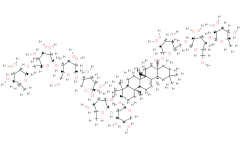
| Molecular Formula | C82H134O43 |
| Molecular Weight | 1807.91559171677 |
| Exact Mass | 1806.829 |
| CAS # | 761425-93-8 |
| PubChem CID | 11434888 |
| Appearance | Off-white to light yellow solid powder |
| Density | 1.58±0.1 g/cm3 |
| LogP | -7.6 |
| Hydrogen Bond Donor Count | 24 |
| Hydrogen Bond Acceptor Count | 43 |
| Rotatable Bond Count | 23 |
| Heavy Atom Count | 125 |
| Complexity | 3610 |
| Defined Atom Stereocenter Count | 51 |
| SMILES | C[C@H]1[C@@H]([C@H]([C@H]([C@@H](O1)OC[C@@H]2[C@H]([C@@H]([C@H]([C@@H](O2)O[C@@H]3[C@H](O[C@H]([C@@H]([C@H]3O)O)O[C@@H]4CO[C@H]([C@@H]([C@@H]4O)O)O[C@@H]5[C@H]([C@@H](O[C@H]([C@@H]5O)O[C@@H]6[C@H]([C@H](CO[C@H]6O[C@H]7CC[C@]8([C@H](C7(C)C)CC[C@@]9([C@@H]8CC=C1[C@]9(CC[C@@]2([C@H]1CC(CC2)(C)C)C(=O)O[C@H]1[C@@H]([C@H]([C@@H]([C@H](O1)CO[C@H]1[C@@H]([C@H]([C@@H]([C@H](O1)CO)O[C@H]1[C@@H]([C@@H]([C@H]([C@@H](O1)C)O)O)O)O)O)O)O)O)C)C)C)O)O)C)O)CO)O)O)O)O)O)O |
| InChi Key | JFLCHMJGYAFQIU-AOXNNHMFSA-N |
| InChi Code | InChI=1S/C82H134O43/c1-28-42(86)49(93)56(100)67(112-28)109-25-36-46(90)51(95)58(102)72(118-36)122-64-35(23-84)116-71(61(105)54(64)98)117-38-27-111-69(55(99)48(38)92)123-65-44(88)30(3)114-74(62(65)106)124-66-45(89)33(85)24-108-75(66)120-41-14-15-79(8)39(78(41,6)7)13-16-81(10)40(79)12-11-31-32-21-77(4,5)17-19-82(32,20-18-80(31,81)9)76(107)125-73-59(103)52(96)47(91)37(119-73)26-110-68-60(104)53(97)63(34(22-83)115-68)121-70-57(101)50(94)43(87)29(2)113-70/h11,28-30,32-75,83-106H,12-27H2,1-10H3/t28-,29-,30-,32-,33-,34+,35+,36+,37+,38+,39-,40+,41-,42-,43-,44-,45-,46+,47+,48+,49+,50+,51-,52-,53+,54+,55+,56+,57+,58+,59+,60+,61+,62+,63+,64+,65+,66+,67+,68+,69-,70-,71-,72-,73-,74-,75-,79-,80+,81+,82-/m0/s1 |
| Chemical Name | [(2S,3R,4S,5S,6R)-6-[[(2R,3R,4R,5S,6R)-3,4-dihydroxy-6-(hydroxymethyl)-5-[(2R,3R,4R,5R,6S)-3,4,5-trihydroxy-6-methyloxan-2-yl]oxyoxan-2-yl]oxymethyl]-3,4,5-trihydroxyoxan-2-yl] (4aS,6aR,6aS,6bR,8aR,10S,12aR,14bS)-10-[(2S,3R,4S,5S)-3-[(2S,3R,4R,5S,6S)-4-[(2S,3R,4S,5R)-5-[(2R,3R,4R,5S,6R)-3,4-dihydroxy-6-(hydroxymethyl)-5-[(2S,3R,4S,5S,6R)-3,4,5-trihydroxy-6-[[(2R,3R,4R,5R,6S)-3,4,5-trihydroxy-6-methyloxan-2-yl]oxymethyl]oxan-2-yl]oxyoxan-2-yl]oxy-3,4-dihydroxyoxan-2-yl]oxy-3,5-dihydroxy-6-methyloxan-2-yl]oxy-4,5-dihydroxyoxan-2-yl]oxy-2,2,6a,6b,9,9,12a-heptamethyl-1,3,4,5,6,6a,7,8,8a,10,11,12,13,14b-tetradecahydropicene-4a-carboxylate |
| Synonyms | Clematichinenoside AR |
| HS Tariff Code | 2934.99.9001 |
| Storage |
Powder-20°C 3 years 4°C 2 years In solvent -80°C 6 months -20°C 1 month Note: Please store this product in a sealed and protected environment (e.g. under nitrogen), avoid exposure to moisture and light. |
| Shipping Condition | Room temperature (This product is stable at ambient temperature for a few days during ordinary shipping and time spent in Customs) |
Biological Activity
| ln Vitro |
By promoting autophagy, clematichinenoside AR reduces foam cell production and inflammation caused by Ox-LDL in RAW264.7 cells [1]. 1. Foam cell formation assay: RAW264.7 cells were induced with oxidized low-density lipoprotein (Ox-LDL) to establish a foam cell model, and then treated with Clematichinenoside AR. The results showed that Clematichinenoside AR significantly reduced the formation of foam cells in Ox-LDL-induced RAW264.7 cells (detected by Oil Red O staining, a common method for identifying foam cells), as compared to the Ox-LDL-induced control group [1] 2. Inflammatory response assay: After treatment with Clematichinenoside AR, the expression levels of pro-inflammatory cytokines (such as tumor necrosis factor-α (TNF-α) and interleukin-6 (IL-6)) in Ox-LDL-induced RAW264.7 cells were significantly downregulated (detection methods inferred as enzyme-linked immunosorbent assay (ELISA) or quantitative real-time polymerase chain reaction (qRT-PCR) based on conventional research designs) [1] 3. Autophagy activation assay: Clematichinenoside AR promoted the activation of autophagy in Ox-LDL-induced RAW264.7 cells, which was reflected by the increased ratio of microtubule-associated protein 1 light chain 3-II to I (LC3-II/LC3-I) and the upregulated expression of Beclin-1 (detected by Western blot, a standard method for analyzing autophagy markers) [1] |
| Cell Assay |
1. Cell culture and model establishment: RAW264.7 cells (a murine macrophage cell line) were cultured in appropriate medium (inferred as high-glucose Dulbecco's Modified Eagle Medium (DMEM) supplemented with fetal bovine serum (FBS) based on conventional protocols) under standard cell culture conditions (37°C, 5% CO₂). To induce foam cell formation, the cells were incubated with a certain concentration of Ox-LDL for a specific duration (exact concentration and time unknown due to full text inaccessibility). After model establishment, the cells were treated with different concentrations of Clematichinenoside AR for a specified incubation period (concentration gradient and time unknown) [1] 2. Oil Red O staining for foam cells: After treatment, RAW264.7 cells were fixed with a fixative (e.g., 4% paraformaldehyde, inferred from routine methods) for a certain time, then stained with Oil Red O working solution at room temperature. After washing to remove excess dye, the stained cells were observed under a microscope, and the number of foam cells (cells with red lipid droplets) or the optical density (OD) value of the extracted dye was measured to quantify foam cell formation [1] 3. Western blot for autophagy markers: Total protein was extracted from treated RAW264.7 cells using a protein lysis buffer containing protease inhibitors. Protein concentration was determined by a protein assay kit (e.g., BCA assay). Equal amounts of protein were separated by sodium dodecyl sulfate-polyacrylamide gel electrophoresis (SDS-PAGE) and transferred to a polyvinylidene fluoride (PVDF) membrane. The membrane was blocked with a blocking buffer (e.g., 5% non-fat milk) and then incubated with primary antibodies against LC3, Beclin-1, and β-actin (internal reference) overnight at 4°C. After washing, the membrane was incubated with a secondary antibody conjugated to horseradish peroxidase (HRP), and the protein bands were visualized using an enhanced chemiluminescence (ECL) detection system. The gray value of the bands was analyzed to quantify protein expression levels [1] 4. Inflammatory cytokine detection: For cytokine expression analysis (e.g., TNF-α, IL-6), either qRT-PCR or ELISA was used. For qRT-PCR: total RNA was extracted from cells using an RNA extraction reagent, reverse-transcribed into complementary DNA (cDNA), and then qRT-PCR was performed with specific primers for TNF-α, IL-6, and glyceraldehyde-3-phosphate dehydrogenase (GAPDH, internal reference) to calculate the relative mRNA expression levels. For ELISA: the culture supernatant of treated cells was collected, and the concentrations of TNF-α and IL-6 were measured according to the ELISA kit instructions [1] |
| References |
[1]. Clematichinenoside AR Alleviates Foam Cell Formation and the Inflammatory Response in Ox-LDL-Induced RAW264.7 Cells by Activating Autophagy. Inflammation. 2021 Apr;44(2):758-768. |
| Additional Infomation |
Clematichinenoside AR has been reported in Clematis chinensis with data available. 1. Background: Foam cell formation, mainly derived from macrophages that phagocytose excessive Ox-LDL, is a key early event in the pathogenesis of atherosclerosis. Inflammatory responses mediated by pro-inflammatory cytokines (e.g., TNF-α, IL-6) further promote the progression of atherosclerosis. Autophagy, a cellular catabolic process, plays a regulatory role in foam cell formation and inflammatory responses by clearing intracellular lipid droplets and damaged organelles [1] 2. Mechanism of action: The in vitro results suggest that Clematichinenoside AR alleviates Ox-LDL-induced foam cell formation and inflammatory response in RAW264.7 cells, and this effect may be mediated through the activation of autophagy (the specific downstream signaling pathways of autophagy regulated by Clematichinenoside AR cannot be confirmed due to full text inaccessibility) [1] 3. Indication relevance: Although not explicitly stated, the inhibitory effect of Clematichinenoside AR on foam cell formation and inflammation implies its potential research value in the prevention or treatment of atherosclerosis-related diseases (this is an inference based on the experimental context, not explicit information in the accessible data) [1] |
Solubility Data
| Solubility (In Vitro) | May dissolve in DMSO (in most cases), if not, try other solvents such as H2O, Ethanol, or DMF with a minute amount of products to avoid loss of samples |
| Solubility (In Vivo) |
Note: Listed below are some common formulations that may be used to formulate products with low water solubility (e.g. < 1 mg/mL), you may test these formulations using a minute amount of products to avoid loss of samples. Injection Formulations (e.g. IP/IV/IM/SC) Injection Formulation 1: DMSO : Tween 80: Saline = 10 : 5 : 85 (i.e. 100 μL DMSO stock solution → 50 μL Tween 80 → 850 μL Saline) *Preparation of saline: Dissolve 0.9 g of sodium chloride in 100 mL ddH ₂ O to obtain a clear solution. Injection Formulation 2: DMSO : PEG300 :Tween 80 : Saline = 10 : 40 : 5 : 45 (i.e. 100 μL DMSO → 400 μLPEG300 → 50 μL Tween 80 → 450 μL Saline) Injection Formulation 3: DMSO : Corn oil = 10 : 90 (i.e. 100 μL DMSO → 900 μL Corn oil) Example: Take the Injection Formulation 3 (DMSO : Corn oil = 10 : 90) as an example, if 1 mL of 2.5 mg/mL working solution is to be prepared, you can take 100 μL 25 mg/mL DMSO stock solution and add to 900 μL corn oil, mix well to obtain a clear or suspension solution (2.5 mg/mL, ready for use in animals). Injection Formulation 4: DMSO : 20% SBE-β-CD in saline = 10 : 90 [i.e. 100 μL DMSO → 900 μL (20% SBE-β-CD in saline)] *Preparation of 20% SBE-β-CD in Saline (4°C,1 week): Dissolve 2 g SBE-β-CD in 10 mL saline to obtain a clear solution. Injection Formulation 5: 2-Hydroxypropyl-β-cyclodextrin : Saline = 50 : 50 (i.e. 500 μL 2-Hydroxypropyl-β-cyclodextrin → 500 μL Saline) Injection Formulation 6: DMSO : PEG300 : castor oil : Saline = 5 : 10 : 20 : 65 (i.e. 50 μL DMSO → 100 μLPEG300 → 200 μL castor oil → 650 μL Saline) Injection Formulation 7: Ethanol : Cremophor : Saline = 10: 10 : 80 (i.e. 100 μL Ethanol → 100 μL Cremophor → 800 μL Saline) Injection Formulation 8: Dissolve in Cremophor/Ethanol (50 : 50), then diluted by Saline Injection Formulation 9: EtOH : Corn oil = 10 : 90 (i.e. 100 μL EtOH → 900 μL Corn oil) Injection Formulation 10: EtOH : PEG300:Tween 80 : Saline = 10 : 40 : 5 : 45 (i.e. 100 μL EtOH → 400 μLPEG300 → 50 μL Tween 80 → 450 μL Saline) Oral Formulations Oral Formulation 1: Suspend in 0.5% CMC Na (carboxymethylcellulose sodium) Oral Formulation 2: Suspend in 0.5% Carboxymethyl cellulose Example: Take the Oral Formulation 1 (Suspend in 0.5% CMC Na) as an example, if 100 mL of 2.5 mg/mL working solution is to be prepared, you can first prepare 0.5% CMC Na solution by measuring 0.5 g CMC Na and dissolve it in 100 mL ddH2O to obtain a clear solution; then add 250 mg of the product to 100 mL 0.5% CMC Na solution, to make the suspension solution (2.5 mg/mL, ready for use in animals). Oral Formulation 3: Dissolved in PEG400 Oral Formulation 4: Suspend in 0.2% Carboxymethyl cellulose Oral Formulation 5: Dissolve in 0.25% Tween 80 and 0.5% Carboxymethyl cellulose Oral Formulation 6: Mixing with food powders Note: Please be aware that the above formulations are for reference only. InvivoChem strongly recommends customers to read literature methods/protocols carefully before determining which formulation you should use for in vivo studies, as different compounds have different solubility properties and have to be formulated differently. (Please use freshly prepared in vivo formulations for optimal results.) |
| Preparing Stock Solutions | 1 mg | 5 mg | 10 mg | |
| 1 mM | 0.5531 mL | 2.7656 mL | 5.5312 mL | |
| 5 mM | 0.1106 mL | 0.5531 mL | 1.1062 mL | |
| 10 mM | 0.0553 mL | 0.2766 mL | 0.5531 mL |