Physicochemical Properties
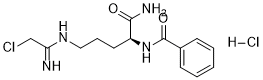
| Molecular Formula | C14H20CL2N4O2 |
| Molecular Weight | 347.24 |
| Exact Mass | 346.096 |
| CAS # | 1373232-26-8 |
| Related CAS # | D-Cl-amidine hydrochloride;Cl-amidine;913723-61-2;Cl-amidine TFA;1043444-18-3;D-Cl-amidine;1404060-15-6 |
| PubChem CID | 74889978 |
| Appearance | White to light yellow solid powder |
| Hydrogen Bond Donor Count | 4 |
| Hydrogen Bond Acceptor Count | 3 |
| Rotatable Bond Count | 8 |
| Heavy Atom Count | 22 |
| Complexity | 381 |
| Defined Atom Stereocenter Count | 1 |
| SMILES | C1=CC=C(C=C1)C(=O)N[C@@H](CCCN=C(CCl)N)C(=O)N.Cl |
| InChi Key | OPFMEGSAOZAJIV-MERQFXBCSA-N |
| InChi Code | InChI=1S/C14H19ClN4O2.ClH/c15-9-12(16)18-8-4-7-11(13(17)20)19-14(21)10-5-2-1-3-6-10;/h1-3,5-6,11H,4,7-9H2,(H2,16,18)(H2,17,20)(H,19,21);1H/t11-;/m0./s1 |
| Chemical Name | N-[(1S)-1-(Aminocarbonyl)-4-[(2-chloro-1-iminoethyl)amino]butyl]-benzamide Hydrochloride |
| Synonyms | Cl amidine hydrochlorideCl amidine HClCl-amidine HCl Cl-amidine hydrochloride |
| HS Tariff Code | 2934.99.9001 |
| Storage |
Powder-20°C 3 years 4°C 2 years In solvent -80°C 6 months -20°C 1 month Note: Please store this product in a sealed and protected environment (e.g. under nitrogen), avoid exposure to moisture. |
| Shipping Condition | Room temperature (This product is stable at ambient temperature for a few days during ordinary shipping and time spent in Customs) |
Biological Activity
| ln Vitro | Cl-amidine hydrochloride is a haloacetamidine-based bioavailable drug that efficiently inhibits all active PAD isoenzymes (kinact/KI=13,000 M-1 min-1 for PAD4) [1 Cl-amidine hydrochloride (0, 5, 10, 15, 20, 25, 50 μg/mL, 24 hours) induces HT29 and TK6 lymphoblastoid cells. It displays the dose diagram on the round cell mold. compared to cells generated by Cl-amidine hydrochloride, the duct amidine series (HT29) is comparatively resistant [2]. In animal models, clonidine hydrochloride improves and inhibits neutrophil extracellular tray creation and histone 3 acidification [4]. |
| ln Vivo | Cl-amidine (75 mg/kg, intraperitoneal injection once daily) prevents and cures mice's DSS-induced cystitis [2]. Histological scores significantly decreased in response to clonidine (5, 25, 75 mg/kg, once daily via side wall gavage) in a dose-dependent manner [2]. |
| Cell Assay |
Apoptosis analysis[2]. Cell Types: TK6 lymphoblastoid cells and HT29 colon cancer cells. Tested Concentrations: 0, 5, 10, 15, 20, 25, 50 μg/mL. Incubation Duration: 24 hrs (hours). Experimental Results: The induction of apoptosis was dose-dependent. |
| Animal Protocol |
Animal/Disease Models: C57BL/6 mice (8-12 weeks old, DSS colitis mouse model) [2]. Doses: 75 mg/kg. Management: IP one time/day. Experimental Results: Inhibition of PAD activity in vivo, protein citrullination, and PAD levels in the colon. Animal/Disease Models: C57BL/6 mice (8-12 weeks old, DSS colitis mouse model) [2]. Doses: 5, 25, 75 mg/kg. Route of Administration: po (oral gavage), one time/day. Experimental Results: Resultant in Dramatically lower histological scores. |
| References |
[1]. Inhibitors and Inactivators of Protein Arginine Deiminase 4: Functional and Structural Characterization. Biochemistry. 2006 Oct 3; 45(39): 11727–11736. [2]. Suppression of colitis in mice by Cl-amidine: a novel peptidylarginine deiminase inhibitor. Am J Physiol Gastrointest Liver Physiol. 2011 Jun;300(6):G929-38. [3]. Molecular targeting of protein arginine deiminases to suppress colitis and prevent colon cancer. Oncotarget. 2015 Nov 3;6(34):36053-62. [4]. Cl-Amidine Prevents Histone 3 Citrullination and Neutrophil Extracellular Trap Formation, and Improves Survival in a Murine Sepsis Model. J Innate Immun. 2017;9(1):22-32. |
Solubility Data
| Solubility (In Vitro) |
DMSO : ~50 mg/mL (~143.99 mM) H2O : ~50 mg/mL (~143.99 mM) |
| Solubility (In Vivo) |
Solubility in Formulation 1: ≥ 1.25 mg/mL (3.60 mM) (saturation unknown) in 10% DMSO + 40% PEG300 + 5% Tween80 + 45% Saline (add these co-solvents sequentially from left to right, and one by one), clear solution. For example, if 1 mL of working solution is to be prepared, you can add 100 μL of 12.5 mg/mL clear DMSO stock solution to 400 μL PEG300 and mix evenly; then add 50 μL Tween-80 to the above solution and mix evenly; then add 450 μL normal saline to adjust the volume to 1 mL. Preparation of saline: Dissolve 0.9 g of sodium chloride in 100 mL ddH₂ O to obtain a clear solution. Solubility in Formulation 2: ≥ 1.25 mg/mL (3.60 mM) (saturation unknown) in 10% DMSO + 90% (20% SBE-β-CD in Saline) (add these co-solvents sequentially from left to right, and one by one), clear solution. For example, if 1 mL of working solution is to be prepared, you can add 100 μL of 12.5 mg/mL clear DMSO stock solution to 900 μL of 20% SBE-β-CD physiological saline solution and mix evenly. Preparation of 20% SBE-β-CD in Saline (4°C,1 week): Dissolve 2 g SBE-β-CD in 10 mL saline to obtain a clear solution. Solubility in Formulation 3: ≥ 1.25 mg/mL (3.60 mM) (saturation unknown) in 10% DMSO + 90% Corn Oil (add these co-solvents sequentially from left to right, and one by one), clear solution. For example, if 1 mL of working solution is to be prepared, you can add 100 μL of 12.5 mg/mL clear DMSO stock solution to 900 μL of corn oil and mix evenly. Solubility in Formulation 4: 5.5 mg/mL (15.84 mM) in PBS (add these co-solvents sequentially from left to right, and one by one), clear solution; with ultrasonication. (Please use freshly prepared in vivo formulations for optimal results.) |
| Preparing Stock Solutions | 1 mg | 5 mg | 10 mg | |
| 1 mM | 2.8799 mL | 14.3993 mL | 28.7985 mL | |
| 5 mM | 0.5760 mL | 2.8799 mL | 5.7597 mL | |
| 10 mM | 0.2880 mL | 1.4399 mL | 2.8799 mL |