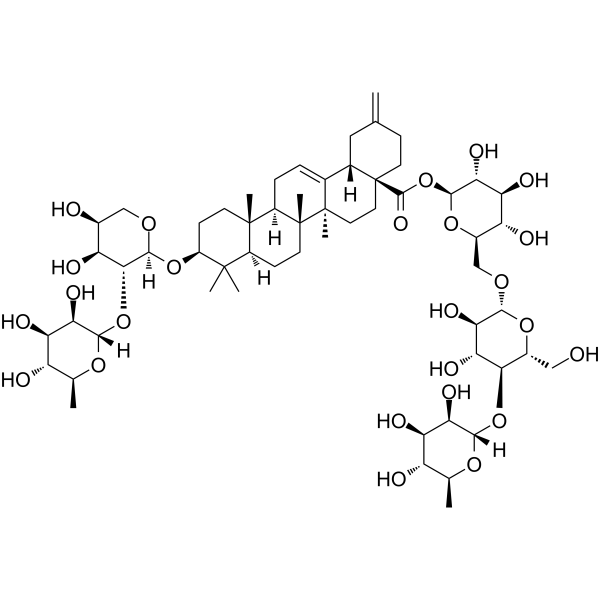
Physicochemical Properties
| Molecular Formula | C58H92O25 |
| Molecular Weight | 1189.33608 |
| Exact Mass | 1186.613 |
| CAS # | 114902-16-8 |
| PubChem CID | 195123 |
| Appearance | White to off-white solid powder |
| Density | 1.4±0.1 g/cm3 |
| Index of Refraction | 1.627 |
| LogP | 7.67 |
| Hydrogen Bond Donor Count | 14 |
| Hydrogen Bond Acceptor Count | 25 |
| Rotatable Bond Count | 13 |
| Heavy Atom Count | 83 |
| Complexity | 2350 |
| Defined Atom Stereocenter Count | 32 |
| SMILES | C[C@H]1[C@@H]([C@H]([C@H]([C@@H](O1)O[C@@H]2[C@H](O[C@H]([C@@H]([C@H]2O)O)OC[C@@H]3[C@H]([C@@H]([C@H]([C@@H](O3)OC(=O)[C@]45CCC(=C)C[C@H]4C6=CC[C@@H]7[C@]8(CC[C@@H](C([C@@H]8CC[C@]7([C@@]6(CC5)C)C)(C)C)O[C@H]9[C@@H]([C@H]([C@H](CO9)O)O)O[C@H]1[C@@H]([C@@H]([C@H]([C@@H](O1)C)O)O)O)C)O)O)O)CO)O)O)O |
| InChi Key | UPROOJBJZLZCGS-CHTHVDMYSA-N |
| InChi Code | InChI=1S/C58H92O25/c1-23-11-16-58(53(73)83-51-44(71)40(67)37(64)30(79-51)22-75-48-45(72)41(68)46(29(20-59)78-48)81-49-42(69)38(65)34(61)24(2)76-49)18-17-56(7)26(27(58)19-23)9-10-32-55(6)14-13-33(54(4,5)31(55)12-15-57(32,56)8)80-52-47(36(63)28(60)21-74-52)82-50-43(70)39(66)35(62)25(3)77-50/h9,24-25,27-52,59-72H,1,10-22H2,2-8H3/t24-,25-,27-,28-,29+,30+,31-,32+,33-,34-,35-,36-,37+,38+,39+,40-,41+,42+,43+,44+,45+,46+,47+,48+,49-,50-,51-,52-,55-,56+,57+,58-/m0/s1 |
| Chemical Name | [(2S,3R,4S,5S,6R)-6-[[(2R,3R,4R,5S,6R)-3,4-dihydroxy-6-(hydroxymethyl)-5-[(2S,3R,4R,5R,6S)-3,4,5-trihydroxy-6-methyloxan-2-yl]oxyoxan-2-yl]oxymethyl]-3,4,5-trihydroxyoxan-2-yl] (4aS,6aR,6aS,6bR,8aR,10S,12aR,14bS)-10-[(2S,3R,4S,5S)-4,5-dihydroxy-3-[(2S,3R,4R,5R,6S)-3,4,5-trihydroxy-6-methyloxan-2-yl]oxyoxan-2-yl]oxy-6a,6b,9,9,12a-pentamethyl-2-methylidene-1,3,4,5,6,6a,7,8,8a,10,11,12,13,14b-tetradecahydropicene-4a-carboxylate |
| HS Tariff Code | 2934.99.9001 |
| Storage |
Powder-20°C 3 years 4°C 2 years In solvent -80°C 6 months -20°C 1 month Note: Please store this product in a sealed and protected environment (e.g. under nitrogen), avoid exposure to moisture and light. |
| Shipping Condition | Room temperature (This product is stable at ambient temperature for a few days during ordinary shipping and time spent in Customs) |
Biological Activity
| ln Vitro |
Ciwujianoside B at concentrations of 1 and 10 µM significantly increased the total dendrite length in primary cultured mouse cortical neurons after 4 days of treatment. This effect was assessed by immunostaining for the dendritic marker microtubule-associated protein 2 (MAP2).[1] |
| ln Vivo |
Oral administration of Ciwujianoside B (0.5 mg/kg/day for 17 days) significantly enhanced object recognition memory in normal male ddY mice. The test was performed with a 72-hour interval between training and test sessions. The treatment did not alter spontaneous locomotor activity or body weight in the mice.[1] |
| Cell Assay |
Primary Cortical Neuron Dendrite Extension Assay: Cortical neurons were dissected from ddY mouse embryos at 14 days of gestation and cultured in neurobasal medium supplemented with B-27, D-glucose, and L-glutamine on poly-D-lysine coated chamber slides. After 3 days in culture, the neurons were treated with fresh medium containing Ciwujianoside B (1 and 10 µM) or vehicle (water) for 4 days. Subsequently, cells were fixed with 4% paraformaldehyde and immunostained using a primary antibody against MAP2 and an Alexa Fluor 568-conjugated secondary antibody. Nuclei were counterstained with DAPI. Fluorescence images were captured, and the total length of MAP2-positive dendrites (excluding cell bodies) was measured automatically using image analysis software. The sum of dendrite lengths was normalized to the number of MAP2-positive neurons.[1] |
| Animal Protocol |
1. Memory Enhancement Study: Male ddY mice (8 weeks old) were orally administered Ciwujianoside B (0.5 mg/kg/day), suspended in distilled water, or vehicle once daily for 17 consecutive days. On day 14 of administration, locomotor activity was assessed in an open-field box for 10 minutes, and the training session of the object recognition test (ORT) was conducted. The test session of the ORT was performed after a 72-hour interval (on day 17). Body weight was monitored throughout the study period.[1] 2. Pharmacokinetic/Tissue Distribution Study: To detect compounds that penetrate the brain, a single high oral dose (5 g/kg) of the Eleutherococcus senticosus leaf water extract (containing Ciwujianoside B) was administered to female ddY mice (6 weeks old). At 3, 6, and 12 hours post-administration, mice were euthanized. Blood was collected, and plasma was obtained by centrifugation. The brain cortex was dissected after saline perfusion. Plasma and cortical tissue samples were processed (extracted with methanol, dried, and reconstituted) for subsequent LC-MS/MS analysis to detect Ciwujianoside B and other compounds.[1] |
| ADME/Pharmacokinetics |
Ciwujianoside B (molecular weight 1189.35) was detected in the plasma and cerebral cortex of mice following a single oral administration of a high dose (5 g/kg) of the Eleutherococcus senticosus leaf water extract. It was detected in plasma at 3, 6, and 12 hours, and in the cerebral cortex at 6 hours after administration. This demonstrates that Ciwujianoside B can be absorbed into the systemic circulation and cross the blood-brain barrier (BBB).[1] |
| References |
[1]. Memory Enhancement by Oral Administration of Extract of Eleutherococcus senticosus Leaves and Active Compounds Transferred in the Brain. Nutrients. 2019 May 22;11(5). pii: E1142. [2]. Comparative investigations on the protective effects of rhodioside, ciwujianoside-B and astragaloside IV on radiation injuries of the hematopoietic system in mice. Phytother Res. 2011 May;25(5):644-53. |
| Additional Infomation |
Yemuoside YM10 has been reported in Eleutherococcus senticosus with data available. 1. Ciwujianoside B is a triterpene saponin isolated from the leaves of Eleutherococcus senticosus. 2. Along with ciwujianoside C3 and eleutheroside M, it was identified as an active principle in the leaf extract responsible for memory enhancement, capable of penetrating the BBB and promoting dendritic growth in neurons.[1] 3. The study suggests that the memory-enhancing effect of Ciwujianoside B (and the leaf extract) may be related to its ability to promote dendritic extension in cortical neurons.[1] 4. The content of Ciwujianoside B in the leaf extract was estimated to be approximately 0.1%, which informed the dose selection for the pure compound efficacy study (0.5 mg/kg/day corresponding to 0.1% of the effective extract dose of 500 mg/kg/day).[1] |
Solubility Data
| Solubility (In Vitro) | DMSO : ~100 mg/mL (~84.08 mM) |
| Solubility (In Vivo) |
Solubility in Formulation 1: ≥ 2.5 mg/mL (2.10 mM) (saturation unknown) in 10% DMSO + 40% PEG300 + 5% Tween80 + 45% Saline (add these co-solvents sequentially from left to right, and one by one), clear solution. For example, if 1 mL of working solution is to be prepared, you can add 100 μL of 25.0 mg/mL clear DMSO stock solution to 400 μL PEG300 and mix evenly; then add 50 μL Tween-80 to the above solution and mix evenly; then add 450 μL normal saline to adjust the volume to 1 mL. Preparation of saline: Dissolve 0.9 g of sodium chloride in 100 mL ddH₂ O to obtain a clear solution. Solubility in Formulation 2: ≥ 2.5 mg/mL (2.10 mM) (saturation unknown) in 10% DMSO + 90% (20% SBE-β-CD in Saline) (add these co-solvents sequentially from left to right, and one by one), clear solution. For example, if 1 mL of working solution is to be prepared, you can add 100 μL of 25.0 mg/mL clear DMSO stock solution to 900 μL of 20% SBE-β-CD physiological saline solution and mix evenly. Preparation of 20% SBE-β-CD in Saline (4°C,1 week): Dissolve 2 g SBE-β-CD in 10 mL saline to obtain a clear solution. Solubility in Formulation 3: ≥ 2.5 mg/mL (2.10 mM) (saturation unknown) in 10% DMSO + 90% Corn Oil (add these co-solvents sequentially from left to right, and one by one), clear solution. For example, if 1 mL of working solution is to be prepared, you can add 100 μL of 25.0 mg/mL clear DMSO stock solution to 900 μL of corn oil and mix evenly. (Please use freshly prepared in vivo formulations for optimal results.) |
| Preparing Stock Solutions | 1 mg | 5 mg | 10 mg | |
| 1 mM | 0.8408 mL | 4.2040 mL | 8.4080 mL | |
| 5 mM | 0.1682 mL | 0.8408 mL | 1.6816 mL | |
| 10 mM | 0.0841 mL | 0.4204 mL | 0.8408 mL |