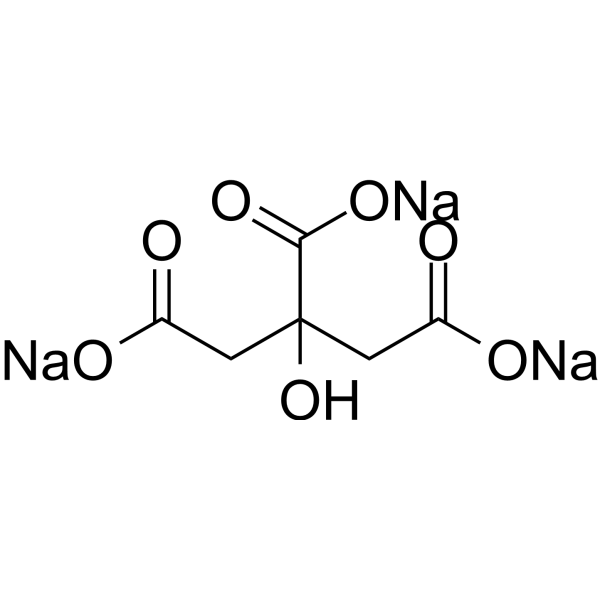
Physicochemical Properties
| Molecular Formula | C6H5NA3O7 |
| Molecular Weight | 258.0690 |
| Exact Mass | 257.972 |
| CAS # | 68-04-2 |
| Related CAS # | Citric acid;77-92-9 |
| PubChem CID | 6224 |
| Appearance | White to off-white solid powder |
| Density | 1.008 g/mL at 20 °C |
| Melting Point | 300°C |
| Hydrogen Bond Donor Count | 1 |
| Hydrogen Bond Acceptor Count | 7 |
| Rotatable Bond Count | 2 |
| Heavy Atom Count | 16 |
| Complexity | 211 |
| Defined Atom Stereocenter Count | 0 |
| InChi Key | HRXKRNGNAMMEHJ-UHFFFAOYSA-K |
| InChi Code | InChI=1S/C6H8O7.3Na/c7-3(8)1-6(13,5(11)12)2-4(9)10;;;/h13H,1-2H2,(H,7,8)(H,9,10)(H,11,12);;;/q;3*+1/p-3 |
| Chemical Name | trisodium;2-hydroxypropane-1,2,3-tricarboxylate |
| HS Tariff Code | 2934.99.9001 |
| Storage |
Powder-20°C 3 years 4°C 2 years In solvent -80°C 6 months -20°C 1 month Note: Please store this product in a sealed and protected environment, avoid exposure to moisture. |
| Shipping Condition | Room temperature (This product is stable at ambient temperature for a few days during ordinary shipping and time spent in Customs) |
Biological Activity
| ln Vitro | Trisodium citrate exhibits dose-dependent antiproliferative action (0–12.5 mM; 24 hours) [3]. In G2/M and S phases, trisodium citrate (12.5 mM; 72 h) dose-dependently promotes apoptosis and cell cycle arrest [3]. The expression of FAS, BAX, BID, AIF, EndoG, cytochrome c, PARP, GADD153, GRP78, and caspase-3, -8, and -9 was upregulated and the expression of BCL-2 and BCL-Xl was downregulated after 48 hours at 12.5 mM of trisodium citrate[3]. |
| ln Vivo | In mouse livers, intraperitoneal injections of trisodium citrate (120, 240, and 480 mg/kg) can dramatically lower GSH-Px activity and raise MDA (malondialdehyde) levels [1]. Mouse hepatocytes exposed to intraperitoneal trisodium citrate (120, 240, and 480 mg/kg) exhibit dose-dependent increases in caspase-3 activity, which results in apoptosis [1]. Mice exposed to intraperitoneal injections of trisodium citrate (120, 240, and 480 mg/kg; once weekly for three weeks) develop nephrotoxicity [2]. |
| Cell Assay |
Cell Viability Assay[3] Cell Types: HaCaT Cell Tested Concentrations: 0, 2.5, 5, 7.5, 10, 12.5 mM Incubation Duration: 24 hrs (hours) Experimental Results: Inhibition of cell viability in a dose-dependent manner. Cell cycle analysis[3] Cell Types: HaCaT Cell Tested Concentrations: 12.5 mM Incubation Duration: 0, 12, 24, 48, 72 hrs (hours) Experimental Results: Induced apoptosis and cell cycle arrest in G2/M phase and S in a dose-dependent manner Expect. Western Blot Analysis[3] Cell Types: HaCaT Cell Tested Concentrations: 12.5 mM Incubation Duration: 12, 24, 48 hrs (hours) Experimental Results: Increased expression of FAS, BAX, BID, AIF, EndoG, cytochrome c, PARP, GADD153, GRP78 and caspase -3, -8, -9, and BCL-2 and BCL-X1 were diminished. |
| Animal Protocol |
Animal/Disease Models: 20 g male Kunming mice [2] Doses: 120, 240, 480 mg/kg Route of Administration: intraperitoneal (ip) injection; once a week for 3 weeks. Experimental Results: The activities of T-SOD and GSH-Px in the treatment group diminished with the increase of citric acid dose, the activity of NOS demonstrated an increasing trend, and the contents of H2O2 and MDA gradually diminished. |
| ADME/Pharmacokinetics |
Absorption, Distribution and Excretion Tmax of 98-130min. Largely eliminated through hepatic metabolism with very little cleared by the kidneys. 19-39L. Total clearance of 313-1107mL/min. IN THE BODY, SODIUM CITRATE IS OXIDIZED TO BICARBONATE & EXCRETED IN THE URINE... Metabolism / Metabolites Citrate is metabolized to bicarbonate in the liver and plays a role as an intermediate in the citric acid cycle. IN THE BODY, SODIUM CITRATE IS OXIDIZED TO BICARBONATE... Biological Half-Life 18-54 min |
| References |
[1]. Study on injury effect of food additive citric acid on liver tissue in mice. Cytotechnology. 2014 Mar;66(2):275-82. [2]. Chen X, Lv Q, Liu Y, Deng W. Effects of the food additive, citric acid, on kidney cells of mice. Biotech Histochem. 2015 Jan;90(1):38-44. [3]. Citric acid induces cell-cycle arrest and apoptosis of human immortalized keratinocyte cell line (HaCaT) via caspase- and mitochondrial-dependent signaling pathways. Anticancer Res. 2013 Oct;33(10):4411-20. |
| Additional Infomation |
Sodium citrate is the trisodium salt of citric acid. It has a role as a flavouring agent and an anticoagulant. It contains a citrate(3-). Sodium citrate is the sodium salt of citric acid. It is white, crystalline powder or white, granular crystals, slightly deliquescent in moist air, freely soluble in water, practically insoluble in alcohol. Like citric acid, it has a sour taste. From the medical point of view, it is used as alkalinizing agent. It works by neutralizing excess acid in the blood and urine. It has been indicated for the treatment of metabolic acidosis. Sodium Citrate is the sodium salt of citrate with alkalinizing activity. Upon absorption, sodium citrate dissociates into sodium cations and citrate anions; organic citrate ions are metabolized to bicarbonate ions, resulting in an increase in the plasma bicarbonate concentration, the buffering of excess hydrogen ion, the raising of blood pH, and potentially the reversal of acidosis. In addition, increases in free sodium load due to sodium citrate administration may increase intravascular blood volume, facilitating the excretion of bicarbonate compounds and an anti-urolithic effect. Sodium salts of citric acid that are used as buffers and food preservatives. They are used medically as anticoagulants in stored blood, and for urine alkalization in the prevention of KIDNEY STONES. See also: Anticoagulant sodium citrate solution (has subclass); sodium chloride; sodium citrate, unspecified form (component of) ... View More ... Drug Indication Used as an anticoagulant during plasmophoresis as well as a neutralizing agent in the treatment of upset stomach and acidic urine. FDA Label Mechanism of Action Citrate chelates free calcium ions preventing them from forming a complex with tissue factor and coagulation factor VIIa to promote the activation of coagulation factor X. This inhibits the extrinsic initiation of the coagulation cascade. Citrate may also exert an anticoagulant effect via a so far unknown mechanism as restoration of calcium concentration does not fully reverse the effect of citrate. Citrate is a weak base and so reacts with hydrochloric acid in the stomach to raise the pH. It it further metabolized to bicarbonate which then acts as a systemic alkalizing agent, raising the pH of the blood and urine. It also acts as a diuretic and increases the urinary excretion of calcium. |
Solubility Data
| Solubility (In Vitro) | H2O : ~50 mg/mL (~193.75 mM) |
| Solubility (In Vivo) |
Note: Listed below are some common formulations that may be used to formulate products with low water solubility (e.g. < 1 mg/mL), you may test these formulations using a minute amount of products to avoid loss of samples. Injection Formulations (e.g. IP/IV/IM/SC) Injection Formulation 1: DMSO : Tween 80: Saline = 10 : 5 : 85 (i.e. 100 μL DMSO stock solution → 50 μL Tween 80 → 850 μL Saline) *Preparation of saline: Dissolve 0.9 g of sodium chloride in 100 mL ddH ₂ O to obtain a clear solution. Injection Formulation 2: DMSO : PEG300 :Tween 80 : Saline = 10 : 40 : 5 : 45 (i.e. 100 μL DMSO → 400 μLPEG300 → 50 μL Tween 80 → 450 μL Saline) Injection Formulation 3: DMSO : Corn oil = 10 : 90 (i.e. 100 μL DMSO → 900 μL Corn oil) Example: Take the Injection Formulation 3 (DMSO : Corn oil = 10 : 90) as an example, if 1 mL of 2.5 mg/mL working solution is to be prepared, you can take 100 μL 25 mg/mL DMSO stock solution and add to 900 μL corn oil, mix well to obtain a clear or suspension solution (2.5 mg/mL, ready for use in animals). Injection Formulation 4: DMSO : 20% SBE-β-CD in saline = 10 : 90 [i.e. 100 μL DMSO → 900 μL (20% SBE-β-CD in saline)] *Preparation of 20% SBE-β-CD in Saline (4°C,1 week): Dissolve 2 g SBE-β-CD in 10 mL saline to obtain a clear solution. Injection Formulation 5: 2-Hydroxypropyl-β-cyclodextrin : Saline = 50 : 50 (i.e. 500 μL 2-Hydroxypropyl-β-cyclodextrin → 500 μL Saline) Injection Formulation 6: DMSO : PEG300 : castor oil : Saline = 5 : 10 : 20 : 65 (i.e. 50 μL DMSO → 100 μLPEG300 → 200 μL castor oil → 650 μL Saline) Injection Formulation 7: Ethanol : Cremophor : Saline = 10: 10 : 80 (i.e. 100 μL Ethanol → 100 μL Cremophor → 800 μL Saline) Injection Formulation 8: Dissolve in Cremophor/Ethanol (50 : 50), then diluted by Saline Injection Formulation 9: EtOH : Corn oil = 10 : 90 (i.e. 100 μL EtOH → 900 μL Corn oil) Injection Formulation 10: EtOH : PEG300:Tween 80 : Saline = 10 : 40 : 5 : 45 (i.e. 100 μL EtOH → 400 μLPEG300 → 50 μL Tween 80 → 450 μL Saline) Oral Formulations Oral Formulation 1: Suspend in 0.5% CMC Na (carboxymethylcellulose sodium) Oral Formulation 2: Suspend in 0.5% Carboxymethyl cellulose Example: Take the Oral Formulation 1 (Suspend in 0.5% CMC Na) as an example, if 100 mL of 2.5 mg/mL working solution is to be prepared, you can first prepare 0.5% CMC Na solution by measuring 0.5 g CMC Na and dissolve it in 100 mL ddH2O to obtain a clear solution; then add 250 mg of the product to 100 mL 0.5% CMC Na solution, to make the suspension solution (2.5 mg/mL, ready for use in animals). Oral Formulation 3: Dissolved in PEG400 Oral Formulation 4: Suspend in 0.2% Carboxymethyl cellulose Oral Formulation 5: Dissolve in 0.25% Tween 80 and 0.5% Carboxymethyl cellulose Oral Formulation 6: Mixing with food powders Note: Please be aware that the above formulations are for reference only. InvivoChem strongly recommends customers to read literature methods/protocols carefully before determining which formulation you should use for in vivo studies, as different compounds have different solubility properties and have to be formulated differently. (Please use freshly prepared in vivo formulations for optimal results.) |
| Preparing Stock Solutions | 1 mg | 5 mg | 10 mg | |
| 1 mM | 3.8749 mL | 19.3746 mL | 38.7492 mL | |
| 5 mM | 0.7750 mL | 3.8749 mL | 7.7498 mL | |
| 10 mM | 0.3875 mL | 1.9375 mL | 3.8749 mL |