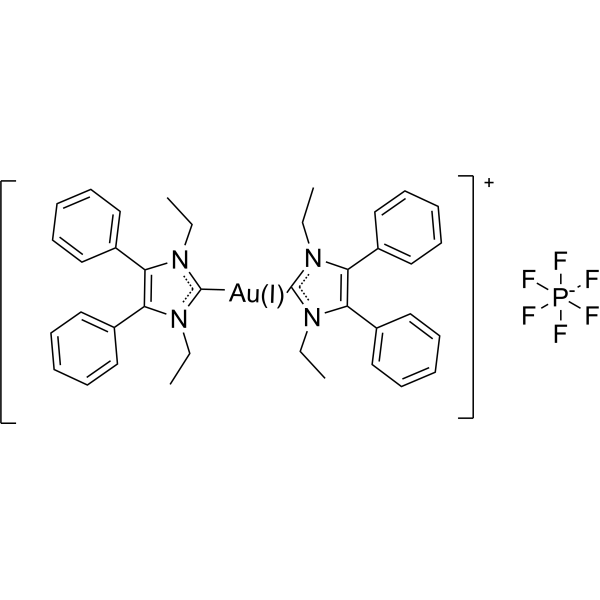
Physicochemical Properties
| Molecular Formula | C38H40AUF6N4P- |
| Molecular Weight | 894.68 |
| Appearance | Typically exists as solid at room temperature |
| HS Tariff Code | 2934.99.9001 |
| Storage |
Powder-20°C 3 years 4°C 2 years In solvent -80°C 6 months -20°C 1 month |
| Shipping Condition | Room temperature (This product is stable at ambient temperature for a few days during ordinary shipping and time spent in Customs) |
Biological Activity
| Targets | DNA |
| ln Vitro | The reactivities of halido[1,3-diethyl-4,5-diphenyl-1H-imidazol-2-ylidene]gold(I) (chlorido (5), bromido (6), iodido (7)), bis[1,3-diethyl-4,5-diphenyl-1H-imidazol-2-ylidene]gold(I) (8), and bis[1,3-diethyl-4,5-diphenyl-1H-imidazol-2-ylidene]dihalidogold(III) (chlorido (9), bromido (10), iodido (11)) complexes against ingredients of the cell culture medium were analyzed by HPLC. The degradation in the RPMI 1640 medium was studied, too. Complex 6 quantitatively reacted with chloride to 5, while 7 showed additionally ligand scrambling to 8. Interactions with non-thiol containing amino acids could not be detected. However, glutathione (GSH) reacted immediately with 5 and 6 yielding the (NHC)gold(I)-GSH complex 12. The most active complex 8 was stable under in vitro conditions and strongly participated on the biological effects of 7. The gold(III) species 9–11 were completely reduced by GSH to 8 and are prodrugs. All complexes were tested for inhibitory effects in Cisplatin-resistant cells, as well as against cancer stem cell-enriched cell lines and showed excellent activity. Such compounds are of utmost interest for the therapy of drug-resistant tumors [1]. |
| Cell Assay | Exponentially growing cells were seeded at a density of 1500 cells/well (A2780, A2780cis, A2780V-CSC, A549, and A549-R), 1750 cells/well (MCF-7 and MCF-7TamR), 2500 cells/well (IGROV1 and IGROV1-CSC), 3000 cells/well (SV-80), and 20,000 cells/well (K562 and K562-R), respectively, into clear flat-bottom 96-well plates in triplicates. After 24 h of incubation for adherent cell lines and 1 h of incubation for suspension cell lines (K562 and K562-R) at 37 °C in a humidified atmosphere (5% CO2/95% air), the compounds were added to reach the indicated concentrations, respectively. The indicated final concentrations of the compounds in the well are 20, 10, 5, 2.5, 1.25, and 0.625 μM for substances 5 and 6 and the references Cisplatin and Auranofin, as well as 1.5, 0.75, 0.375, 0.1875, 0.09375, and 0.046875 μM for substances 7–11. All stock solutions were prepared in DMF at a concentration of 10 mM and were then diluted with RPMI 1640, supplemented with l-glutamine (2 mM) and FCS (10%), to the respective concentrations. After another 72 h of incubation, the cellular metabolic activity was measured employing a modified 3-(4,5-dimethylthiazol-2-yl)-2,5-diphenyltetrazolium bromide (MTT) assay following the manufacturer’s protocol. The optical density of the particular medium was subtracted to exclude the unspecific staining caused by FCS containing medium. The values were calculated with Excel 2019 using nonlinear regression and decal logarithm of the inhibitor versus variable slope equation, while the top constraint was set to 100% [1]. |
| References |
[1]. Reaction Behavior of [1,3-Diethyl-4,5-diphenyl-1H-imidazol-2-ylidene] Containing Gold(I/III) Complexes against Ingredients of the Cell Culture Medium and the Meaning on the Potential Use for Cancer Eradication Therapy. J. Med. Chem. 2023, 66, 12, 8238–8250. |
| Additional Infomation | Halido[1,3-diethyl-4,5-diphenyl-1H-imidazol-2-ylidene]gold(I) and [bis(1,3-diethyl-4,5-diphenyl-1H-imidazol-2-ylidene)]dihalidogold(III) hexafluorophosphate (halido = chlorido, bromido, iodido) complexes were synthesized and characterized. Of particular interest was the reactivity of the complexes against components of the cell culture medium and the identification of reaction products. Additionally, the complexes were tested in wildtype and drug-resistant cancer cell lines for antimetabolic activity. X-Ray structures of the (NHC)Au(I)-X complexes 5–7 showed the existence of dimeric units with Au(I)-Au(I) distances of 3.5 to 4.0 Å. Such aurophilic interactions can also be assumed in solution as a prerequisite for the observed ligand scrambling to the [(NHC)2Au(I)]+ species 8. Nucleophiles, such as chloride or GSH caused substitution reactions at (NHC)Au(I)-X, in case of the bromido complex 6 even quantitatively to 5 and 12. An interaction with non-thiol containing amino acids was not evident. The role of GSH on the cytotoxicity of (NHC)Au(I)-X complexes is not fully elucidated. (NHC)Au(I)-GSH is partially formed in the medium. Interestingly, this reaction did not lead to an inactive species. (NHC)Au(I)-GSH caused antiproliferative effects in A2780 cells, only 2-fold less than 5. Regarding the antiproliferative effects of 5–11, it must be mentioned that only 5 and 8 were stable against nucleophiles of the cell culture medium and the biological activity can be ascribed to these species. The nearly identical activity of 5 and 6 in all cell lines (IC50 > 5 μM) resulted from the fast transformation of 6 to 5 in the cell culture medium, while partial ligand scrambling of 7 (→8) strongly increased the effects. The formed complex 8 was the most active compound in this study. In the complete RPMI 1640 medium, supplemented with FCS, protein binding must be taken into account. Quantification of 7 and its degradation products in RPMI 1640/FCS indicated that about 50% of the available complex 7 is located in the protein bound fraction. The complexes 9–11 showed another reaction profile, without ligand scrambling, but with halide exchange reactions. Most importantly, GSH reduced the gold(III) complexes to 8, indicating the prodrug character of the [(NHC)2Au(III)X2]+ complexes 9–11. Complexes 8 and 9–11 possessed high cytotoxicity and reduced the viability of, e.g., A2780cis cells in the low nanomolar range. The circumvention of Cisplatin-resistance in ovarian carcinoma cells is therefore feasible with these complexes. Remarkably, the complexes also showed a promising potential to eradicate therapy-resistant CSCs. Unfortunately, selectivity for tumor cells is not given for 5–11. The growth of SV80 fibroblasts was reduced to the same extent as tumor cells. Therefore, we will use in the following structure–activity relationship study the 1,3-dialkyl-4,5-diaryl-4,5-dihydro-1H-imidazol-2-ylidene as a new NHC carrier ligand to design effective (NHC)gold(I) complexes. The results will be presented in forthcoming papers.[1] |
Solubility Data
| Solubility (In Vitro) | May dissolve in DMSO (in most cases), if not, try other solvents such as H2O, Ethanol, or DMF with a minute amount of products to avoid loss of samples |
| Solubility (In Vivo) |
Note: Listed below are some common formulations that may be used to formulate products with low water solubility (e.g. < 1 mg/mL), you may test these formulations using a minute amount of products to avoid loss of samples. Injection Formulations (e.g. IP/IV/IM/SC) Injection Formulation 1: DMSO : Tween 80: Saline = 10 : 5 : 85 (i.e. 100 μL DMSO stock solution → 50 μL Tween 80 → 850 μL Saline) *Preparation of saline: Dissolve 0.9 g of sodium chloride in 100 mL ddH ₂ O to obtain a clear solution. Injection Formulation 2: DMSO : PEG300 :Tween 80 : Saline = 10 : 40 : 5 : 45 (i.e. 100 μL DMSO → 400 μLPEG300 → 50 μL Tween 80 → 450 μL Saline) Injection Formulation 3: DMSO : Corn oil = 10 : 90 (i.e. 100 μL DMSO → 900 μL Corn oil) Example: Take the Injection Formulation 3 (DMSO : Corn oil = 10 : 90) as an example, if 1 mL of 2.5 mg/mL working solution is to be prepared, you can take 100 μL 25 mg/mL DMSO stock solution and add to 900 μL corn oil, mix well to obtain a clear or suspension solution (2.5 mg/mL, ready for use in animals). Injection Formulation 4: DMSO : 20% SBE-β-CD in saline = 10 : 90 [i.e. 100 μL DMSO → 900 μL (20% SBE-β-CD in saline)] *Preparation of 20% SBE-β-CD in Saline (4°C,1 week): Dissolve 2 g SBE-β-CD in 10 mL saline to obtain a clear solution. Injection Formulation 5: 2-Hydroxypropyl-β-cyclodextrin : Saline = 50 : 50 (i.e. 500 μL 2-Hydroxypropyl-β-cyclodextrin → 500 μL Saline) Injection Formulation 6: DMSO : PEG300 : castor oil : Saline = 5 : 10 : 20 : 65 (i.e. 50 μL DMSO → 100 μLPEG300 → 200 μL castor oil → 650 μL Saline) Injection Formulation 7: Ethanol : Cremophor : Saline = 10: 10 : 80 (i.e. 100 μL Ethanol → 100 μL Cremophor → 800 μL Saline) Injection Formulation 8: Dissolve in Cremophor/Ethanol (50 : 50), then diluted by Saline Injection Formulation 9: EtOH : Corn oil = 10 : 90 (i.e. 100 μL EtOH → 900 μL Corn oil) Injection Formulation 10: EtOH : PEG300:Tween 80 : Saline = 10 : 40 : 5 : 45 (i.e. 100 μL EtOH → 400 μLPEG300 → 50 μL Tween 80 → 450 μL Saline) Oral Formulations Oral Formulation 1: Suspend in 0.5% CMC Na (carboxymethylcellulose sodium) Oral Formulation 2: Suspend in 0.5% Carboxymethyl cellulose Example: Take the Oral Formulation 1 (Suspend in 0.5% CMC Na) as an example, if 100 mL of 2.5 mg/mL working solution is to be prepared, you can first prepare 0.5% CMC Na solution by measuring 0.5 g CMC Na and dissolve it in 100 mL ddH2O to obtain a clear solution; then add 250 mg of the product to 100 mL 0.5% CMC Na solution, to make the suspension solution (2.5 mg/mL, ready for use in animals). Oral Formulation 3: Dissolved in PEG400 Oral Formulation 4: Suspend in 0.2% Carboxymethyl cellulose Oral Formulation 5: Dissolve in 0.25% Tween 80 and 0.5% Carboxymethyl cellulose Oral Formulation 6: Mixing with food powders Note: Please be aware that the above formulations are for reference only. InvivoChem strongly recommends customers to read literature methods/protocols carefully before determining which formulation you should use for in vivo studies, as different compounds have different solubility properties and have to be formulated differently. (Please use freshly prepared in vivo formulations for optimal results.) |
| Preparing Stock Solutions | 1 mg | 5 mg | 10 mg | |
| 1 mM | 1.1177 mL | 5.5886 mL | 11.1772 mL | |
| 5 mM | 0.2235 mL | 1.1177 mL | 2.2354 mL | |
| 10 mM | 0.1118 mL | 0.5589 mL | 1.1177 mL |