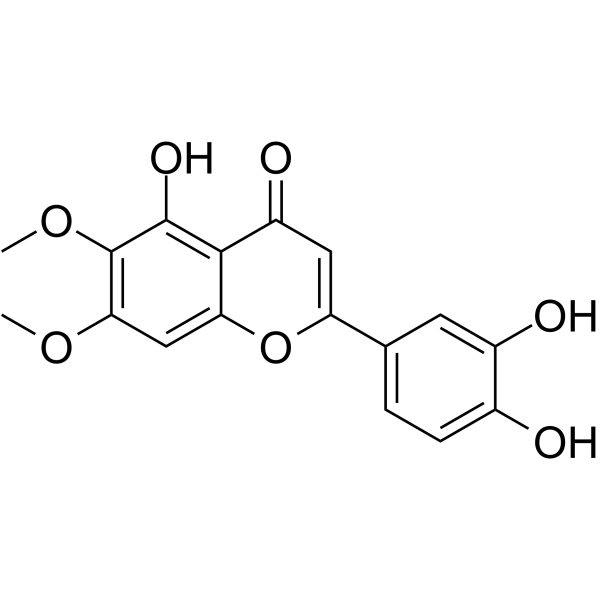
Physicochemical Properties
| Molecular Formula | C17H14O7 |
| Molecular Weight | 330.28886 |
| Exact Mass | 330.073 |
| CAS # | 34334-69-5 |
| PubChem CID | 160237 |
| Appearance | Off-white to light yellow solid powder |
| Density | 1.5±0.1 g/cm3 |
| Boiling Point | 616.1±55.0 °C at 760 mmHg |
| Melting Point | 280-281.5℃ (methanol ) |
| Flash Point | 230.8±25.0 °C |
| Vapour Pressure | 0.0±1.8 mmHg at 25°C |
| Index of Refraction | 1.671 |
| LogP | 2.27 |
| Hydrogen Bond Donor Count | 3 |
| Hydrogen Bond Acceptor Count | 7 |
| Rotatable Bond Count | 3 |
| Heavy Atom Count | 24 |
| Complexity | 505 |
| Defined Atom Stereocenter Count | 0 |
| InChi Key | IMEYGBIXGJLUIS-UHFFFAOYSA-N |
| InChi Code | InChI=1S/C17H14O7/c1-22-14-7-13-15(16(21)17(14)23-2)11(20)6-12(24-13)8-3-4-9(18)10(19)5-8/h3-7,18-19,21H,1-2H3 |
| Chemical Name | 2-(3,4-dihydroxyphenyl)-5-hydroxy-6,7-dimethoxychromen-4-one |
| HS Tariff Code | 2934.99.9001 |
| Storage |
Powder-20°C 3 years 4°C 2 years In solvent -80°C 6 months -20°C 1 month Note: (1). This product requires protection from light (avoid light exposure) during transportation and storage.(2). Please store this product in a sealed and protected environment (e.g. under nitrogen), avoid exposure to moisture. |
| Shipping Condition | Room temperature (This product is stable at ambient temperature for a few days during ordinary shipping and time spent in Customs) |
Biological Activity
| Targets |
miR-34a, Notch-1 [2] Acetylcholine receptor, histamine receptor (related to ileal smooth muscle contraction) [1] |
| ln Vitro |
Cirsiliol causes concentration-dependent relaxation in the isolated rat ileum at concentrations ranging from 0.01 to 300 μM. Cirsiliol may promote the release of intracellularly stored Ca2+ while inhibiting Ca2+ influx[1]. By blocking radiation-induced Notch-1 expression, rhamnetin or cirsiliol treatment inhibits the proliferation of NSCLC cells [2]. - Cirsiliol (1-100 μM) dose-dependently inhibited acetylcholine and histamine-induced contraction of isolated rat ileum. At 100 μM, it achieved a maximal inhibition rate of ~70% for acetylcholine-induced contraction and ~65% for histamine-induced contraction (detected by isometric tension measurement) [1] - In non-small cell lung cancer (NSCLC) cell lines (A549, H1299), Cirsiliol (5, 10, 20 μM) enhanced radiosensitivity. When combined with ionizing radiation (2-8 Gy), it reduced cell viability (MTT assay) and increased apoptotic rate (Annexin V-FITC/PI staining) compared with radiation alone [2] - Cirsiliol (5-20 μM) suppressed epithelial-mesenchymal transition (EMT) in NSCLC cells: upregulated epithelial marker E-cadherin and downregulated mesenchymal markers N-cadherin and vimentin (Western blot) [2] - Cirsiliol (5-20 μM) upregulated miR-34a expression (qPCR) and downregulated Notch-1 mRNA and protein expression (qPCR, Western blot) in NSCLC cells, mediating its radiosensitizing and EMT-inhibiting effects [2] - Cirsiliol (10, 20 μM) dose-dependently reduced the migration and invasion of A549 and H1299 cells (Transwell assay) [2] |
| ln Vivo | In comparison to radiation alone, combination treatment with rhamnetin or cecillin significantly reduced the tumor volume in xenograft mice models [2]. |
| Enzyme Assay |
- Isolated ileum contraction assay: Rat ileum segments (2-3 mm) were mounted in organ baths with oxygenated Krebs solution (37°C, pH 7.4) and connected to force transducers. After 60-minute equilibration, segments were contracted with acetylcholine (1 μM) or histamine (10 μM). Cirsiliol (1-100 μM) was added cumulatively, and isometric tension changes were recorded to construct concentration-response curves and calculate inhibition rates [1] |
| Cell Assay |
- NSCLC cell radiosensitivity assay: A549/H1299 cells were seeded in 96-well plates, pretreated with Cirsiliol (5-20 μM) for 24 hours, then exposed to 2-8 Gy ionizing radiation. Cell viability was detected by MTT assay 48 hours post-radiation; apoptotic rate was measured by Annexin V-FITC/PI staining and flow cytometry [2] - EMT and pathway analysis: NSCLC cells were treated with Cirsiliol (5-20 μM) for 48 hours. Total RNA was extracted for qPCR to detect miR-34a and Notch-1 mRNA expression (GAPDH as internal control). Proteins were extracted for Western blot to analyze Notch-1, E-cadherin, N-cadherin, vimentin, and β-actin levels [2] - Migration and invasion assay: NSCLC cells were treated with Cirsiliol (10, 20 μM) for 24 hours, then seeded in Transwell upper chambers (with Matrigel for invasion assay). After 24-48 hours incubation, migrated/invasive cells in the lower chamber were stained and counted [2] |
| References |
[1]. Effects of cirsiliol, a flavone isolated from Achillea fragrantissima, on rat isolated ileum. Gen Pharmacol. 1992 May;23(3):555-60. [2]. Rhamnetin and cirsiliol induce radiosensitization and inhibition of epithelial-mesenchymal transition (EMT) by miR-34a-mediated suppression of Notch-1 expression in non-small cell lung cancer cell lines. J Biol Chem. 2013 Sep 20;288(38):27343-57. |
| Additional Infomation |
Cirsiliol is a dimethoxyflavone that is flavone substituted by methoxy groups at positions 6 and 7 and hydroxy groups at positions 5, 3' and 4' respectively. It has a role as a plant metabolite. It is a trihydroxyflavone and a dimethoxyflavone. It is functionally related to a flavone. Cirsiliol has been reported in Achillea setacea, Salvia officinalis, and other organisms with data available. - Cirsiliol is a natural flavone compound isolated from the herbal medicine Achillea fragrantissima [1][2] - Its core biological mechanisms include: inhibiting acetylcholine/histamine-mediated ileal smooth muscle contraction [1]; regulating the miR-34a/Notch-1 signaling pathway to enhance radiosensitivity and suppress EMT in NSCLC cells [2] - Cirsiliol exhibits potential application value as a radiosensitizer for non-small cell lung cancer treatment and a modulator of intestinal smooth muscle function [1][2] |
Solubility Data
| Solubility (In Vitro) | DMSO : ≥ 25 mg/mL (~75.69 mM) |
| Solubility (In Vivo) |
Note: Listed below are some common formulations that may be used to formulate products with low water solubility (e.g. < 1 mg/mL), you may test these formulations using a minute amount of products to avoid loss of samples. Injection Formulations (e.g. IP/IV/IM/SC) Injection Formulation 1: DMSO : Tween 80: Saline = 10 : 5 : 85 (i.e. 100 μL DMSO stock solution → 50 μL Tween 80 → 850 μL Saline) *Preparation of saline: Dissolve 0.9 g of sodium chloride in 100 mL ddH ₂ O to obtain a clear solution. Injection Formulation 2: DMSO : PEG300 :Tween 80 : Saline = 10 : 40 : 5 : 45 (i.e. 100 μL DMSO → 400 μLPEG300 → 50 μL Tween 80 → 450 μL Saline) Injection Formulation 3: DMSO : Corn oil = 10 : 90 (i.e. 100 μL DMSO → 900 μL Corn oil) Example: Take the Injection Formulation 3 (DMSO : Corn oil = 10 : 90) as an example, if 1 mL of 2.5 mg/mL working solution is to be prepared, you can take 100 μL 25 mg/mL DMSO stock solution and add to 900 μL corn oil, mix well to obtain a clear or suspension solution (2.5 mg/mL, ready for use in animals). Injection Formulation 4: DMSO : 20% SBE-β-CD in saline = 10 : 90 [i.e. 100 μL DMSO → 900 μL (20% SBE-β-CD in saline)] *Preparation of 20% SBE-β-CD in Saline (4°C,1 week): Dissolve 2 g SBE-β-CD in 10 mL saline to obtain a clear solution. Injection Formulation 5: 2-Hydroxypropyl-β-cyclodextrin : Saline = 50 : 50 (i.e. 500 μL 2-Hydroxypropyl-β-cyclodextrin → 500 μL Saline) Injection Formulation 6: DMSO : PEG300 : castor oil : Saline = 5 : 10 : 20 : 65 (i.e. 50 μL DMSO → 100 μLPEG300 → 200 μL castor oil → 650 μL Saline) Injection Formulation 7: Ethanol : Cremophor : Saline = 10: 10 : 80 (i.e. 100 μL Ethanol → 100 μL Cremophor → 800 μL Saline) Injection Formulation 8: Dissolve in Cremophor/Ethanol (50 : 50), then diluted by Saline Injection Formulation 9: EtOH : Corn oil = 10 : 90 (i.e. 100 μL EtOH → 900 μL Corn oil) Injection Formulation 10: EtOH : PEG300:Tween 80 : Saline = 10 : 40 : 5 : 45 (i.e. 100 μL EtOH → 400 μLPEG300 → 50 μL Tween 80 → 450 μL Saline) Oral Formulations Oral Formulation 1: Suspend in 0.5% CMC Na (carboxymethylcellulose sodium) Oral Formulation 2: Suspend in 0.5% Carboxymethyl cellulose Example: Take the Oral Formulation 1 (Suspend in 0.5% CMC Na) as an example, if 100 mL of 2.5 mg/mL working solution is to be prepared, you can first prepare 0.5% CMC Na solution by measuring 0.5 g CMC Na and dissolve it in 100 mL ddH2O to obtain a clear solution; then add 250 mg of the product to 100 mL 0.5% CMC Na solution, to make the suspension solution (2.5 mg/mL, ready for use in animals). Oral Formulation 3: Dissolved in PEG400 Oral Formulation 4: Suspend in 0.2% Carboxymethyl cellulose Oral Formulation 5: Dissolve in 0.25% Tween 80 and 0.5% Carboxymethyl cellulose Oral Formulation 6: Mixing with food powders Note: Please be aware that the above formulations are for reference only. InvivoChem strongly recommends customers to read literature methods/protocols carefully before determining which formulation you should use for in vivo studies, as different compounds have different solubility properties and have to be formulated differently. (Please use freshly prepared in vivo formulations for optimal results.) |
| Preparing Stock Solutions | 1 mg | 5 mg | 10 mg | |
| 1 mM | 3.0276 mL | 15.1382 mL | 30.2764 mL | |
| 5 mM | 0.6055 mL | 3.0276 mL | 6.0553 mL | |
| 10 mM | 0.3028 mL | 1.5138 mL | 3.0276 mL |